
Cambodia was a fairly late addition to our itinerary, one which we vacillated back and forth over quite a bit. While Angkor Wat was definitely somewhere on our lifetime bucket list, we had some inexplicable hesitancy about going to Cambodia. Certainly this was in part because (in the U.S. at least), other than Angkor Wat, Cambodia is not talked about as a Southeast Asia travel destination as much as Thailand, Bali, the Philippines, or even Vietnam are. As we reconsidered going there, we discovered that Cambodia had a rich history similar to and linked with Thailand. We also realized that we knew less than we should have about Cambodia’s history, particularly the dark period during and following the Vietnam War in which the U.S. played a large role.
And so, we ultimately decided to not only visit Siem Reap (the site of Angkor Wat) but also Phnom Penh, Cambodia’s capital and the epicenter of that dark chapter in Cambodia’s history.
Getting There (The Train! The Train!)
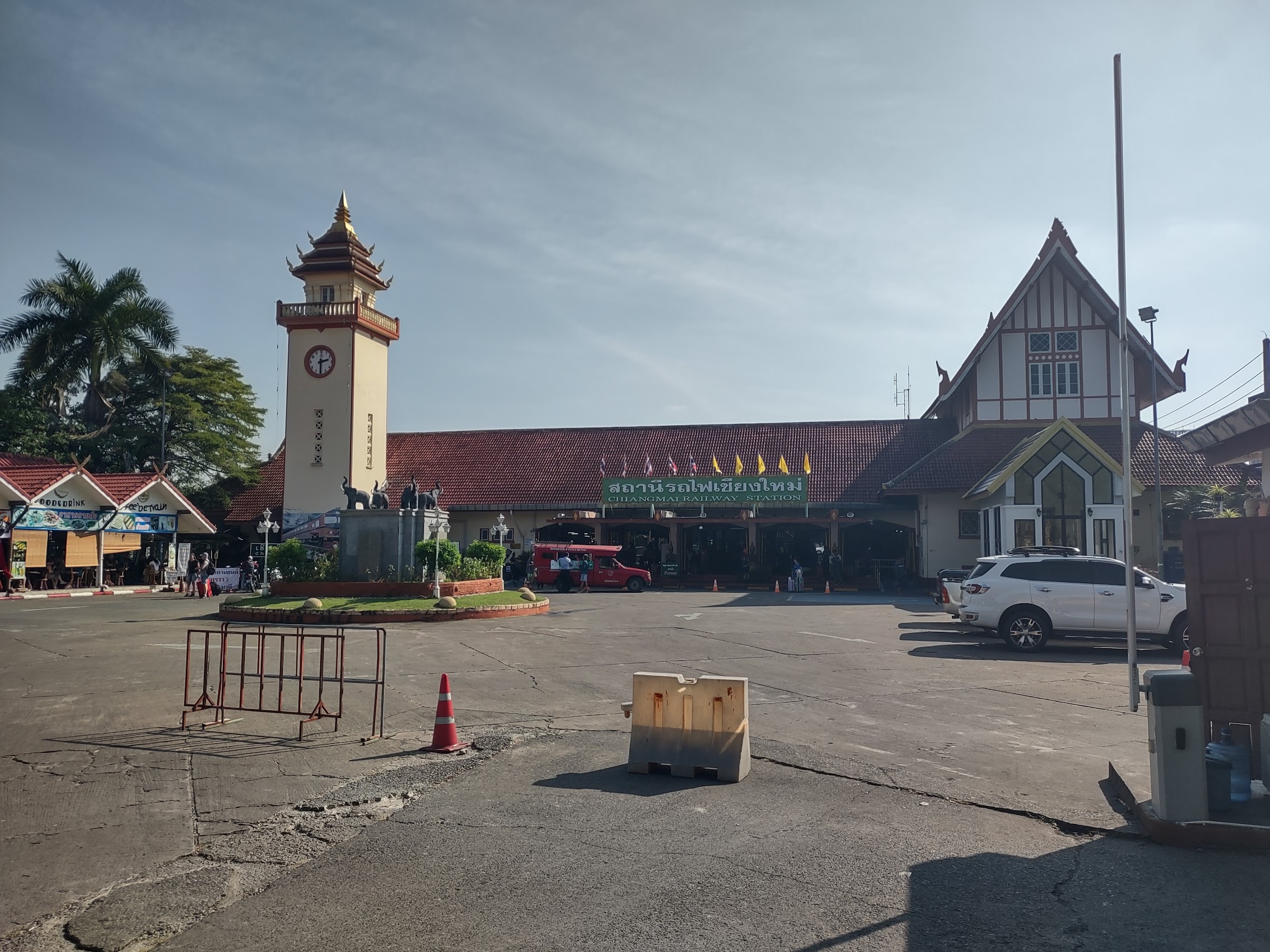
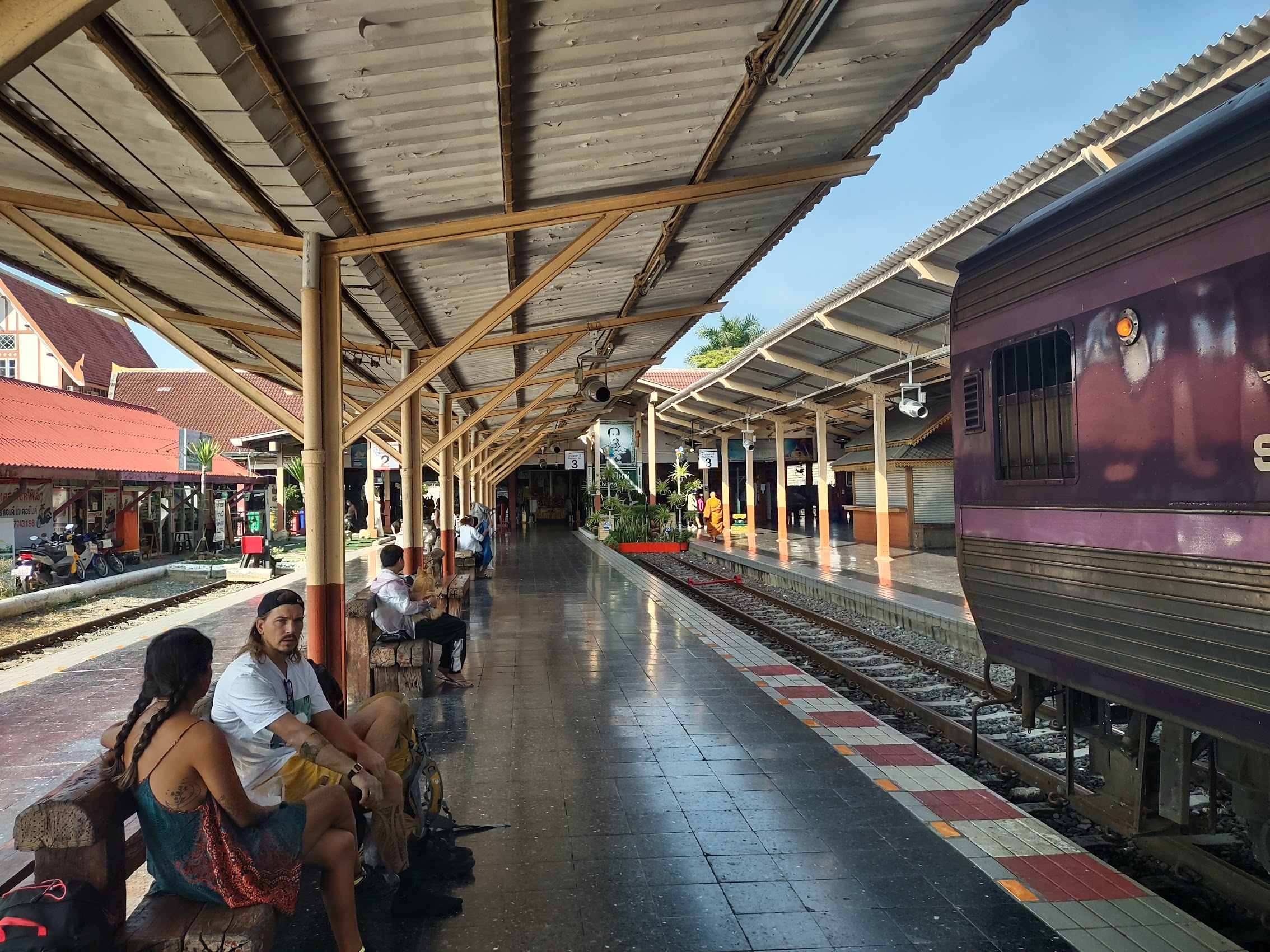
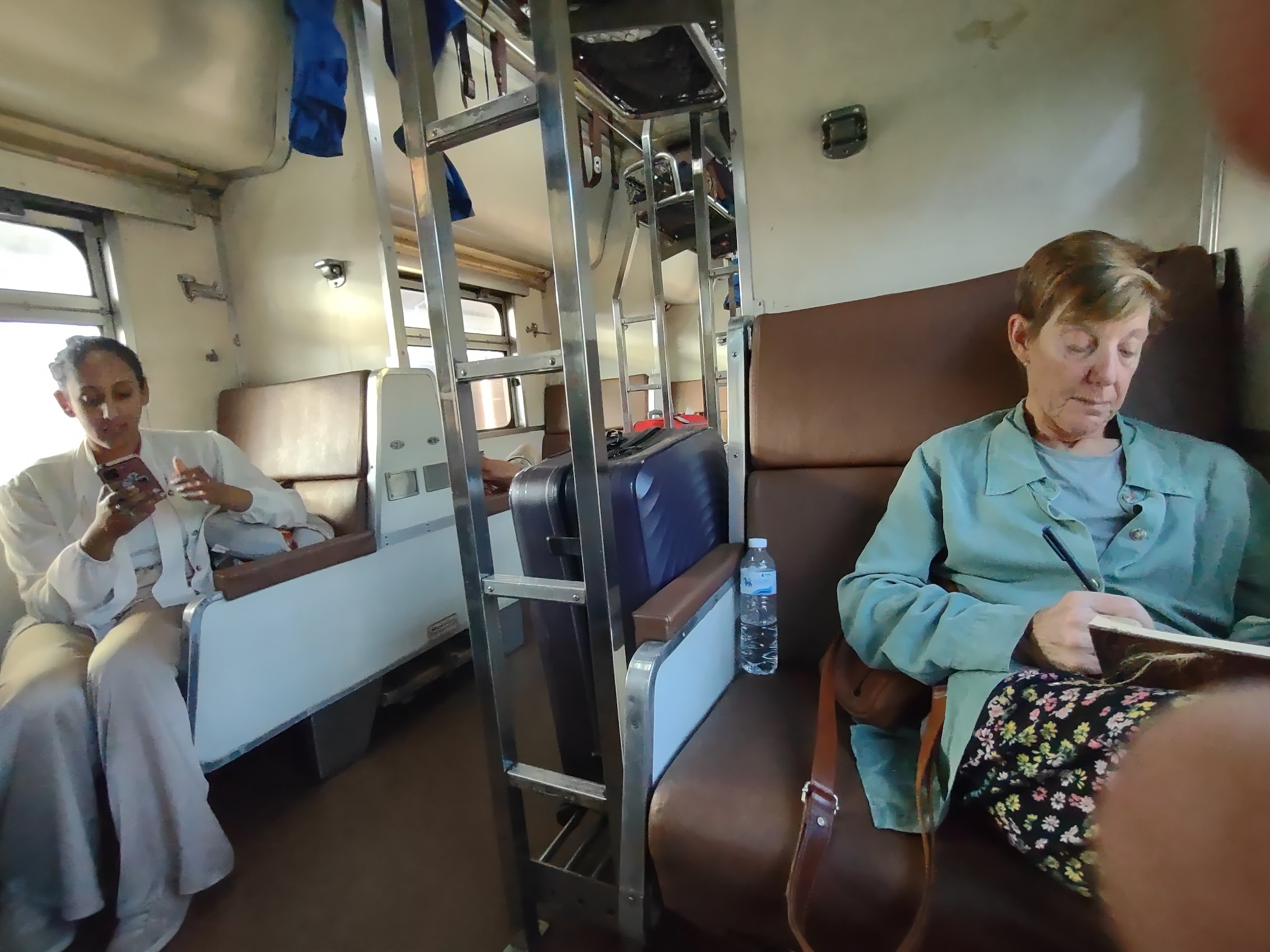
Getting to Siem Reap, Cambodia from Chiang Dao, Thailand turned out to be its own adventure. Our trip began on November 30th with a taxi ride from Chiang Dao back to Chiang Mai where we grabbed a delicious Thai lunch before heading to the train station to catch the overnight train from Chiang Mai back to Bangkok which departed around 3 PM.


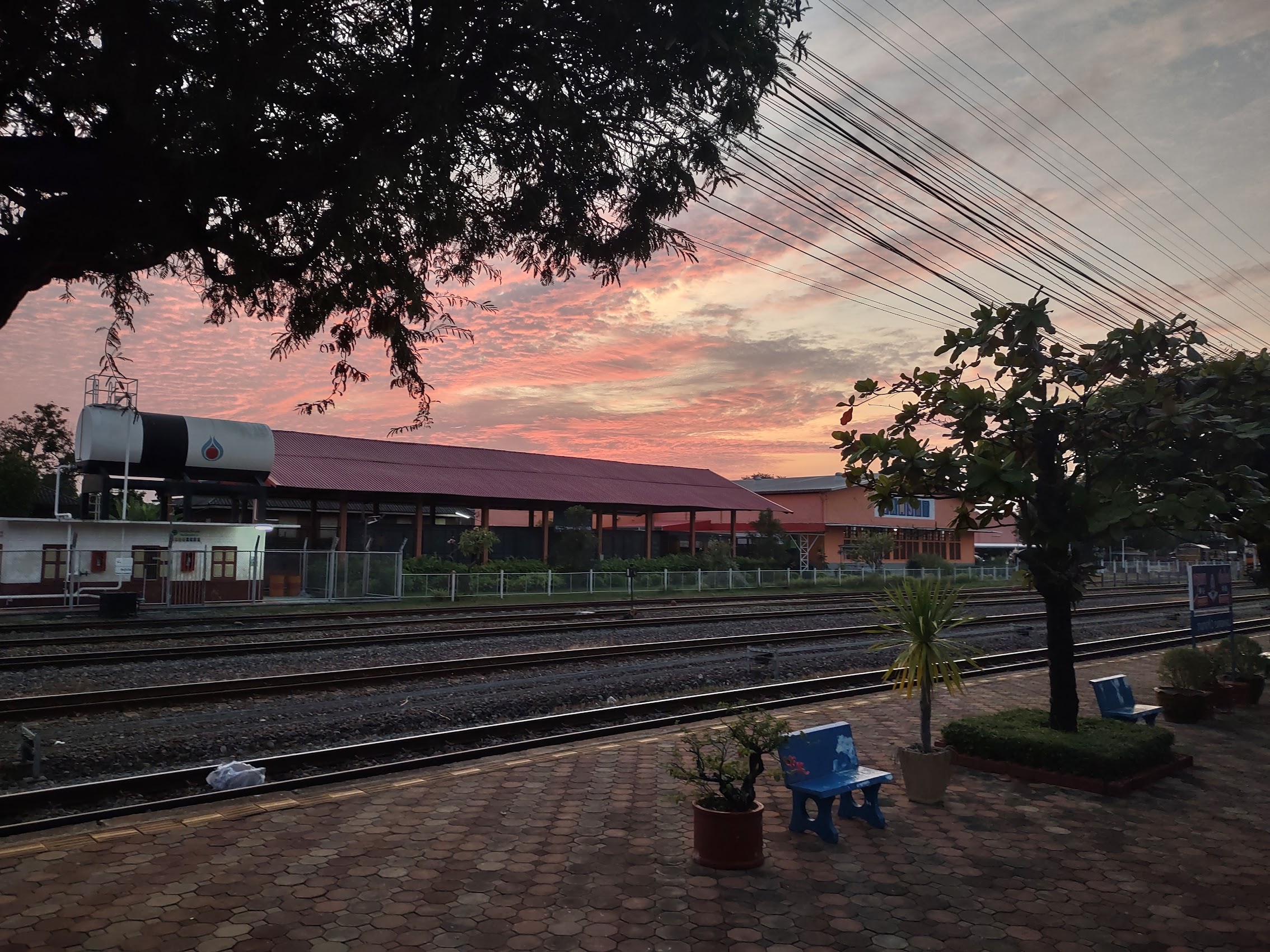
The train made several stops along the way and we enjoyed the scenery, including a nice sunset at one of those stops.
We were seated in a pretty comfortable second class car which was clearly designed to be converted into bunks in some way but we were uncertain how that would be accomplished until, at around 7 PM, a porter came around and, after a push here and a shove there along with a lot of accompanying noise, he miraculously converted our seating compartment into a sleeping compartment with over and under bunks and privacy curtains. This miraculous process was repeated in reverse shortly before we arrived back in Bangkok around 5 AM the next morning (December 1st), just in time to see the sun rise and actually feeling quite well rested.
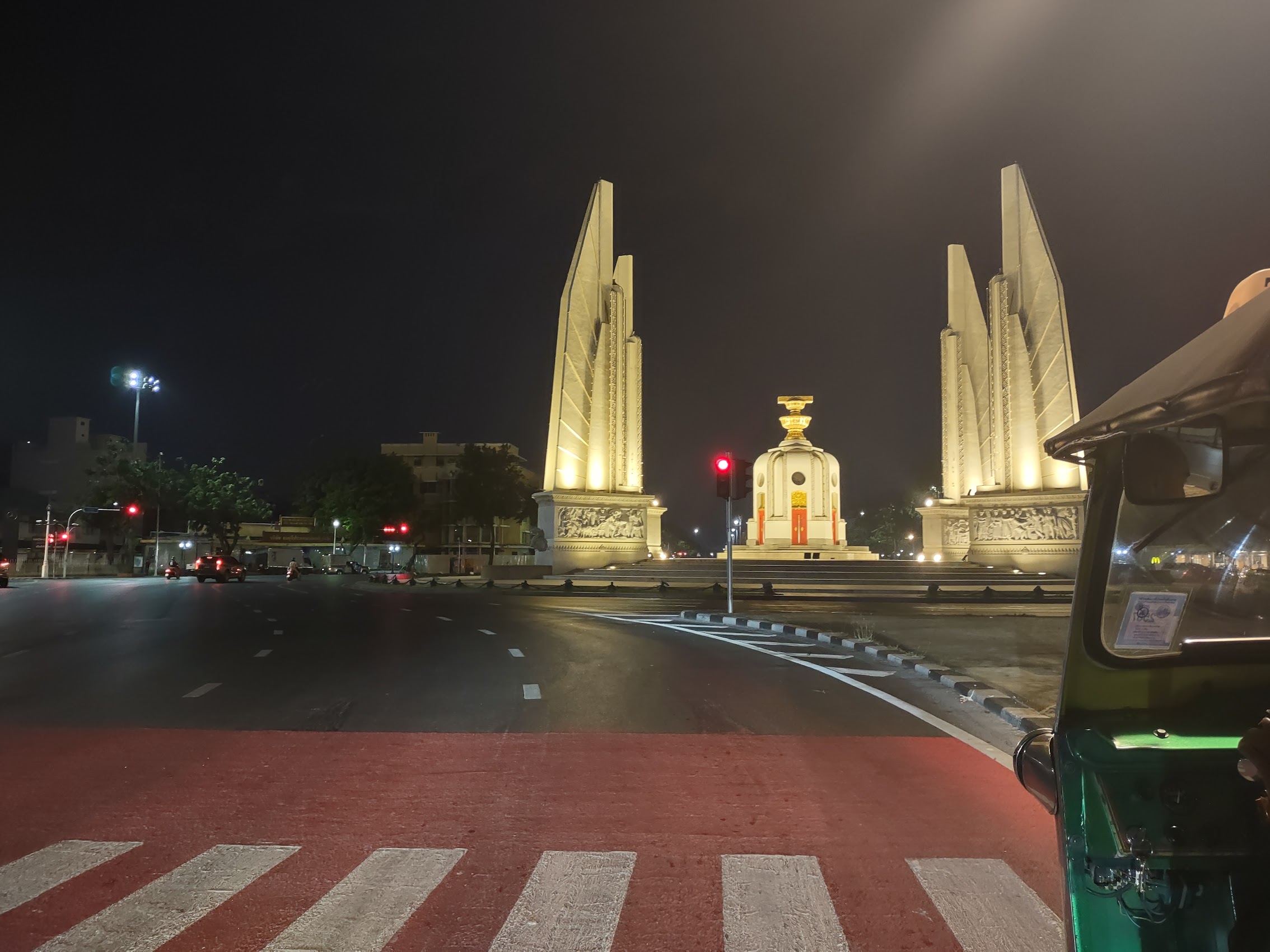
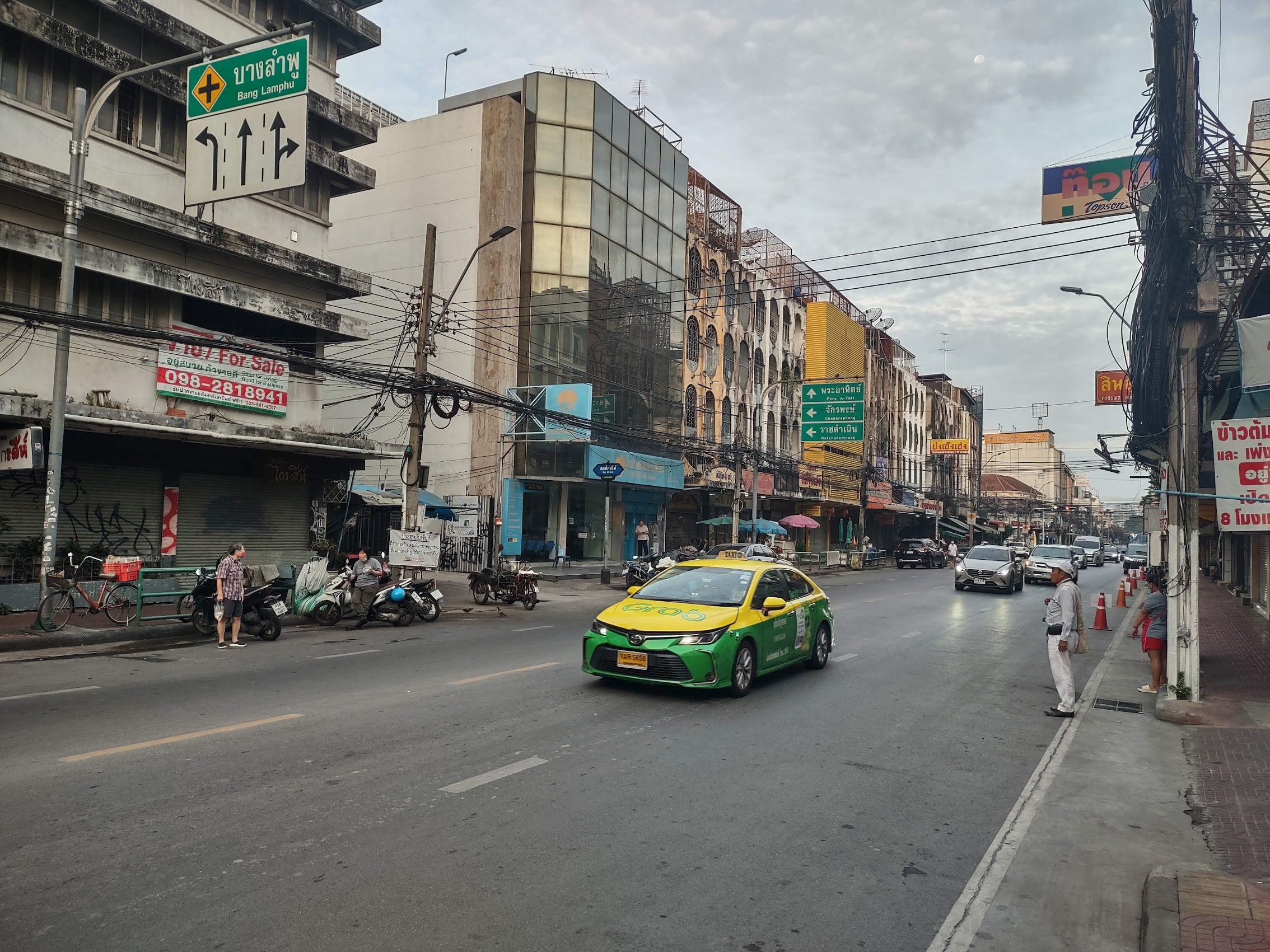
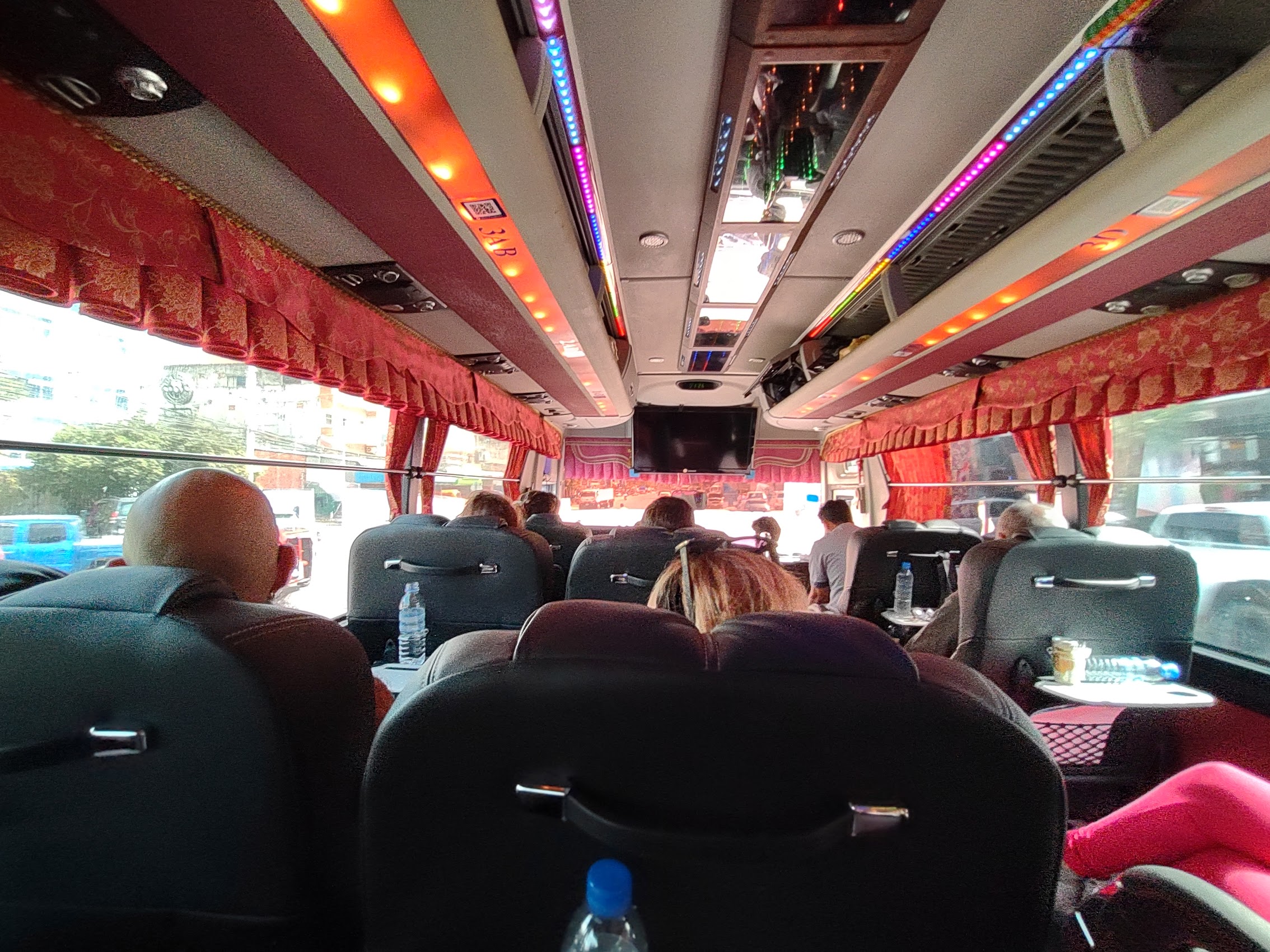
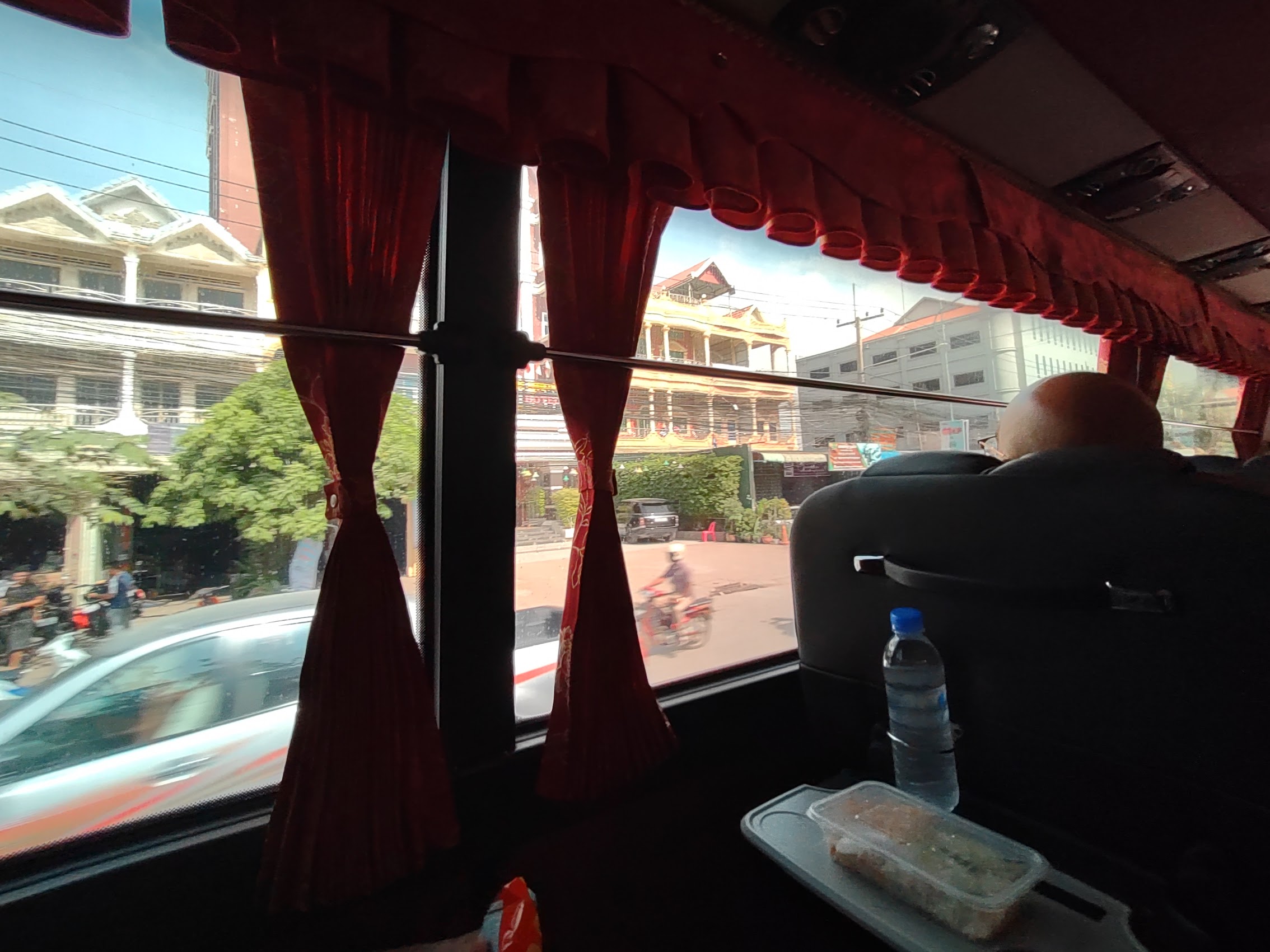
From the Bangkok train station, we took a tuk tuk (sorry about that unintentional and unfortunate alliteration) to a bus office not far from our last stay in Bangkok near Khaosan Road. (It’s oddly nice being familiar with the neighborhood you are in at 6 AM in a big foreign city.) We departed from Bangkok around 8 AM on a “VIP” bus which turned out to be quite comfortable and included enroute food and beverages served by a uniformed attendant. About four hours later, we arrived at the Cambodian border town of Krong Poi Pet.
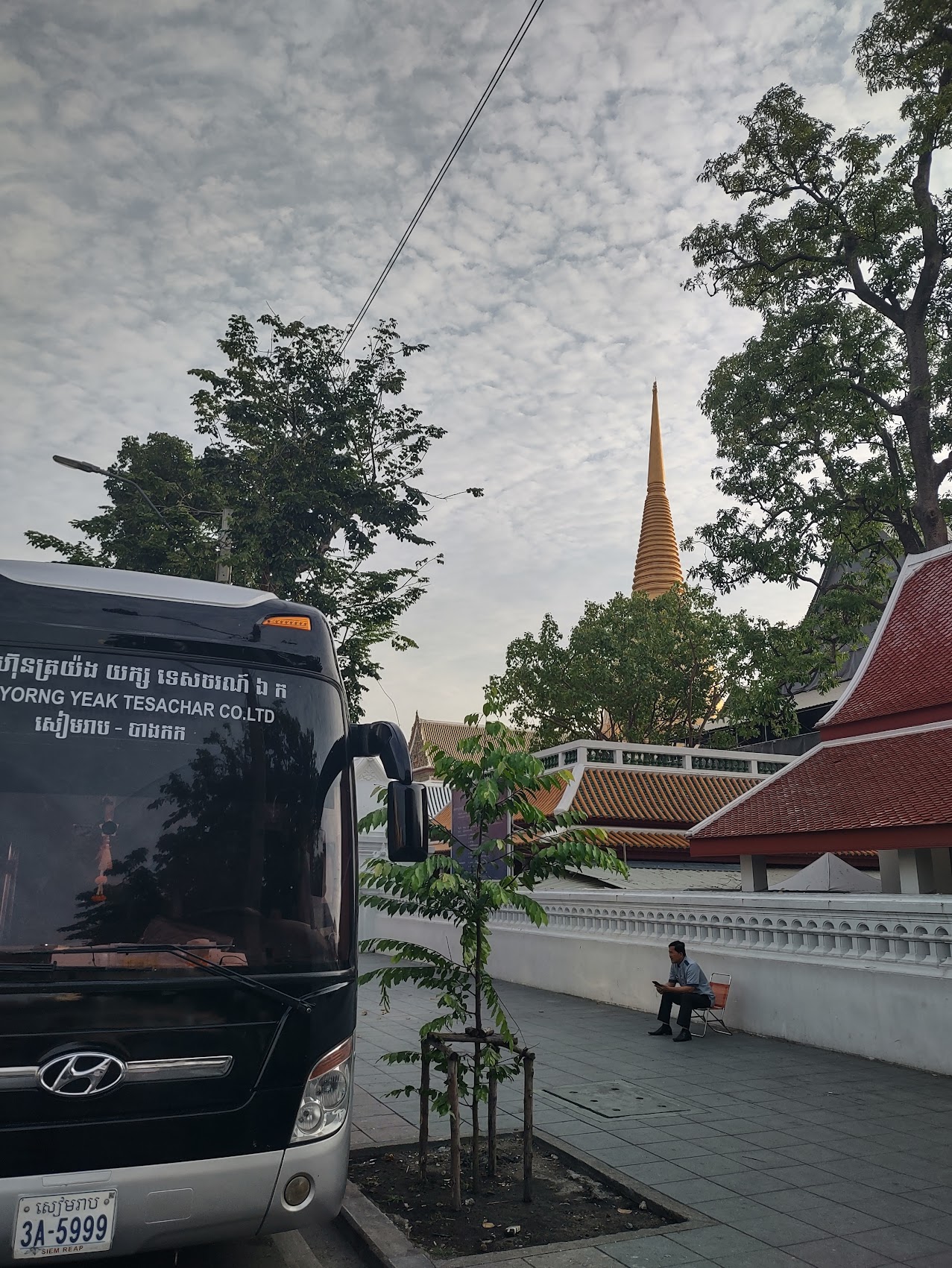
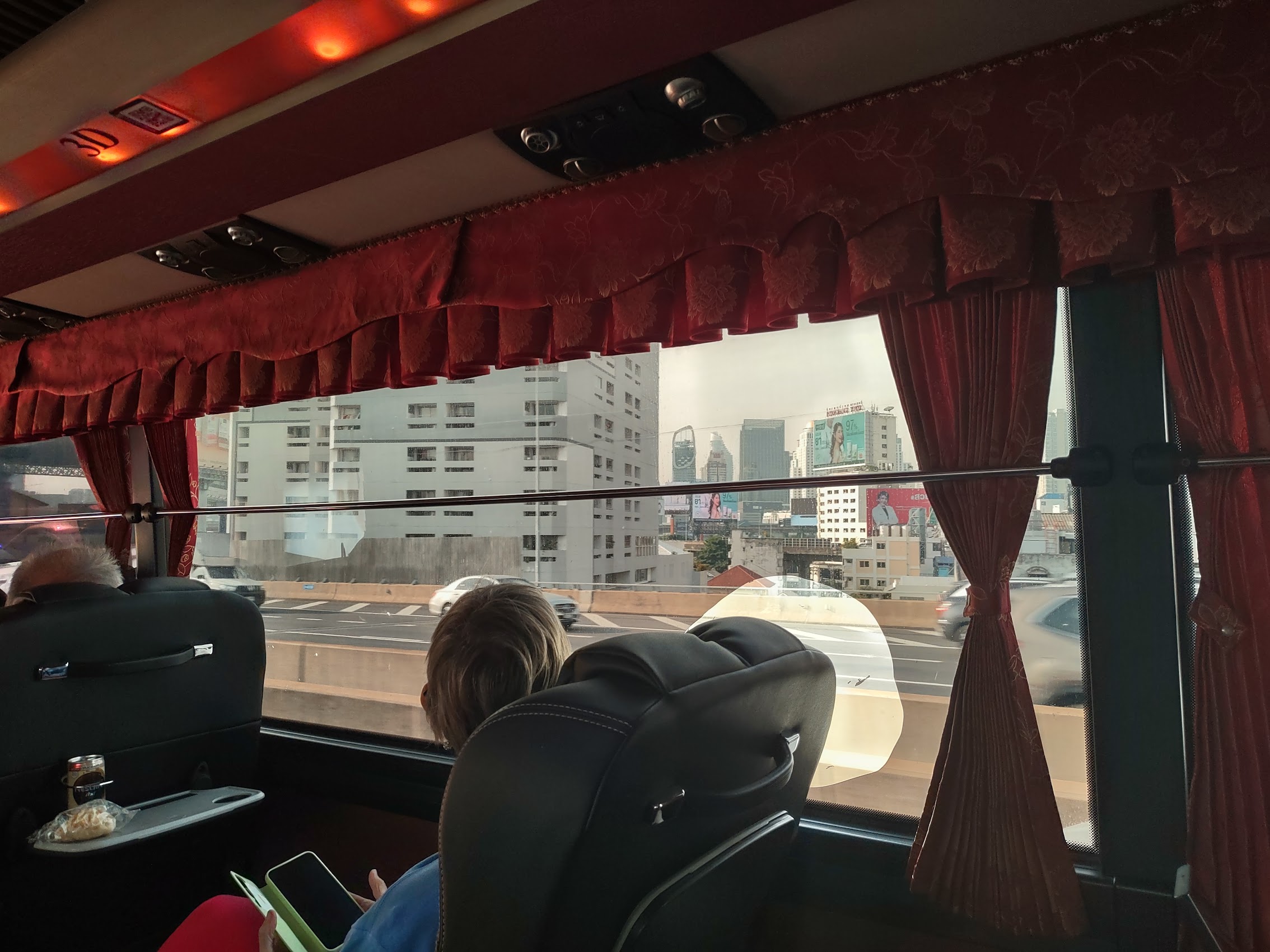

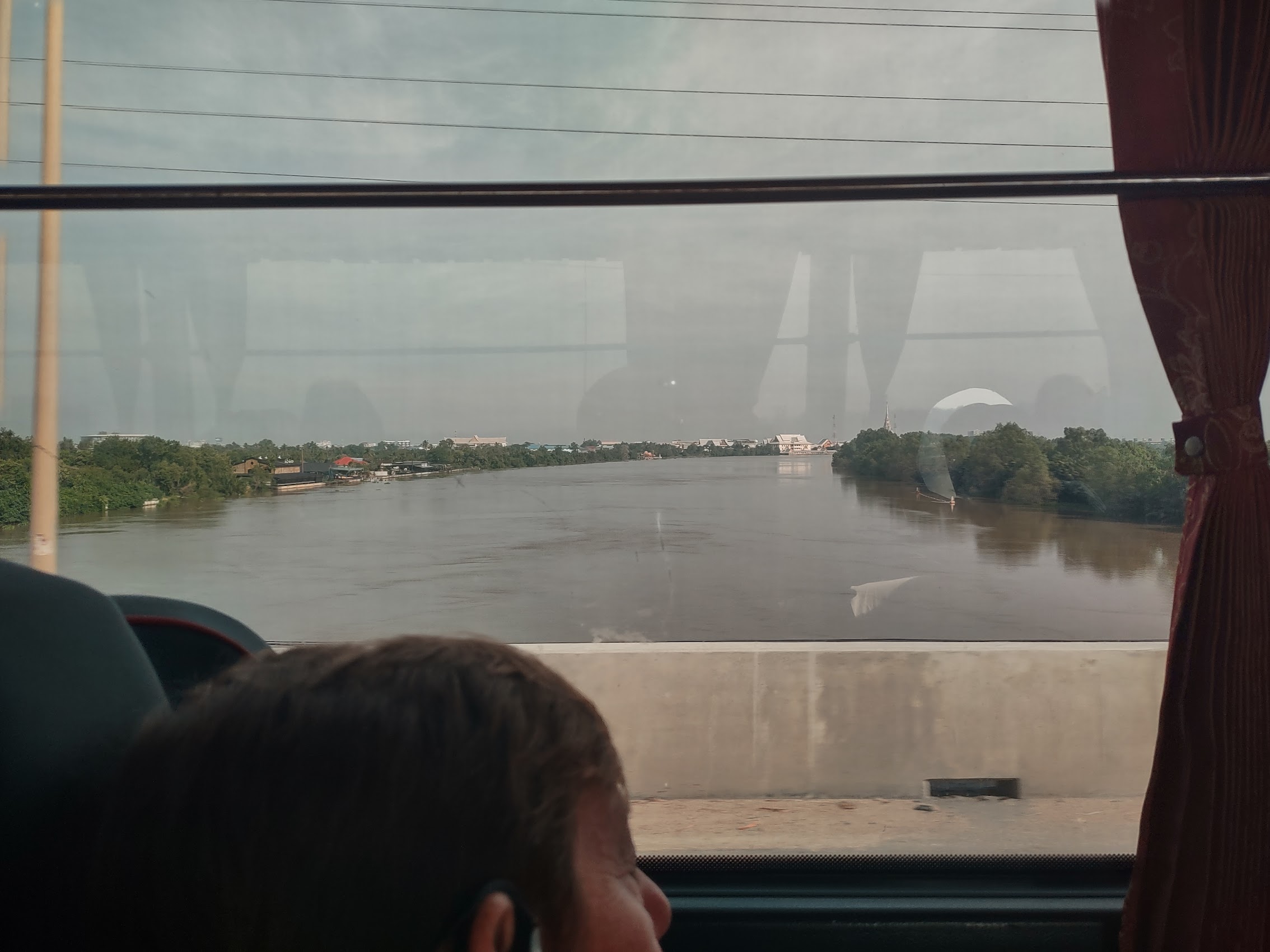
The border crossing itself was pretty well choreographed and we were allowed to leave our belongings on the bus and walk through the customs and immigrations offices before reboarding our bus (with a new driver) about an hour later on the Cambodian side of the border. From there, it was another 3 hour ride to Siem Reap where we had a tuk tuk driver waiting to take us to the place we would be staying for the next three nights.
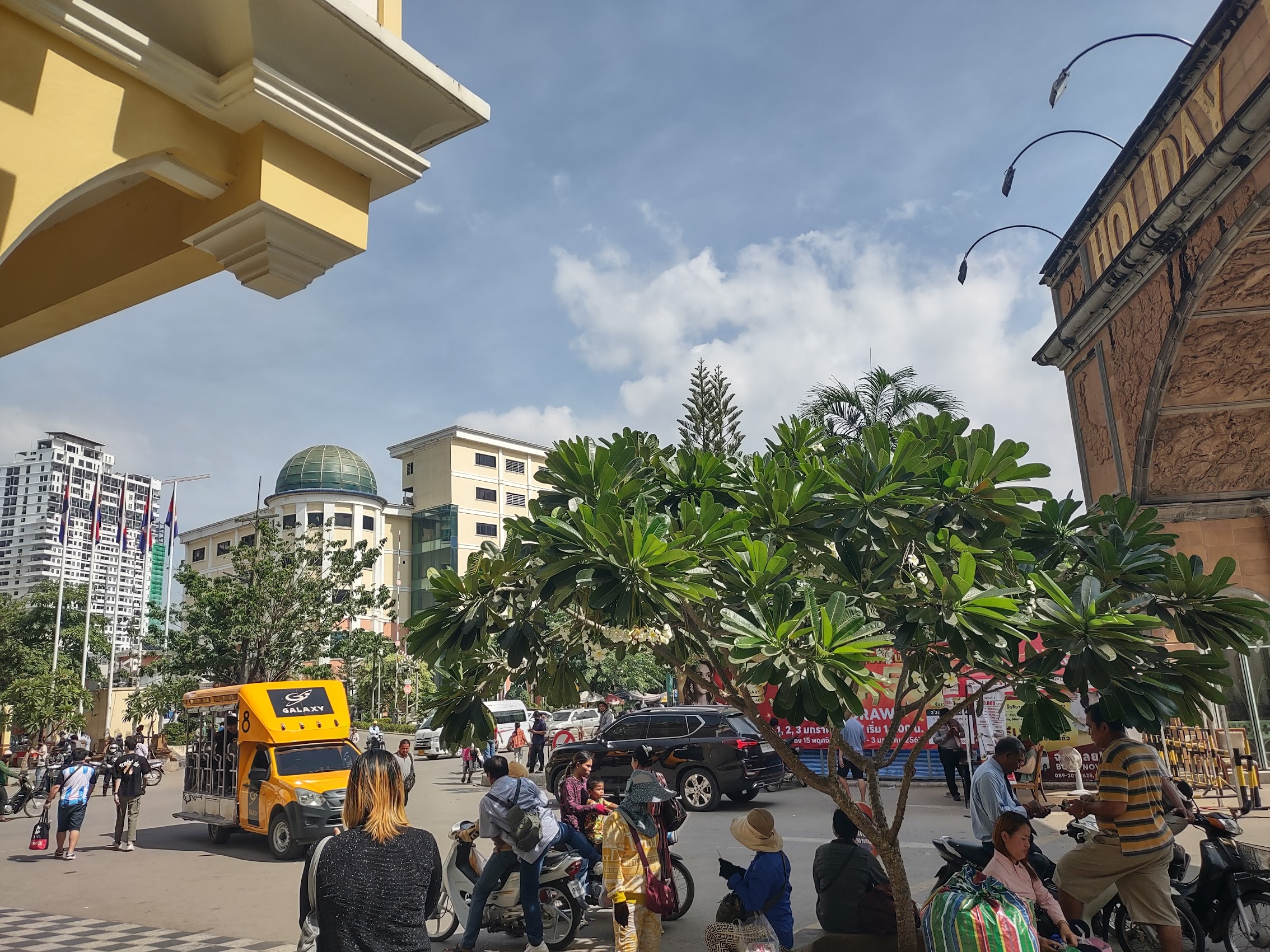


Siem Reap
While it is very likely that you have heard of Angkor Wat the ancient temple complex located in north central Cambodia, it is much less likely that you have heard of Krong Siem Reap, the city we stayed in for the next three days. Siem Reap’s history dates back to the 12th century when the nearby temple complex began construction, but it was little more than a village when westerners “re-discovered” Angkor Wat in the 19th century. Today, Siem Reap is a Provincial capital and resort city (the second largest in Cambodia with a population of 140,000) which, for all intents and purposes, serves as the gateway and visitors center for Angkor Wat which is located just 5 kilometers to the north of the city.
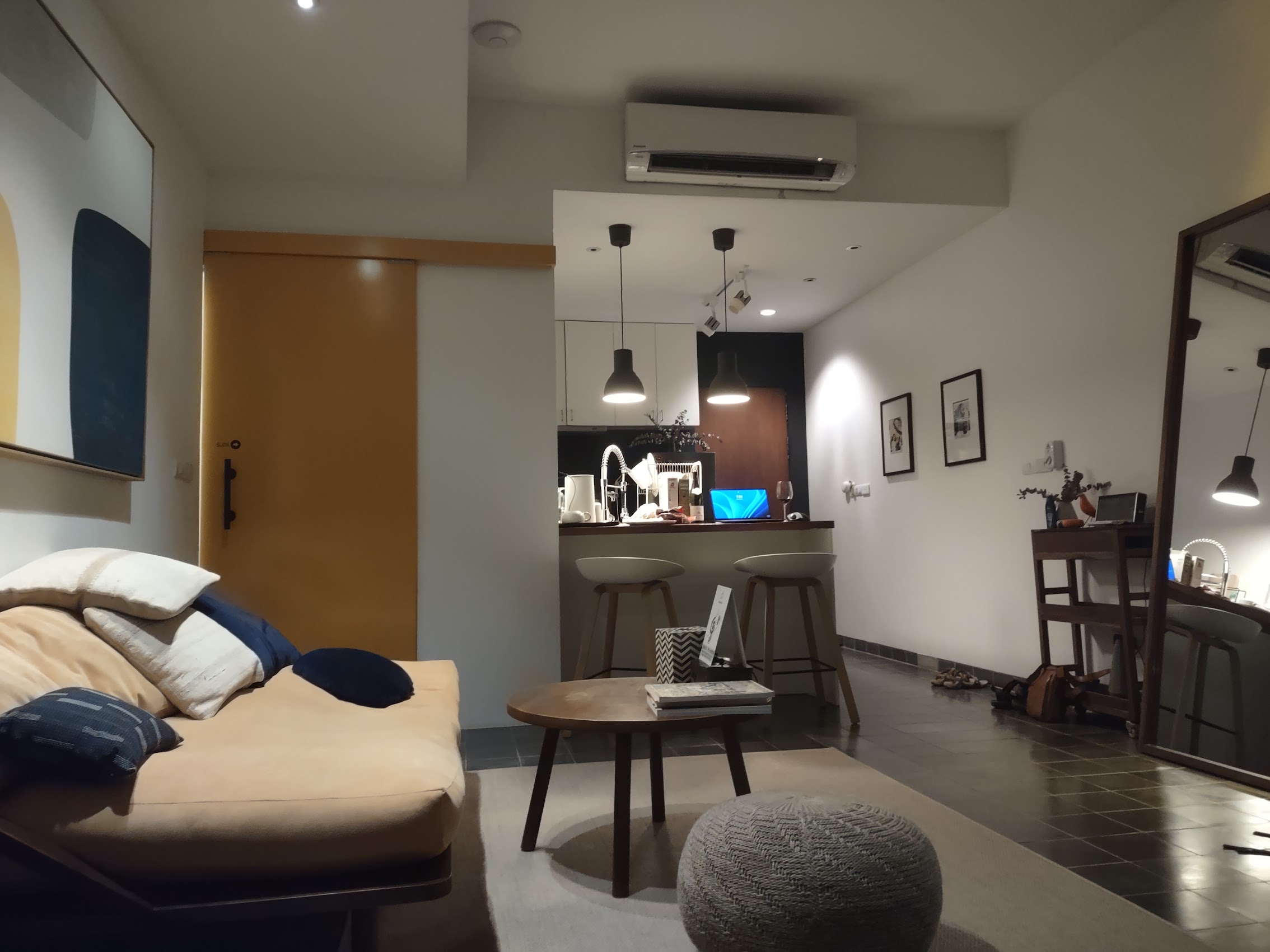
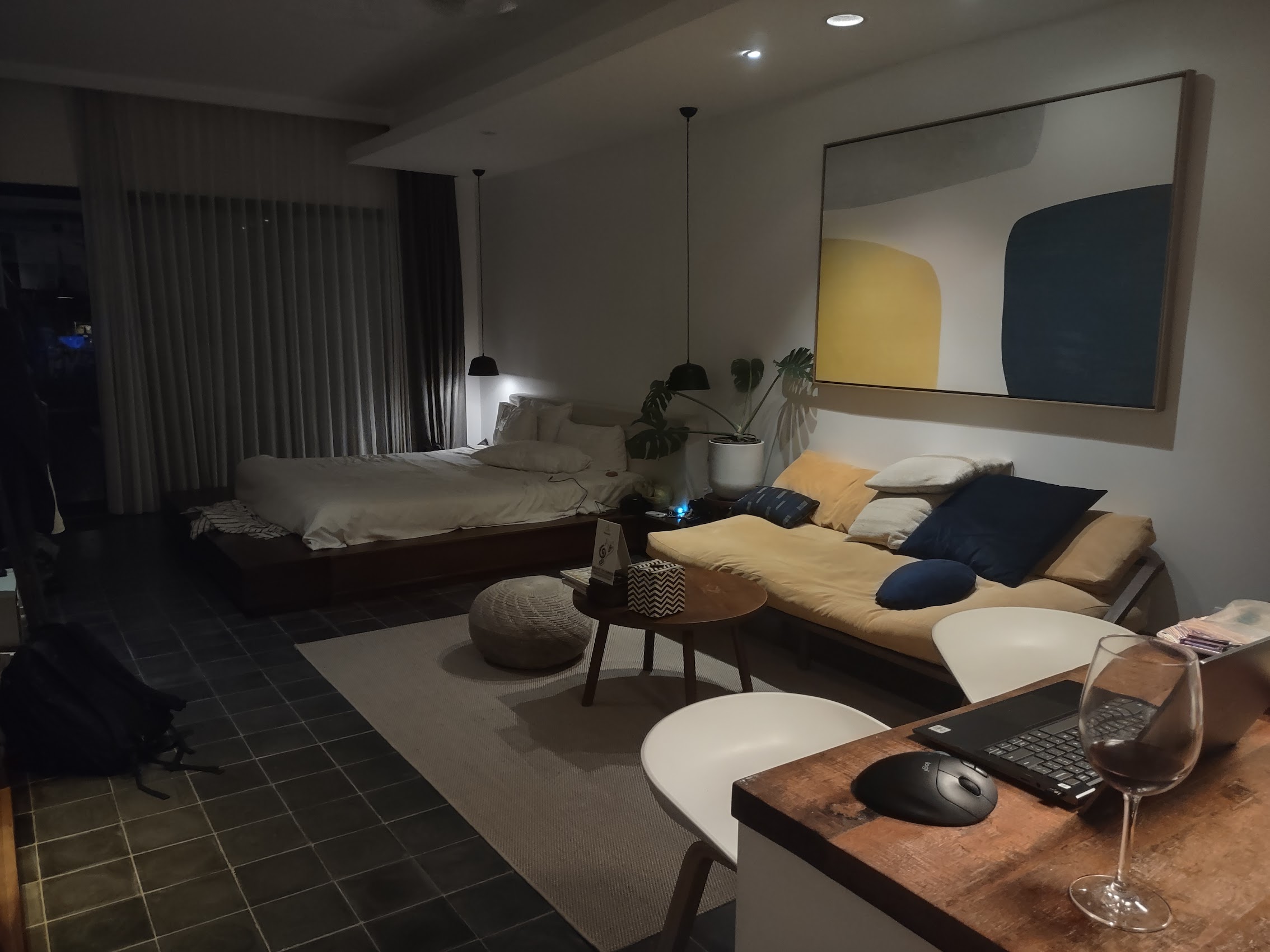
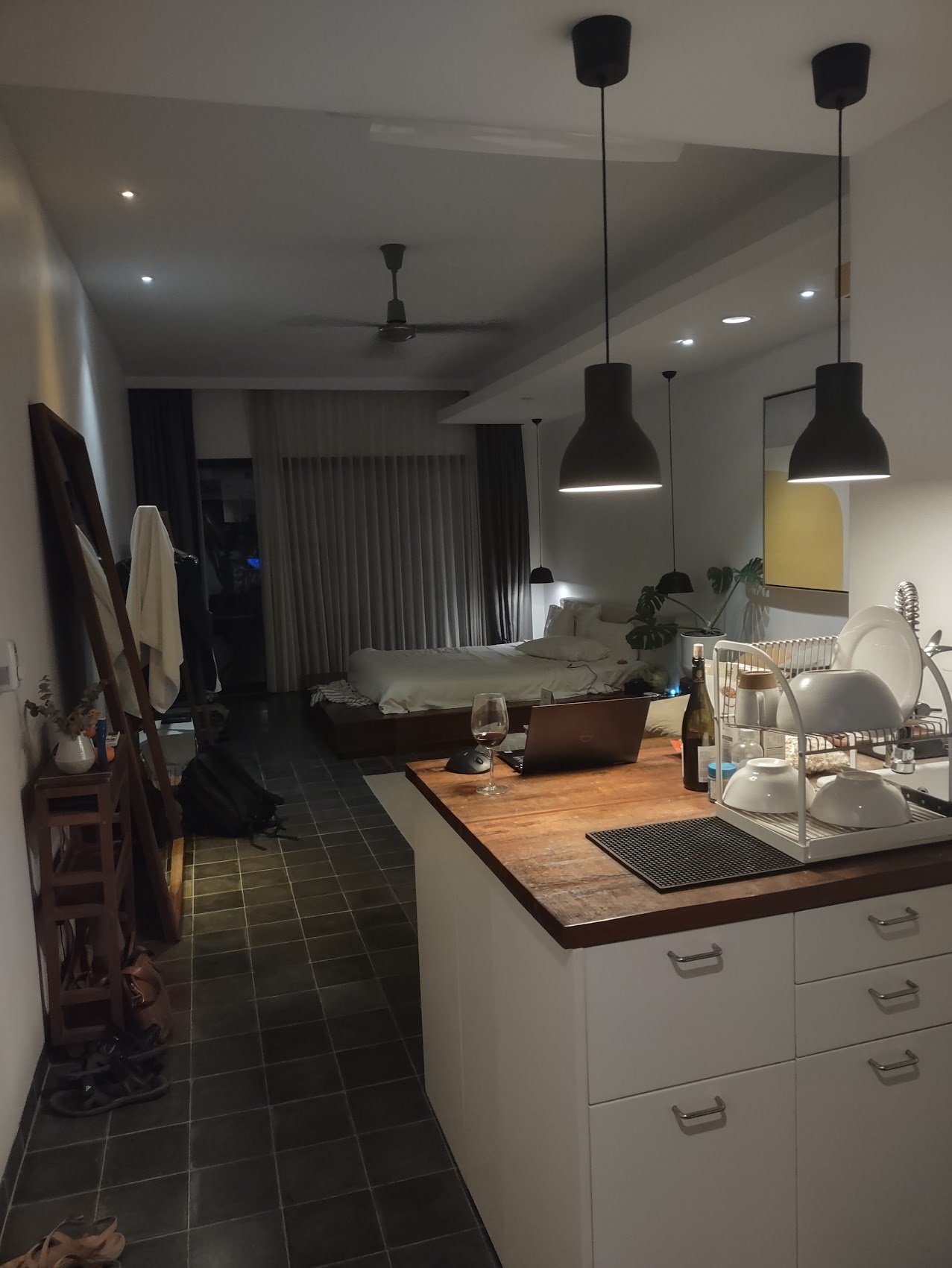
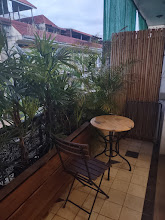
Our place in Siem Reap was a second-floor apartment overlooking a small but nice side street full of interesting shops and restaurants located in a neighborhood along the Siem Reap River in the city center. The entrance to our place was off a narrow alley behind the building which we were assured was very safe (but were also advised to padlock the gate into our building before retiring at night). The apartment itself was a small but clean and efficient, with a well-equipped kitchen and a nice balcony which turned out to be a great place to people watch as well as dry laundry.

Angkor Wat
As I mentioned in the introduction, Angkor Wat was (at least until recently) our primary reason for being in Cambodia and really our only reason for being in Siem Reap. If you’re not aware of it (which, as I said before seems unlikely), Angkor Wat is arguably the best known and most widely recognized religious structure in the world (identified by the Guinness Book of World Records as the largest religious structure in the world and recently named the Eighth Wonder of the World by people who do such things).
What you may not know is that the Angkor Wat temple is just one of hundreds of temples in the Angkor complex (a UNESCO World Heritage Site) which was the religious center of the city of Angkor, capital city of the Khmer Empire which flourished from the 9th through the 12th centuries. Even more interestingly (to me at least), based on recent archeological investigations it appears that Angkor was the largest pre-industrial city in the world with an estimated population of over 1,000,000 people and covering almost 400 square miles (larger than modern Paris!). After the 12th century, the Khmer empire slowly declined and contracted, the population of Angkor diminished and dispersed, and the Angor temple complex slowly fell into ruin as the jungle gradually reclaimed much of it.

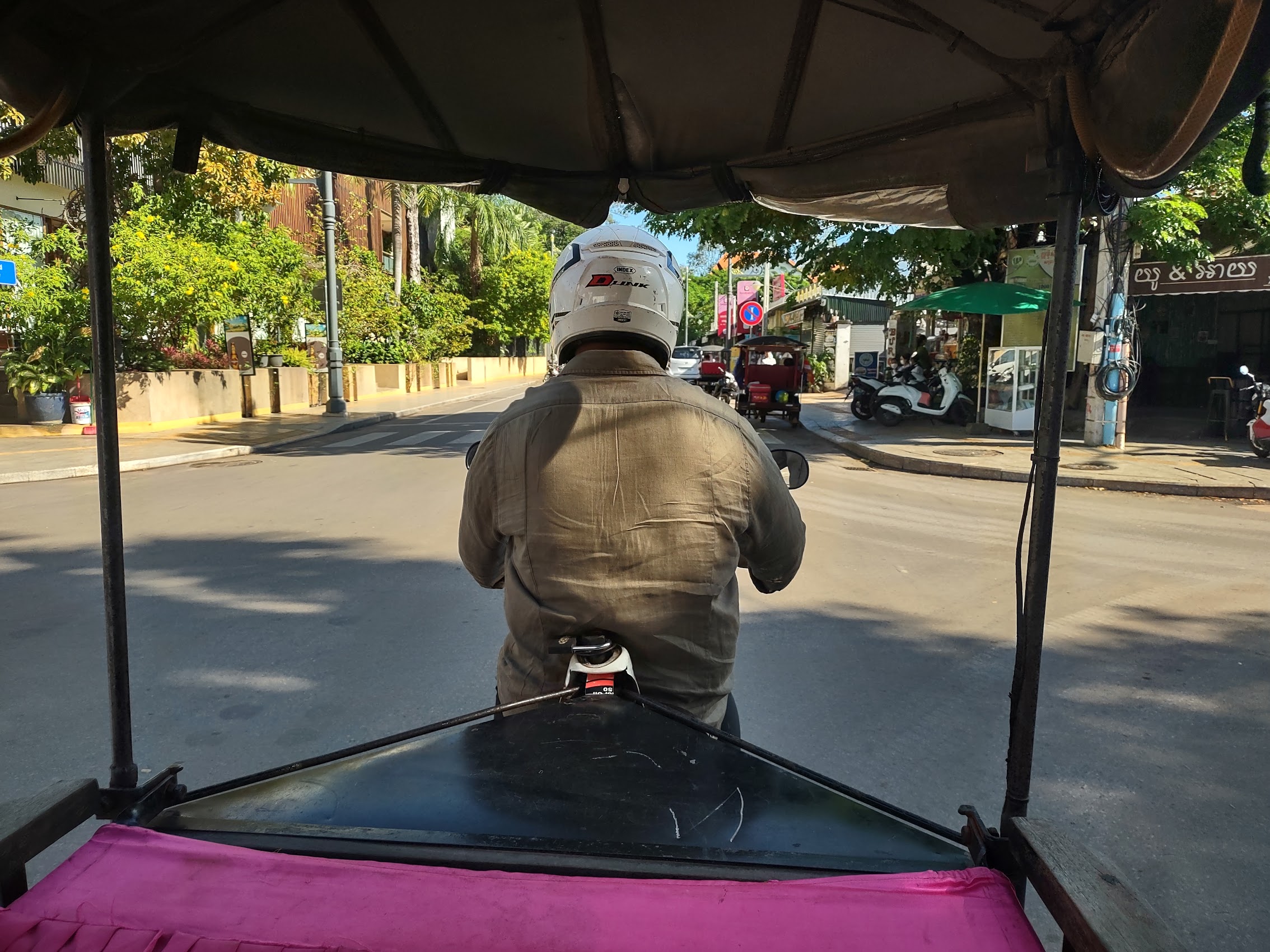
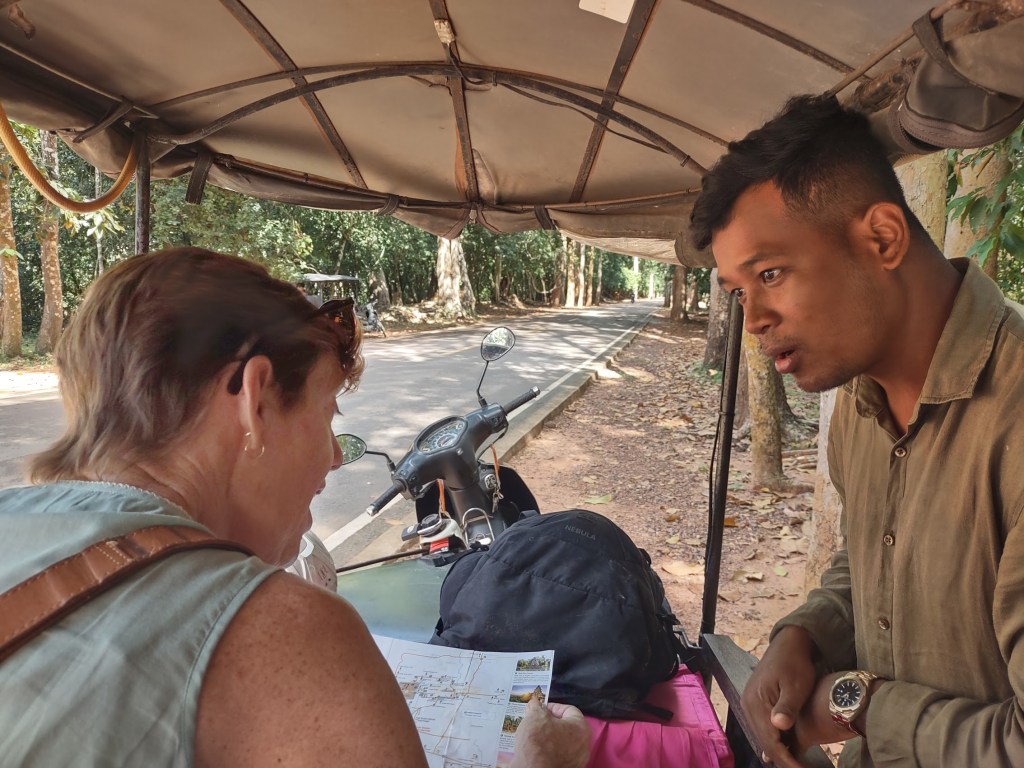
Within the Angkor temple complex there are some 72 major temples and buildings and several hundred additional minor temples scattered over an area of about 150 square miles and you could probably spend weeks (if not months) here just visiting temples. From research, we knew that getting around by tuk tuk was the way to go and that having a good and knowledgeable tuk tuk driver was essential. After a little bit of discussion, we elected to engage Mr. Black, the driver who brought us to our apartment, and, after reviewing a map of the temple complex and his recommendations, we arranged a two-day package which included sunset one day and sunrise the next.
A Day in the Park
On our first full day in Siem Reap, our driver, Mr. Black, picked us up outside our apartment at 9 AM and drove us to the Angkor complex (officially known as the Angkor Archaeological Park). As we made our way there in Mr. Black’s tuk tuk, we discovered the park was surrounded by a number of very large resort hotels and shopping centers which was becoming oddly reminiscent of Orlando, Florida. I was very curious to see how access to this enormous complex (which we quickly began to think of and refer to as “the Park”) was managed and was pretty impressed at how well organized everything seemed to be.
Our first stop was at one of the Park’s visitor complexes where we purchased three-day passes (there are one-day, three-day, and, of course, the ever popular one-week option!). Beyond the visitor center, there were periodic pull-offs along the main roadways where we were required to show our passes (which included our photographs) and there were also park staff to check your passes at most of the individual temple sites. The complex was much larger than we had imagined and I don’t know how we would have navigated all this so smoothly were it not for our tuk tuk driver Mr. Black.


The first temple site we visited in the Park was the Pre Rup temple, a Hindu temple constructed in the late 10th century as the state temple of Khmer King Rajendravarman. Like all the temples in Angkor, it was in a state of decay (which, more than anything, only served to emphasize its age), but the structure was largely whole and there were enough remnants of the original stone carving and bas relief work to have a pretty good sense of how grand it must once have been.
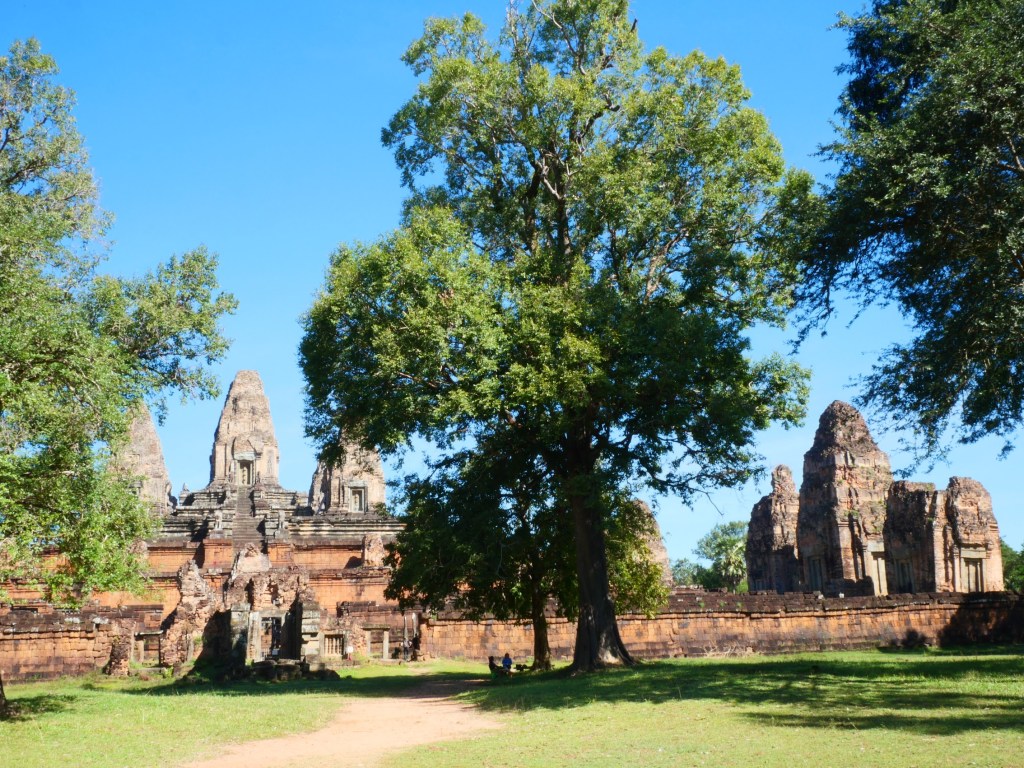
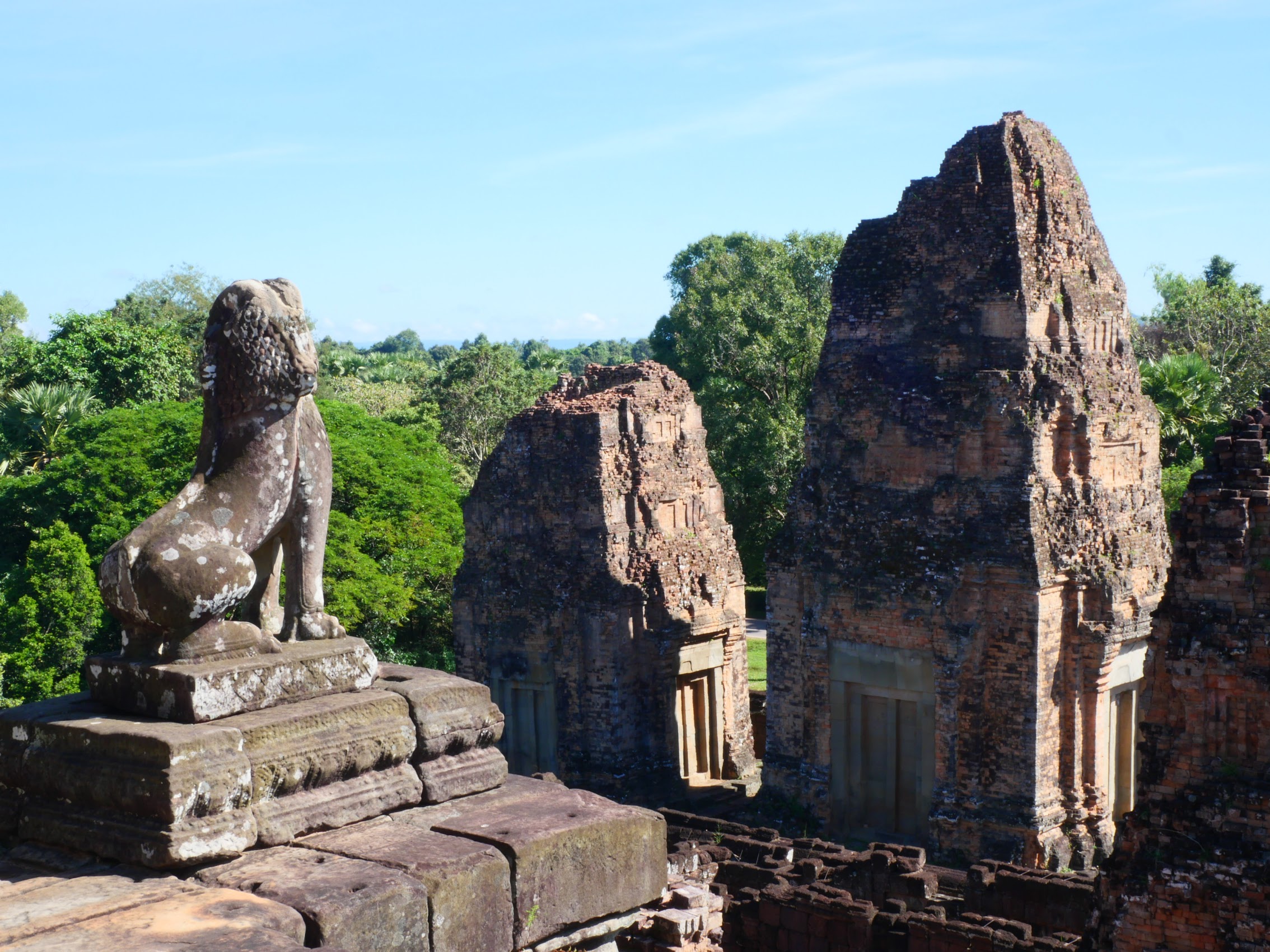
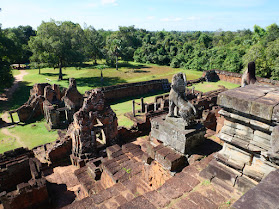

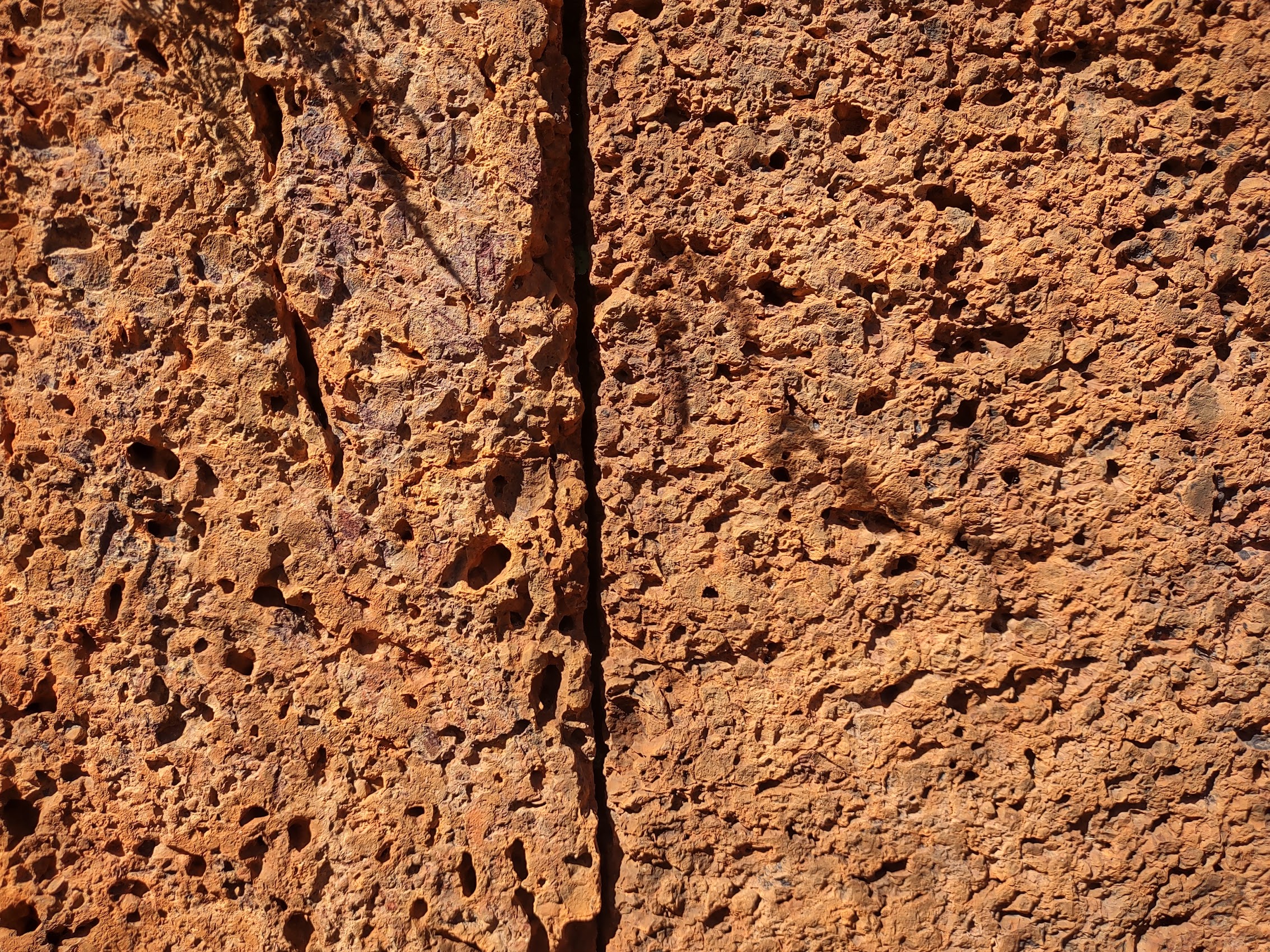
It was particularly interesting to me (the architect) to see the techniques and materials which were used in the construction of the temple. These included brick (used for infill), limestone (used for the finished facing, cladding, and details), and a new material for me, something called laterite (the rust colored stone you see in the photos). Laterite is actually a soil rich in iron and aluminum which, when excavated from below the water table and exposed to air, turns into a relatively hard (but very porous) stone-like material. The laterite was used to build the foundations upon which the temple stands, but also as a facing material where its beautiful color and texture contrast nicely with the lighter colored and smoother limestone. It was surprising to see how well the laterite had weathered despite its porosity (but then, it never freezes here!). Really a beautiful material!
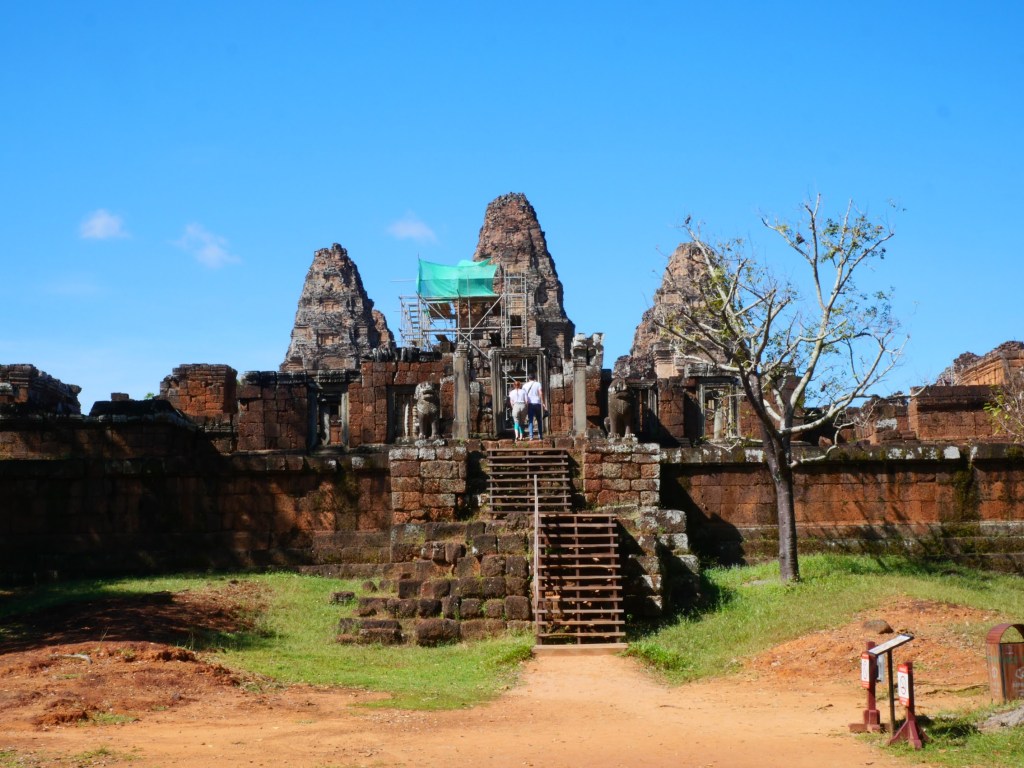
From Pre Rup, we proceeded to the nearby East Mebon temple, another Hindu temple constructed in the late 10th century by King Rajendravarman, this one a temple to the Hindu god Shiva and dedicated to the King’s parents. Perhaps not surprisingly, the construction of East Mebon was similar to that of Pre Rup, but its sense of place was very different. East Mebon was built on an artificial island constructed of laterite in the now dry East Baray reservoir and is now an island in the encroaching jungle.

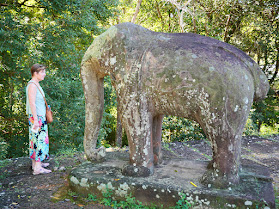
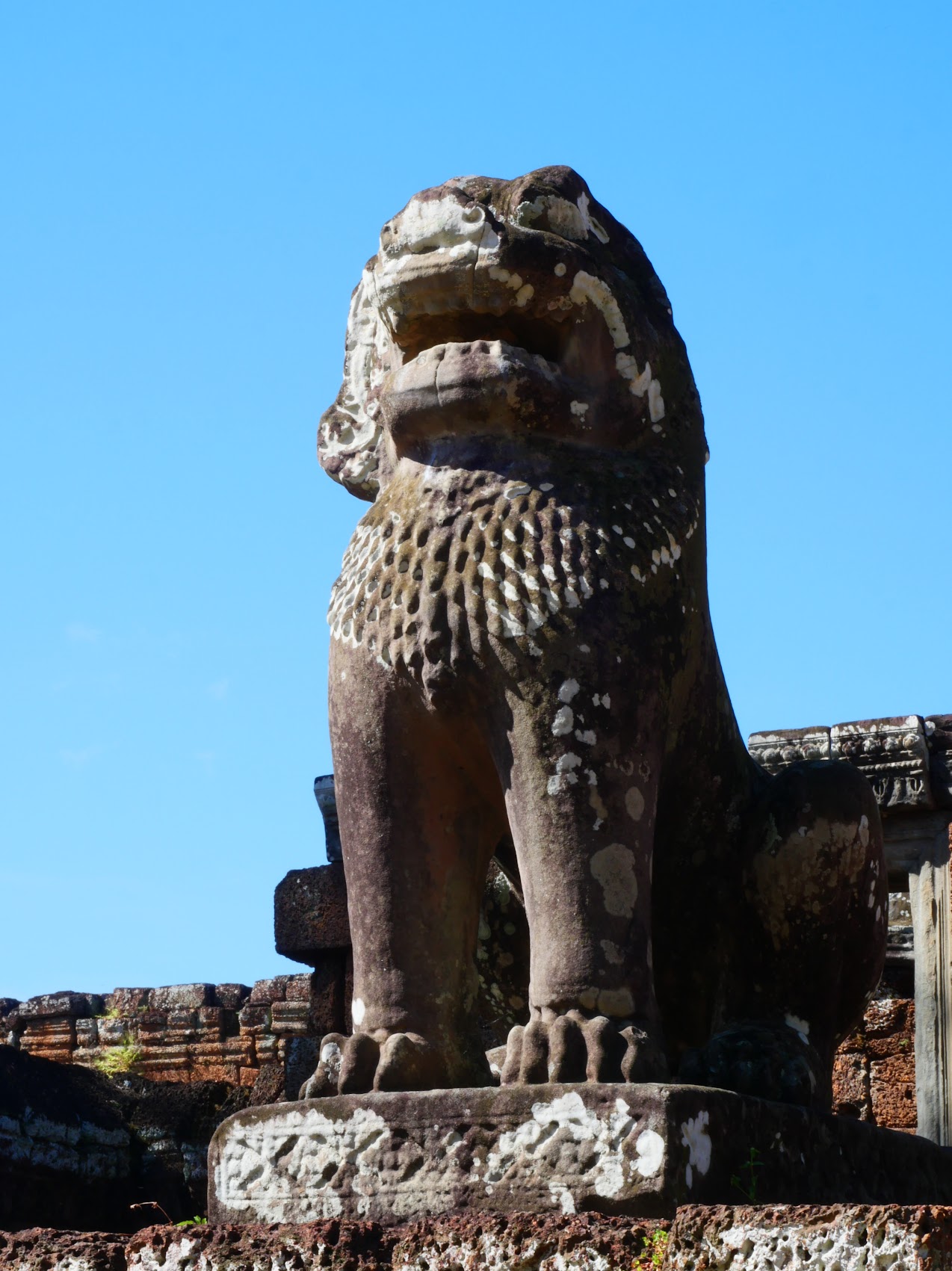
Our next stop was Prasat Ta Som, a smaller lesser-known Buddhist temple built in the late 12th century during the reign of King Jayavarman VII. This temple consists of a single shrine on one level surrounded by an enclosure of laterite walls. The temple features intricately carved bas-reliefs (including a smiling Buddha) and has clearly been reclaimed by the jungle, with strangler fig trees still wrapping one side, which add a mystical and enchanting quality to this particularly picturesque site.
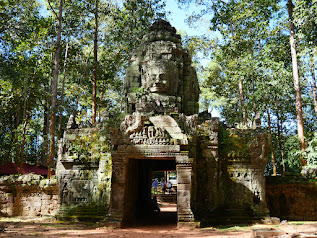
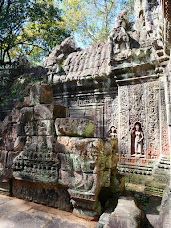
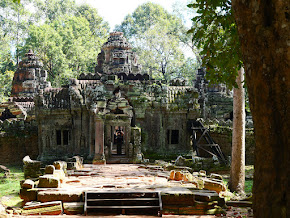
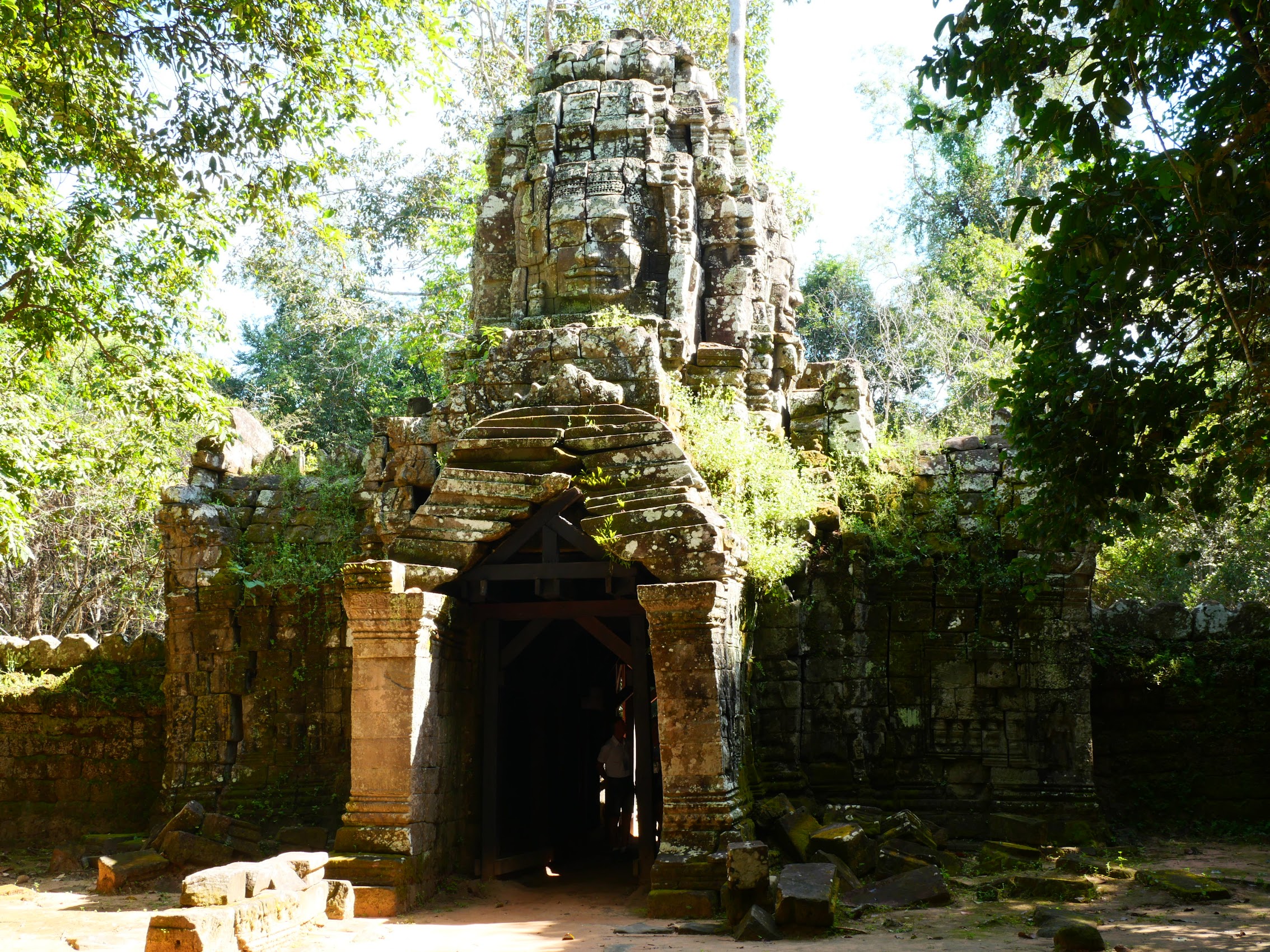
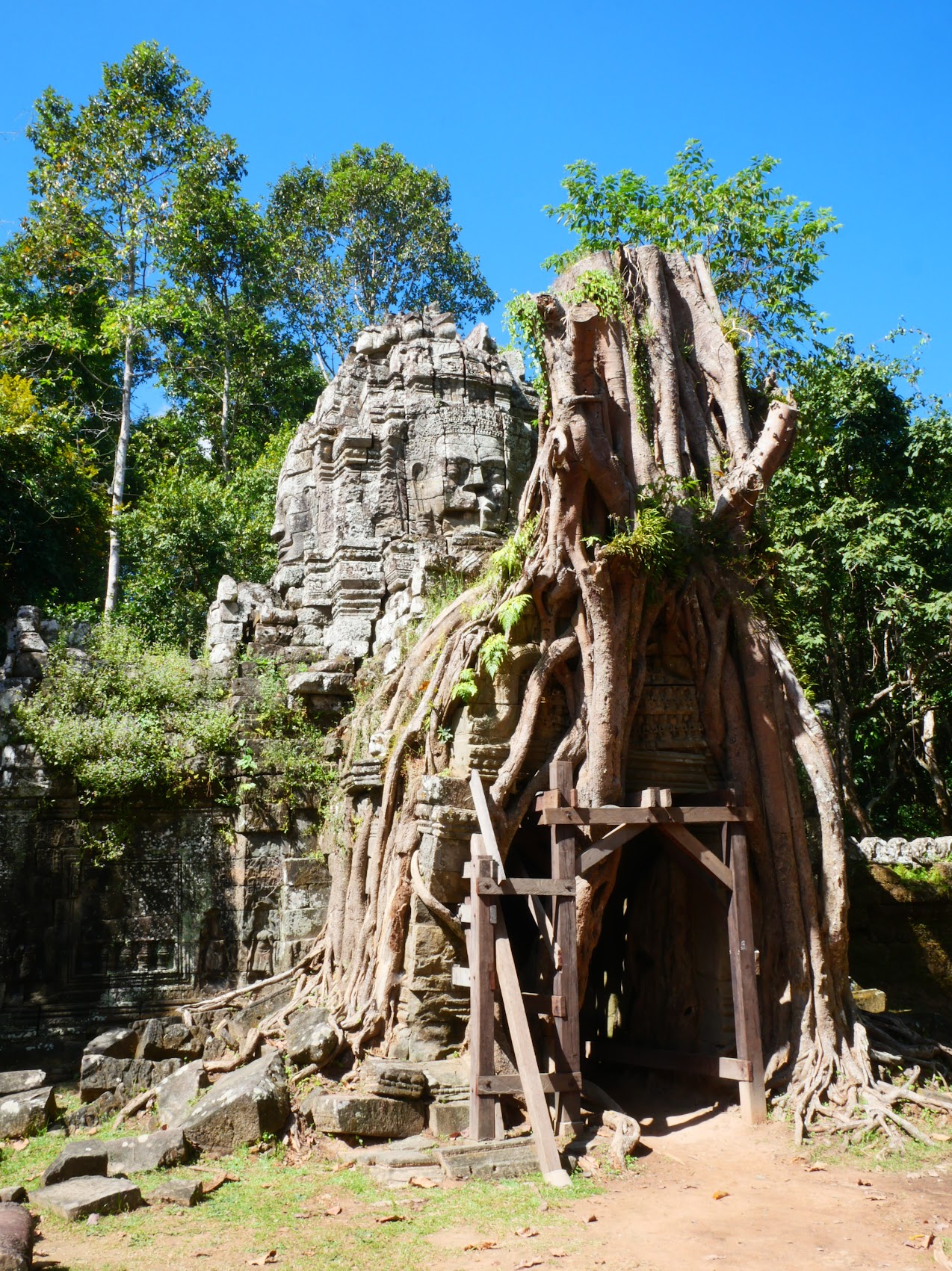
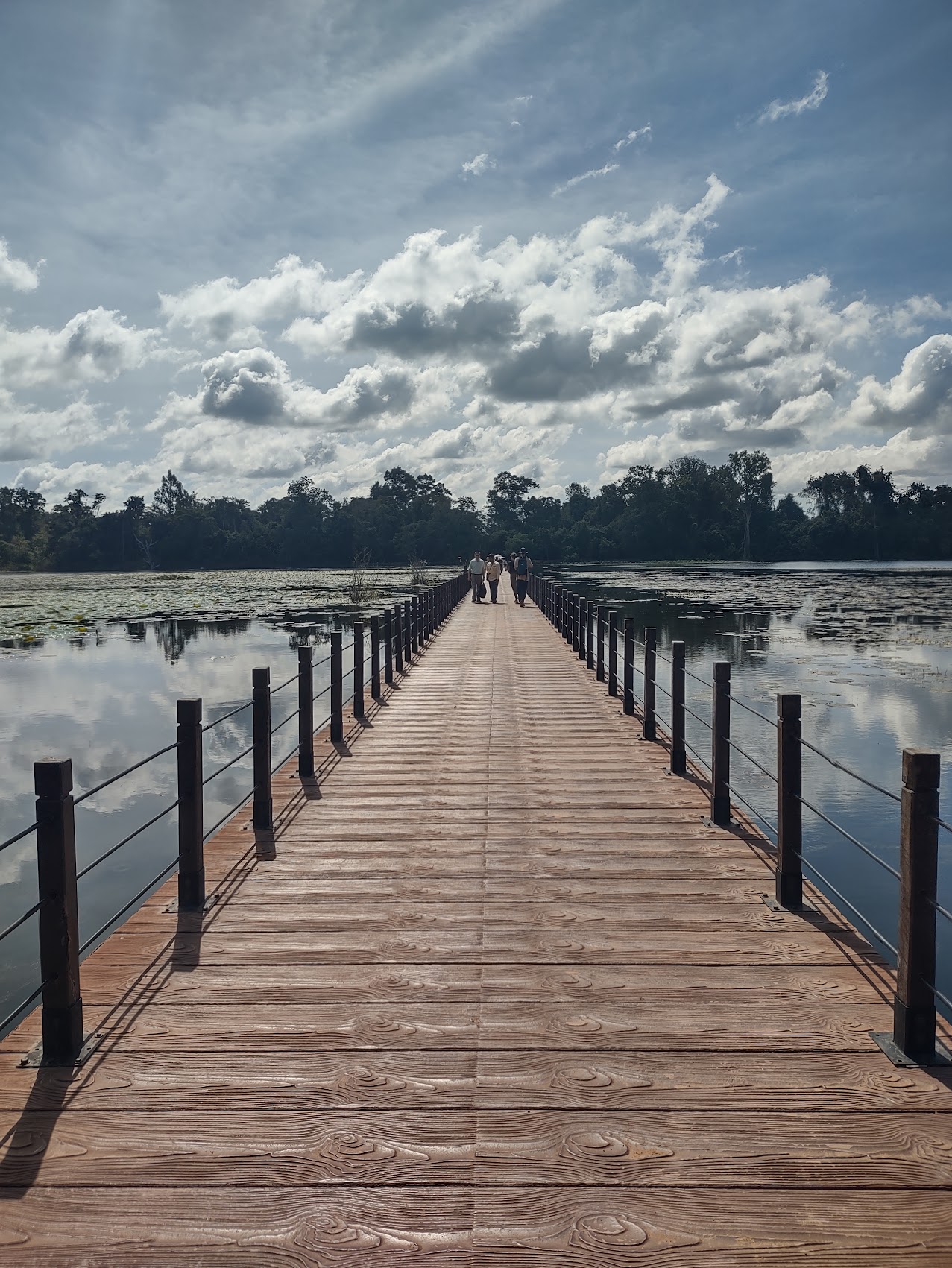
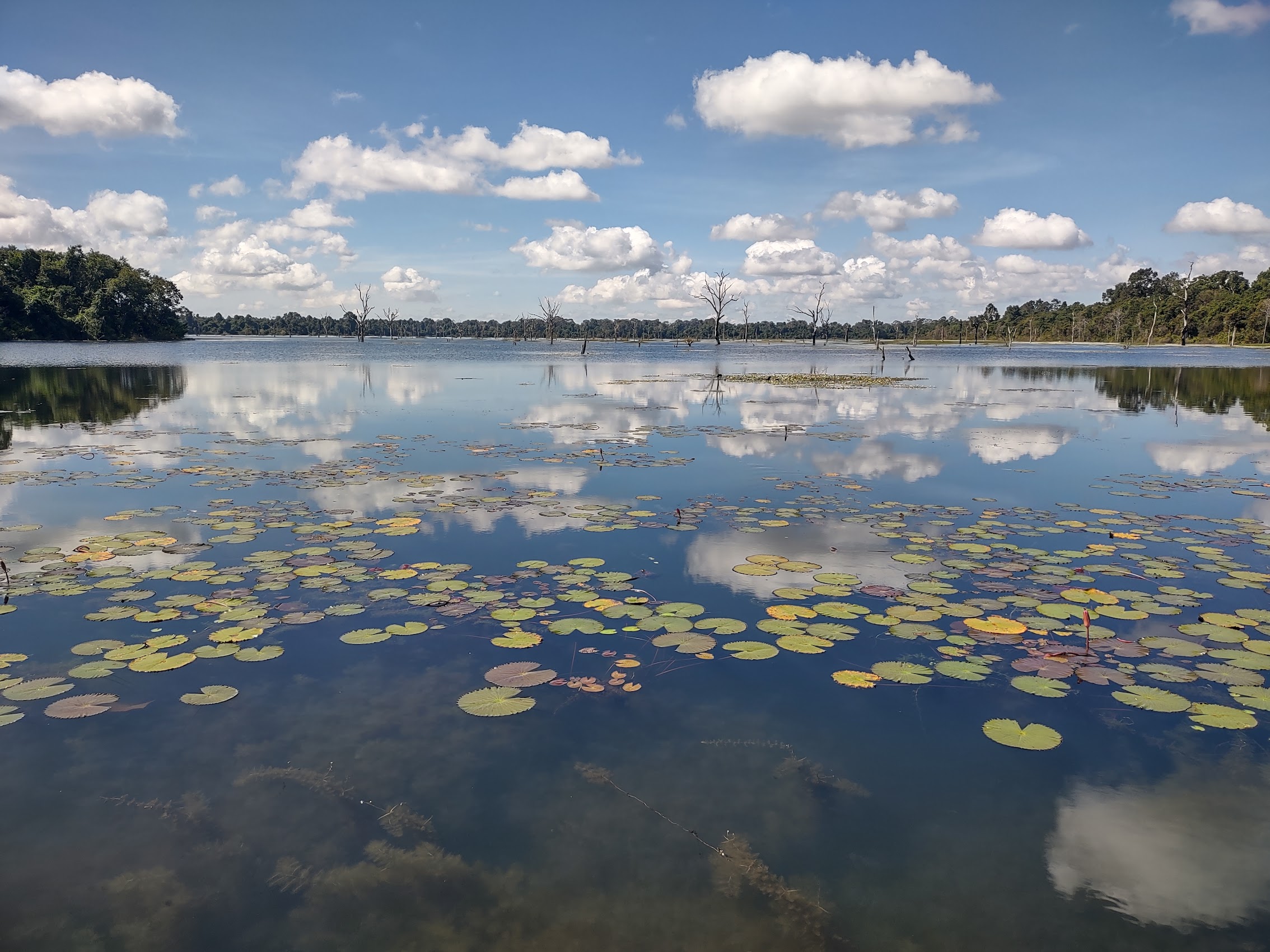
Our next stop was Prasat Preah Neak Poan, another Buddhist temple constructed under the patronage of King Jayavarman VII in the late 12th century. The Preah Neak temple is located on an island constructed in the center of a very large man-made lake which has been restored in recent years. The central sanctuary is reached by a long bridge which spans the lake and is itself located within a pond surrounded by four smaller ponds representing the mythical four great rivers flowing from the Himalayan mountains, the end result of all this being a particularly tranquil and serene site.

Our last stop of the morning (now afternoon) was the Prasat Preah Khan, a large temple complex built in the 12th century for King Jayavarman VII to honor his father. The temple complex combined the roles of city, temple and Buddhist university and is believed to have housed 100,000 attendants and servants, including 1000 dancers and 1000 teachers.
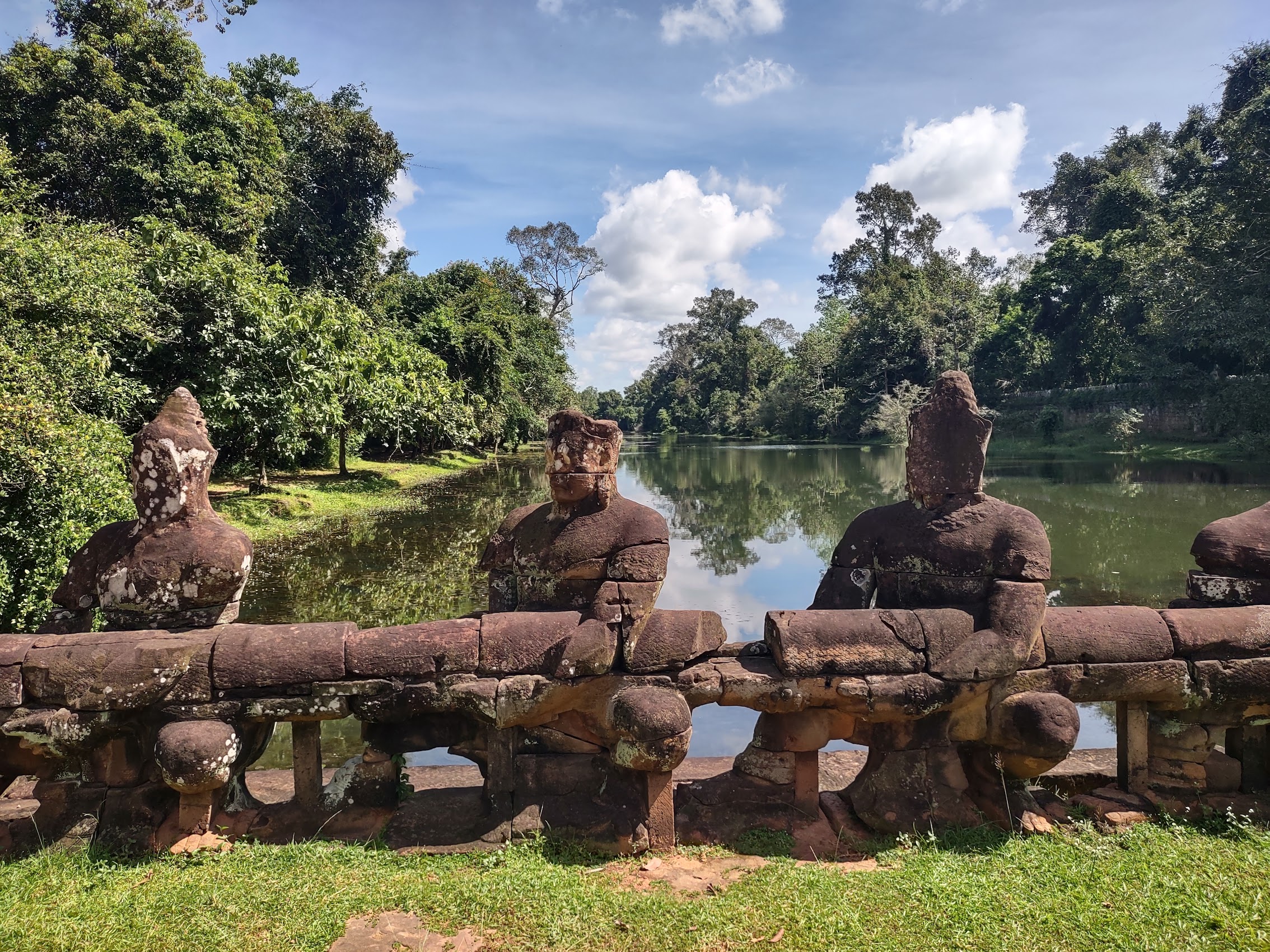
The temple has four entrances (East, West, North, and South) each of which is reached by a bridge across its moat which is lined with a series of deities grappling with a demon snake.

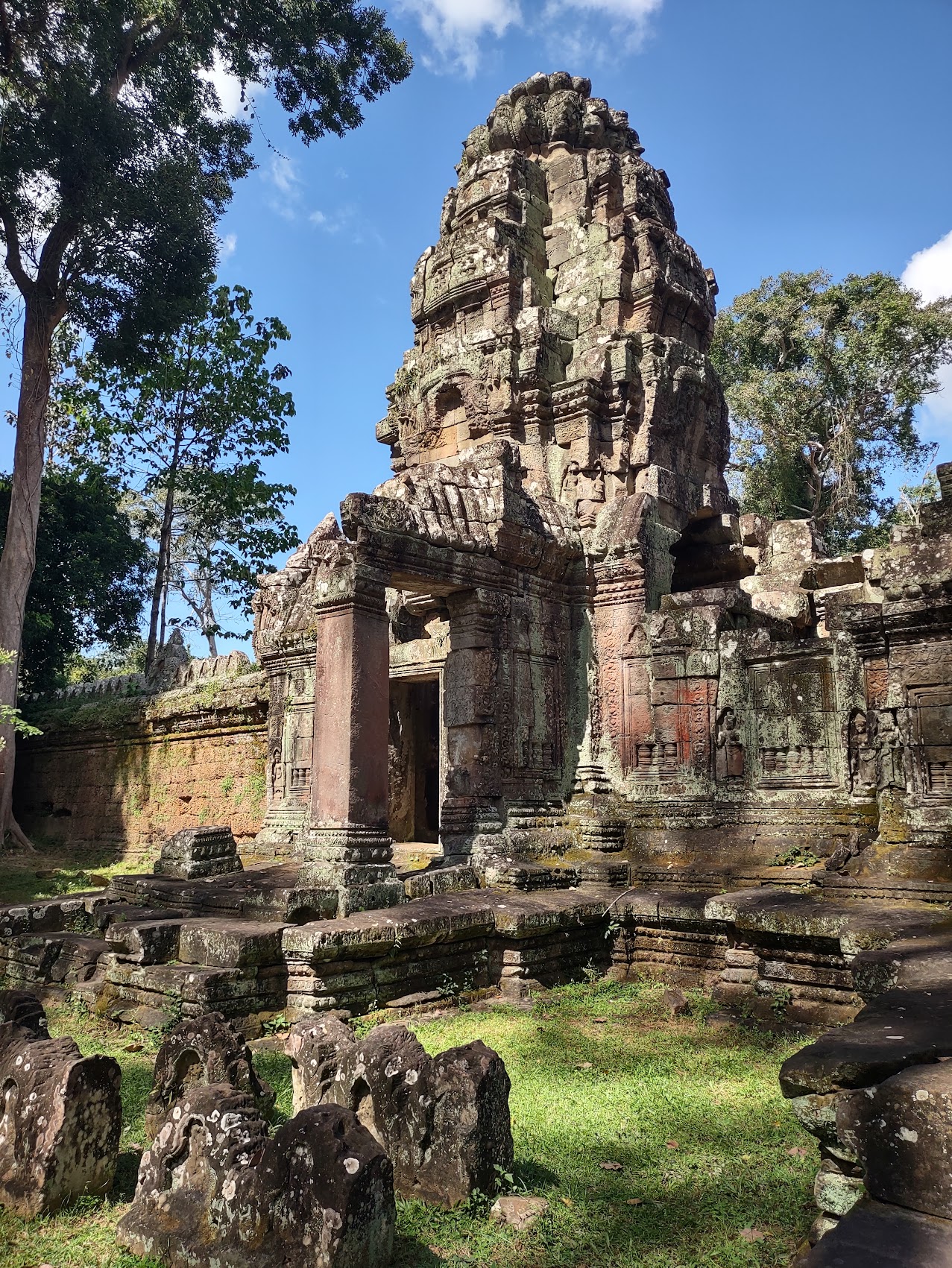
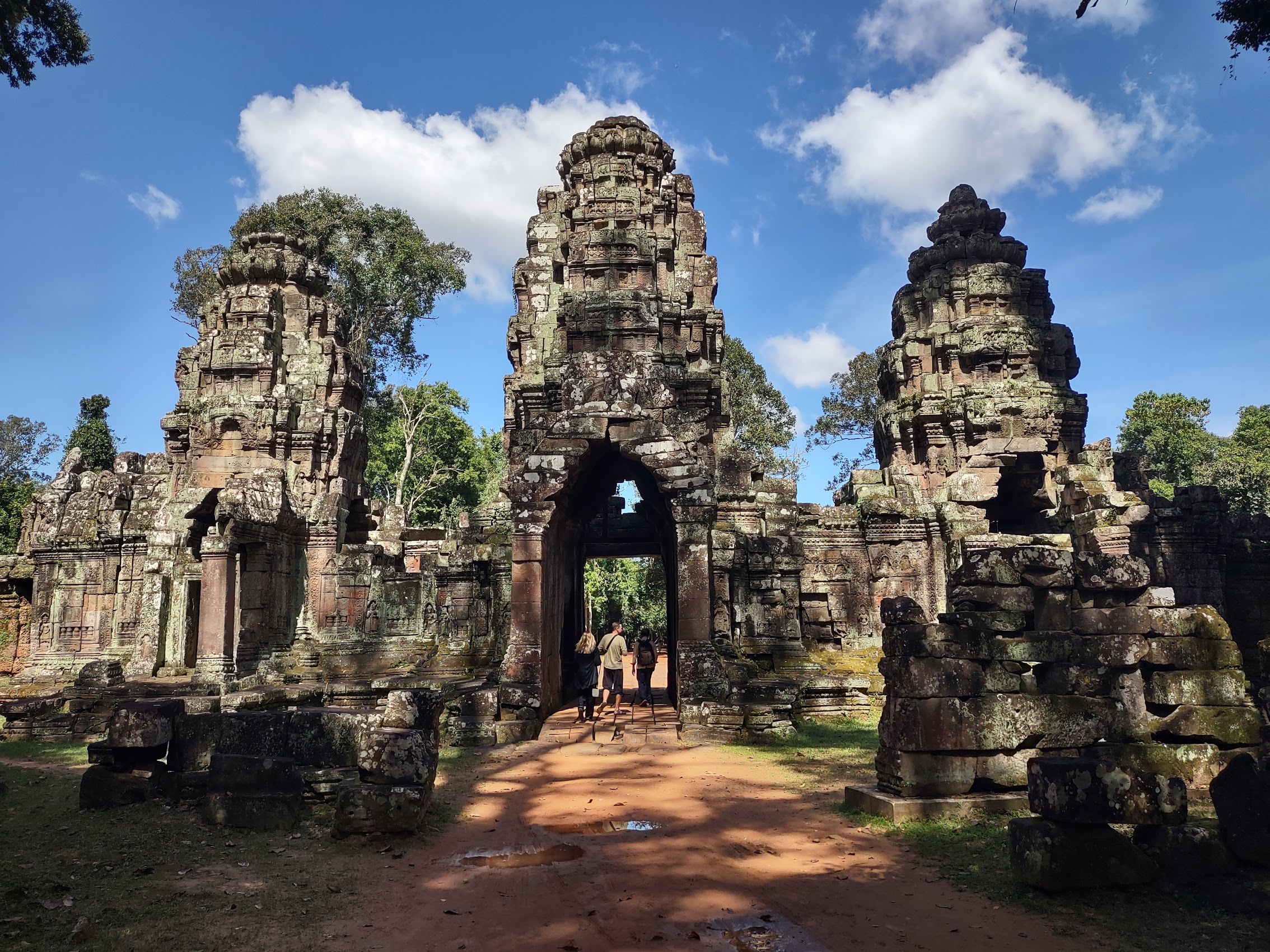
The temple is flat in design, with a basic plan of four successive rectangular galleries around a Buddhist sanctuary surrounded by Hindu satellite temples and numerous later additions. Like the nearby Ta Prohm, Preah Khan has been left largely unrestored, with numerous trees and other vegetation growing among the ruins. Since 1991, the site has been maintained by the World Monuments Fund. It has continued the cautious approach to restoration, believing that to go further would involve too much guesswork, and prefers to respect the ruined nature of the temple.
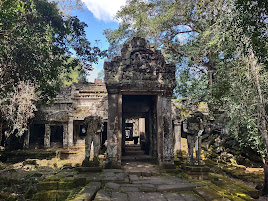
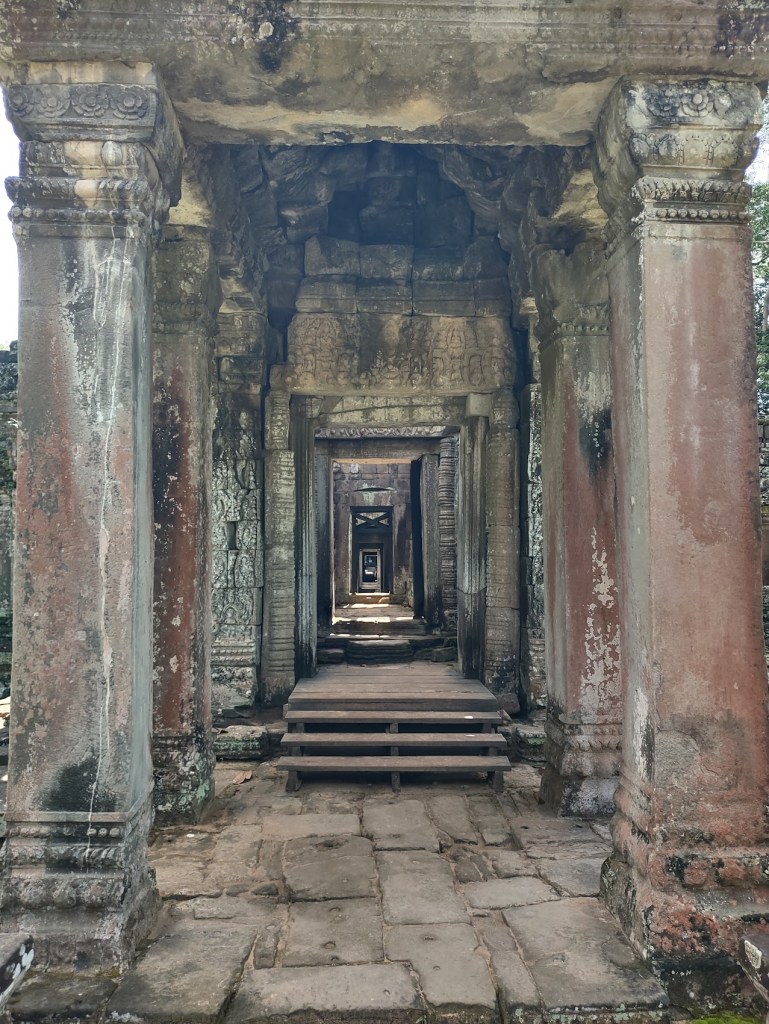
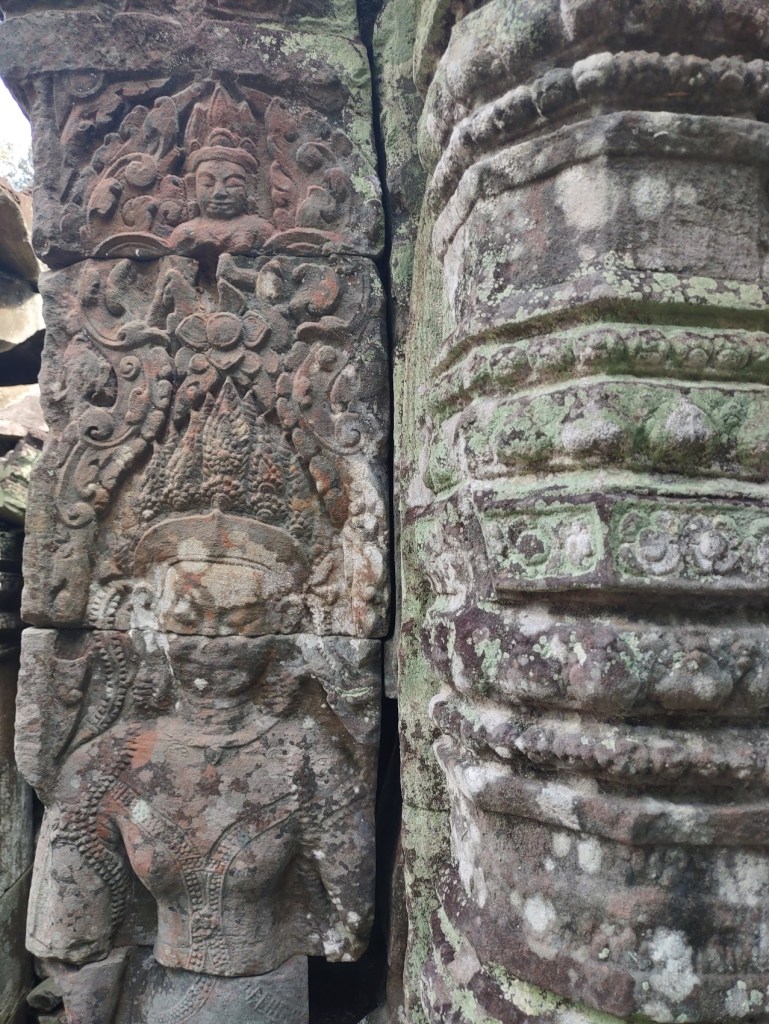
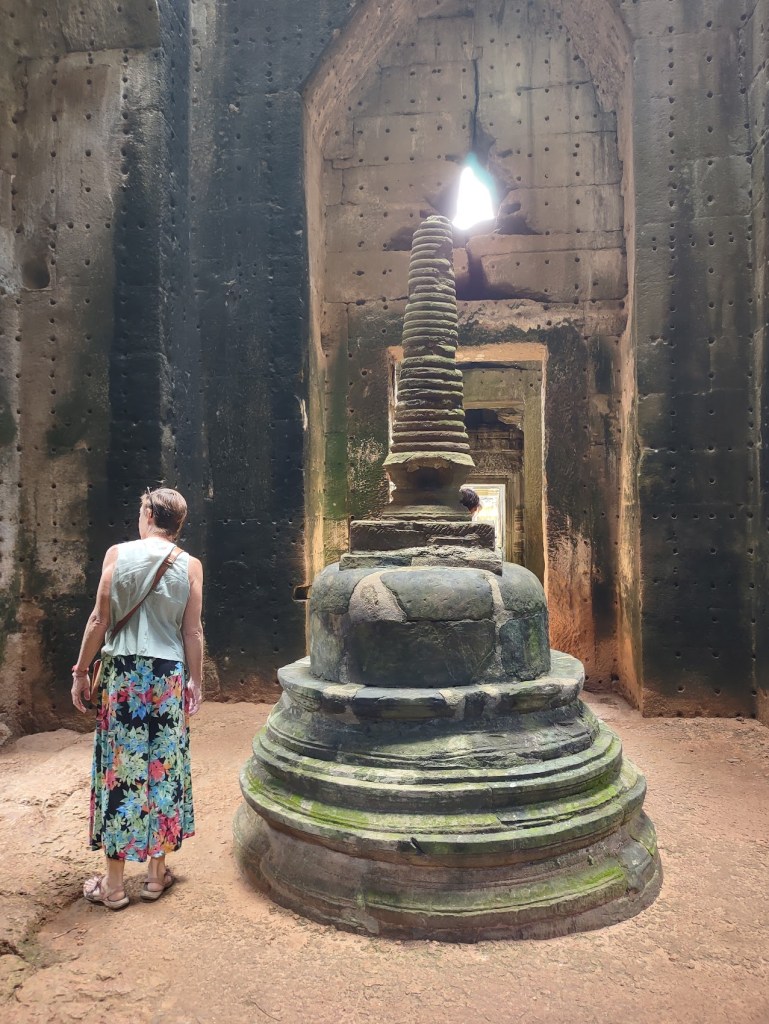


On the way home, we stopped at a very cool shop we had spotted on our way to the Park called the Fair Trade Village. They had some beautiful handicrafts as well as demonstrations of traditional weaving and pottery making.
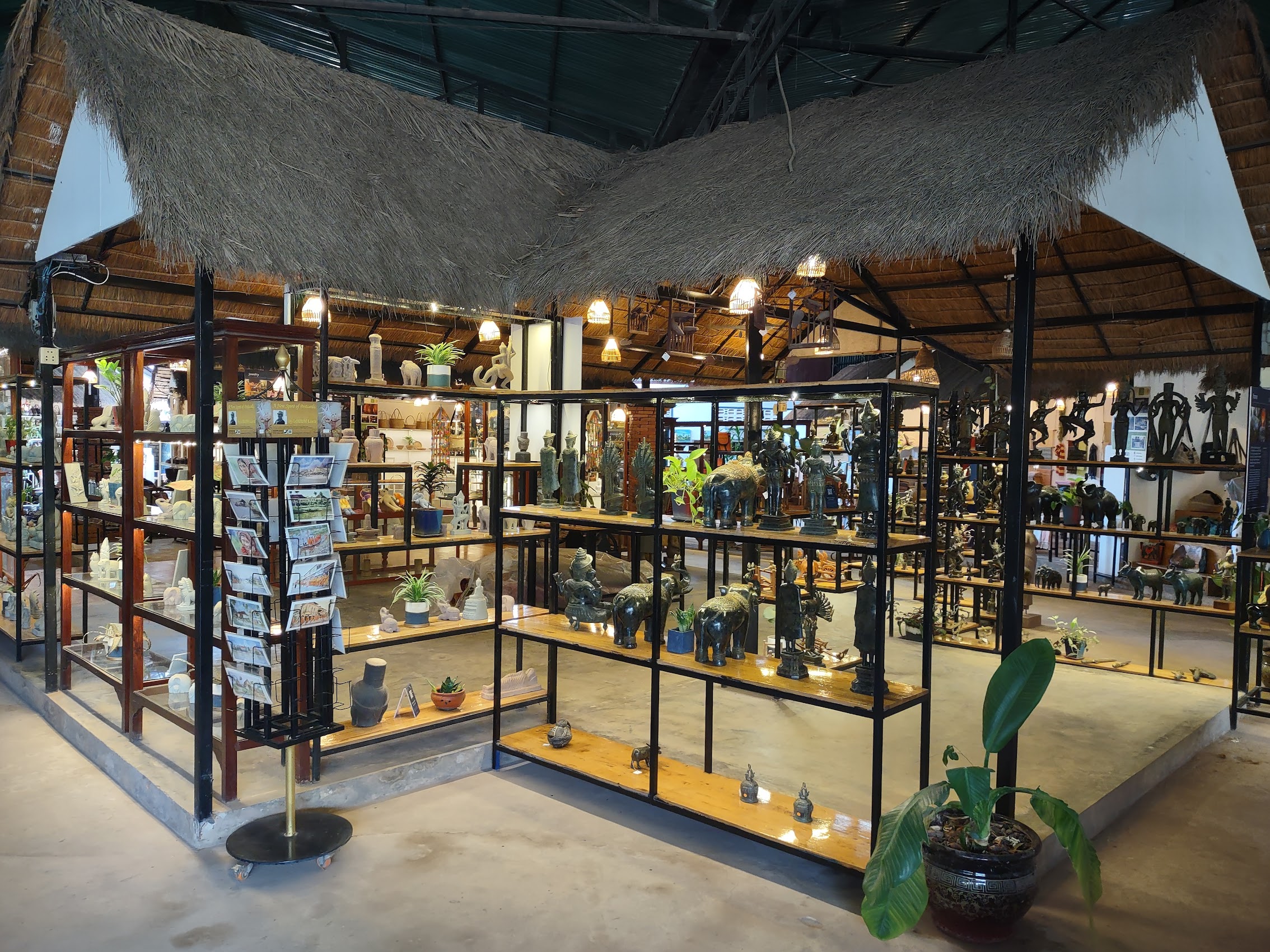

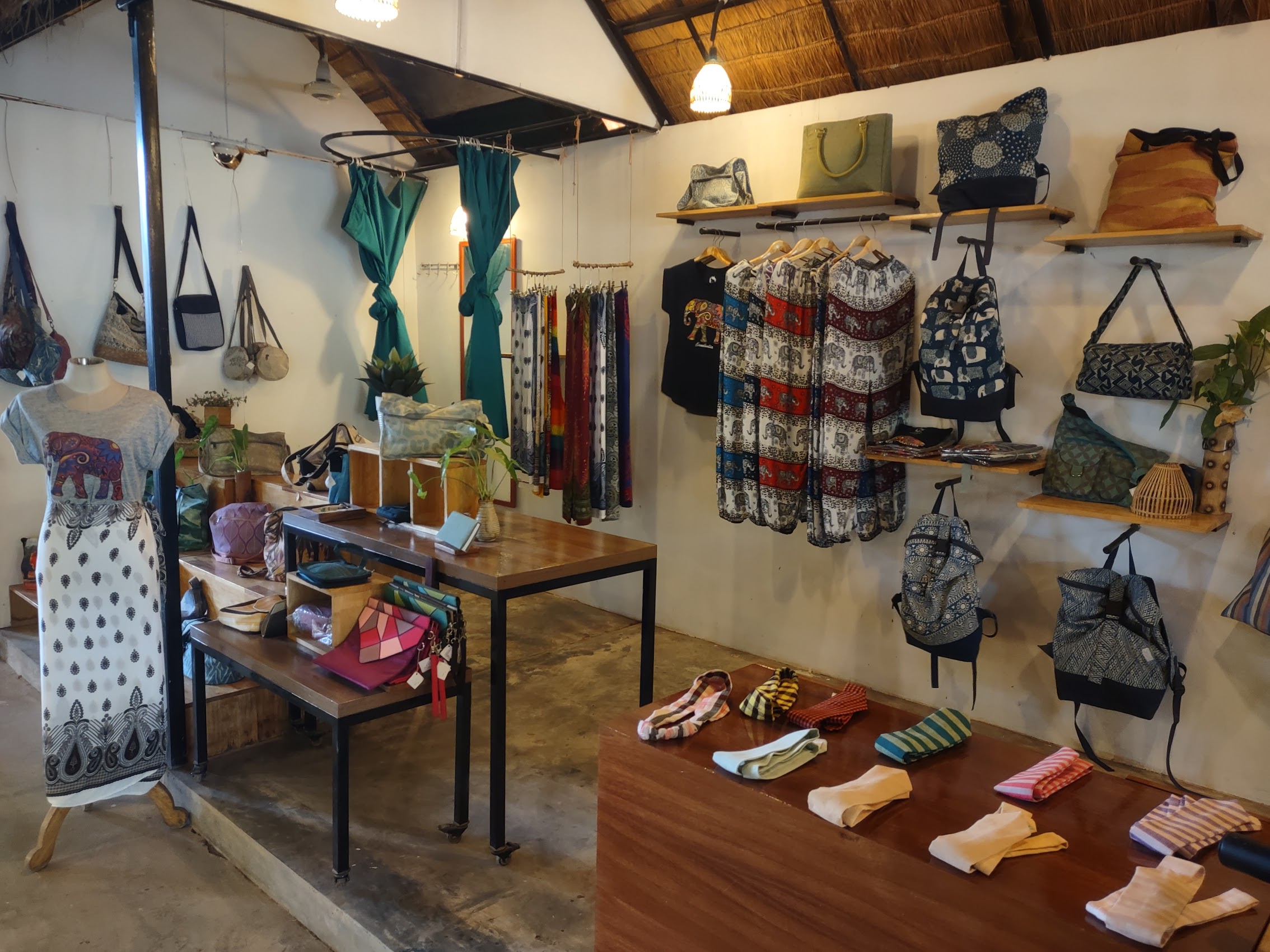
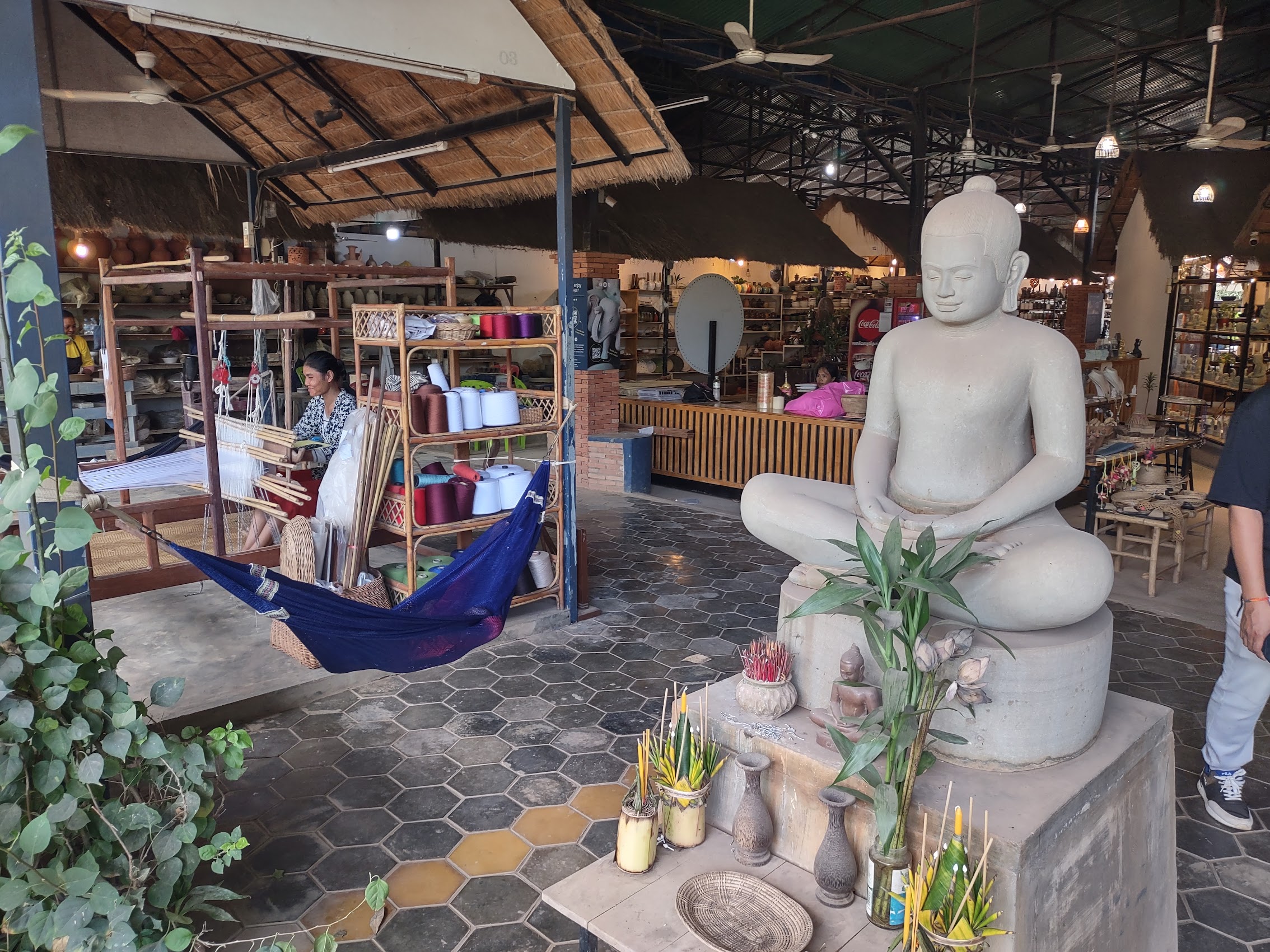
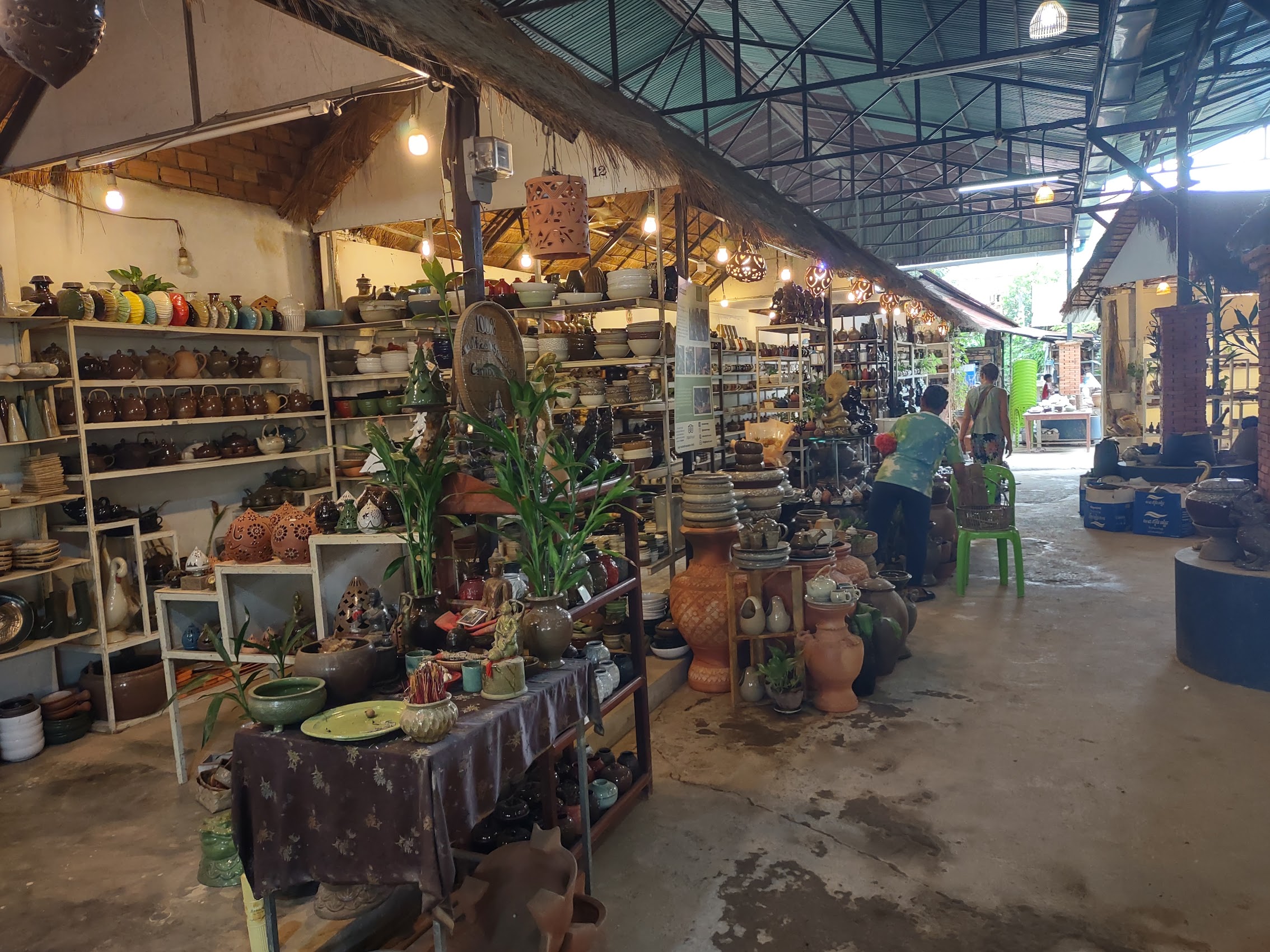
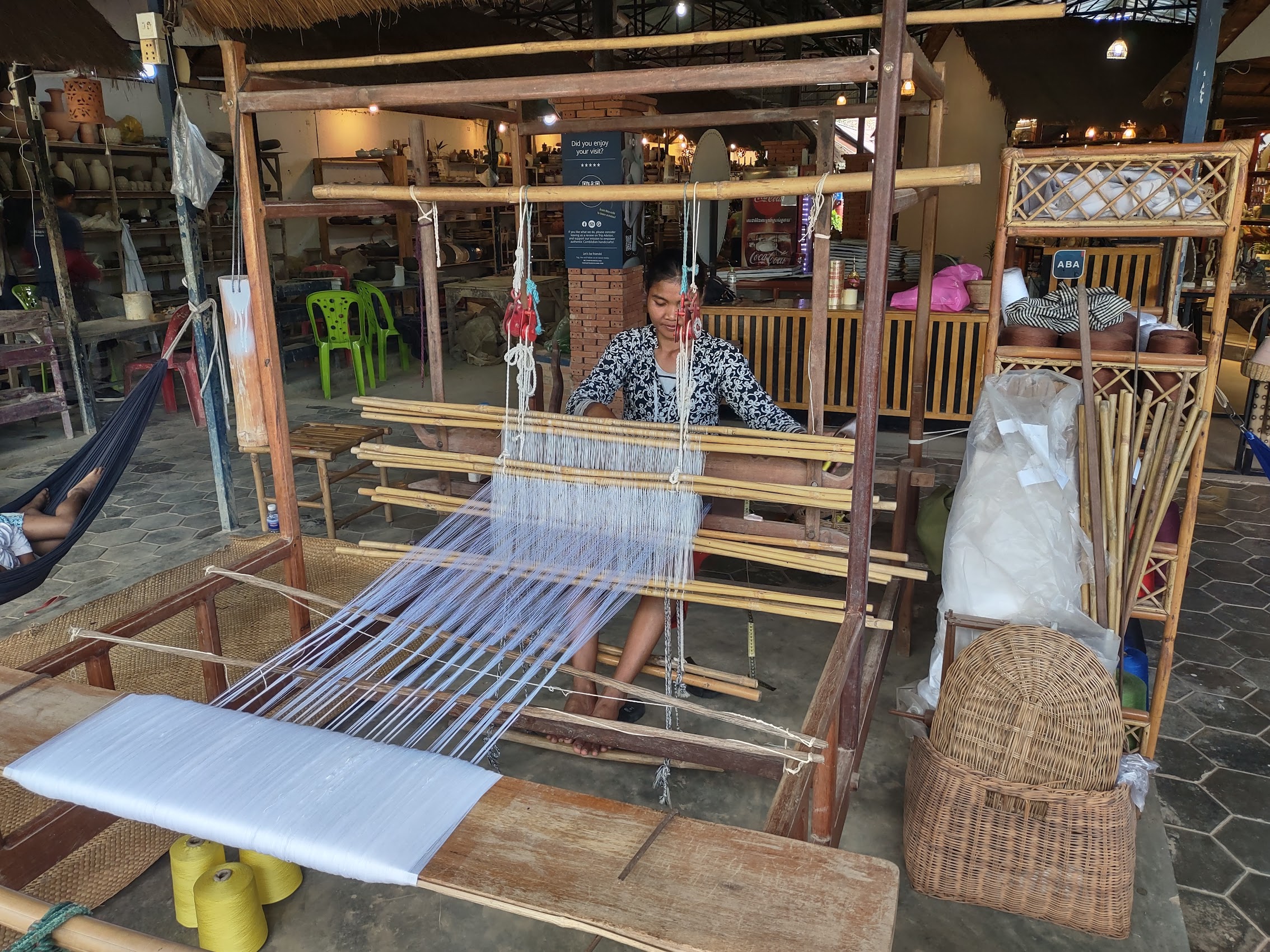
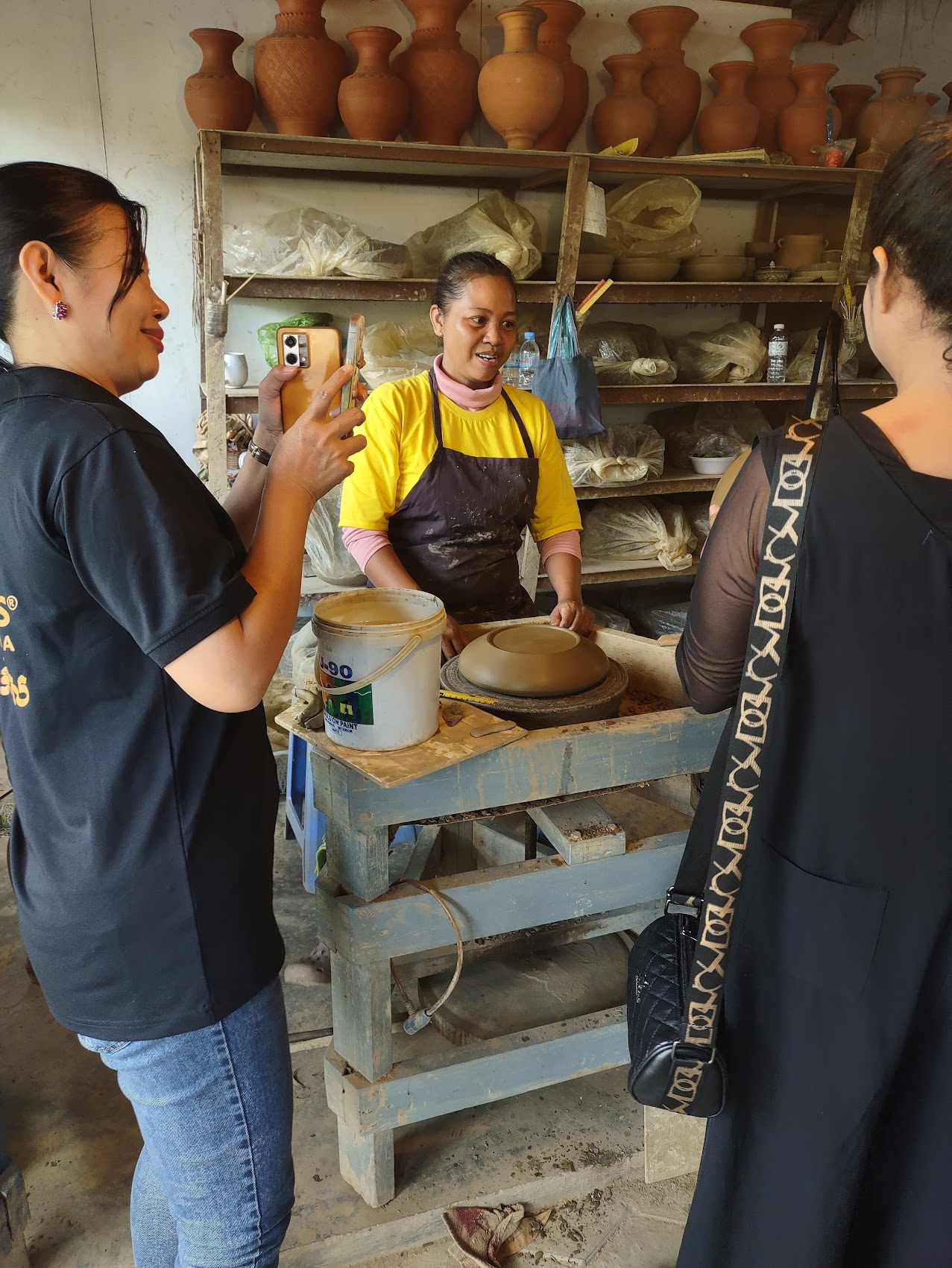
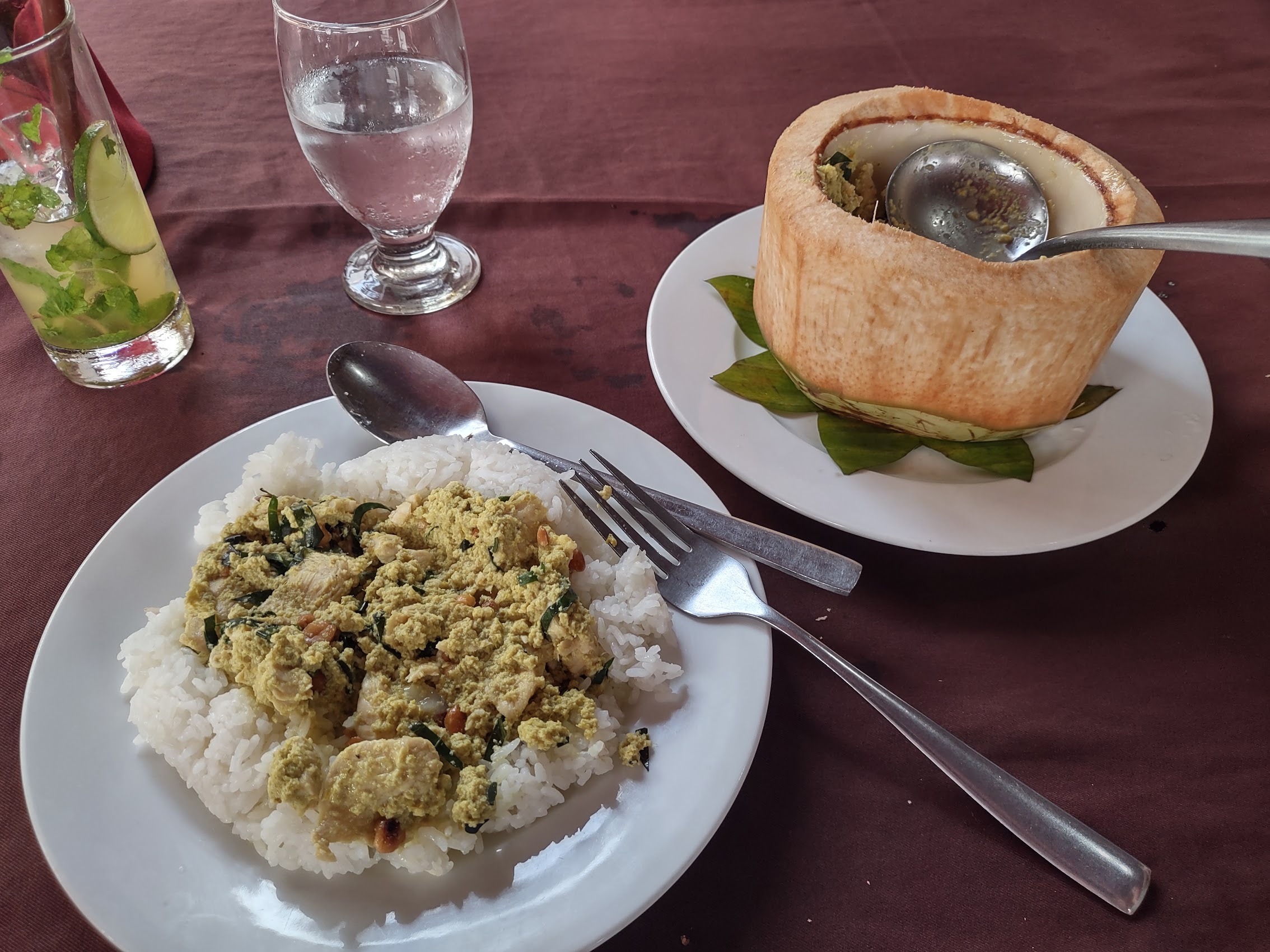
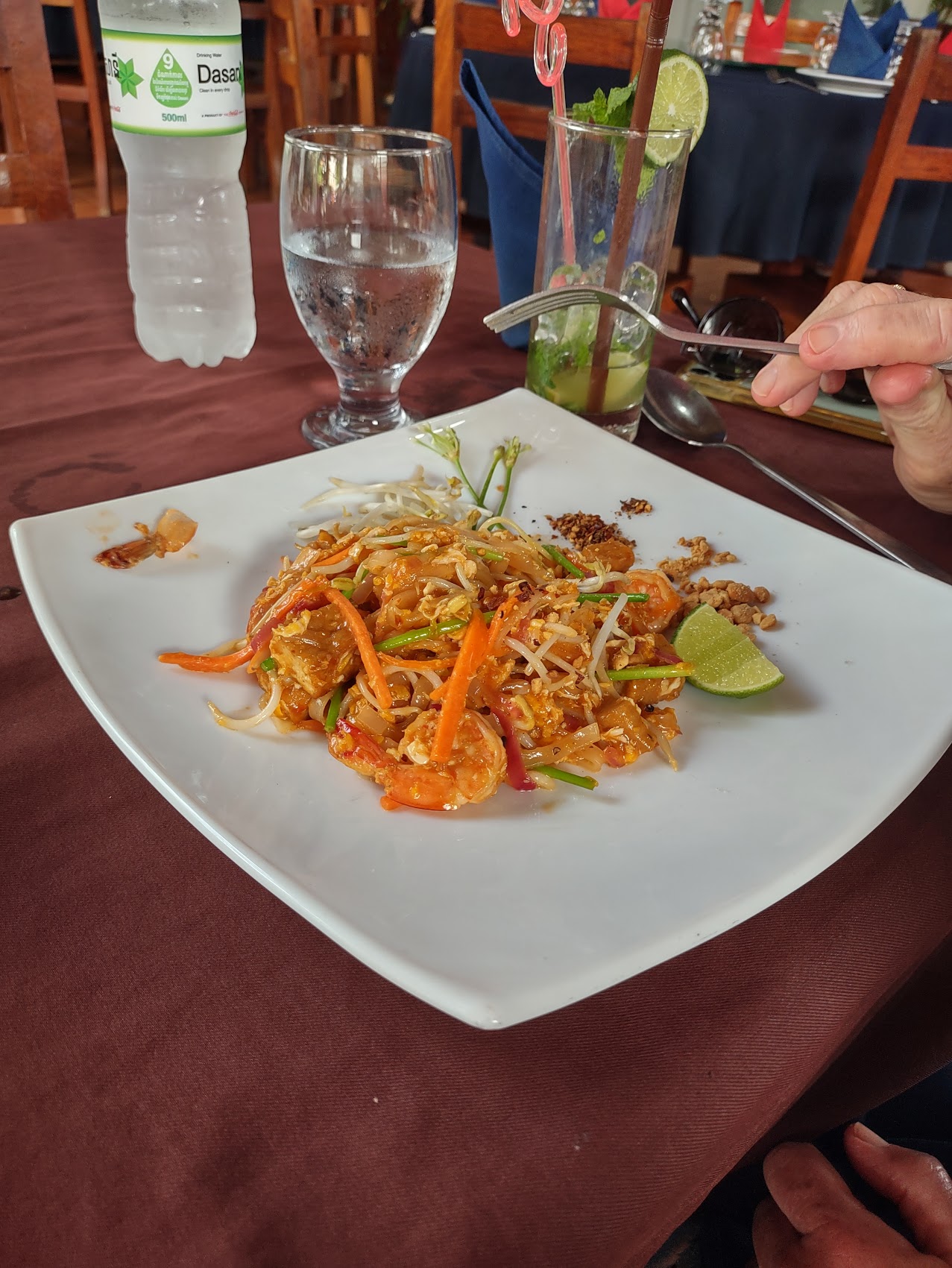
After that we stopped for a quick lunch of prawns and a delicious coconut chicken curry and then headed home for a very brief siesta.

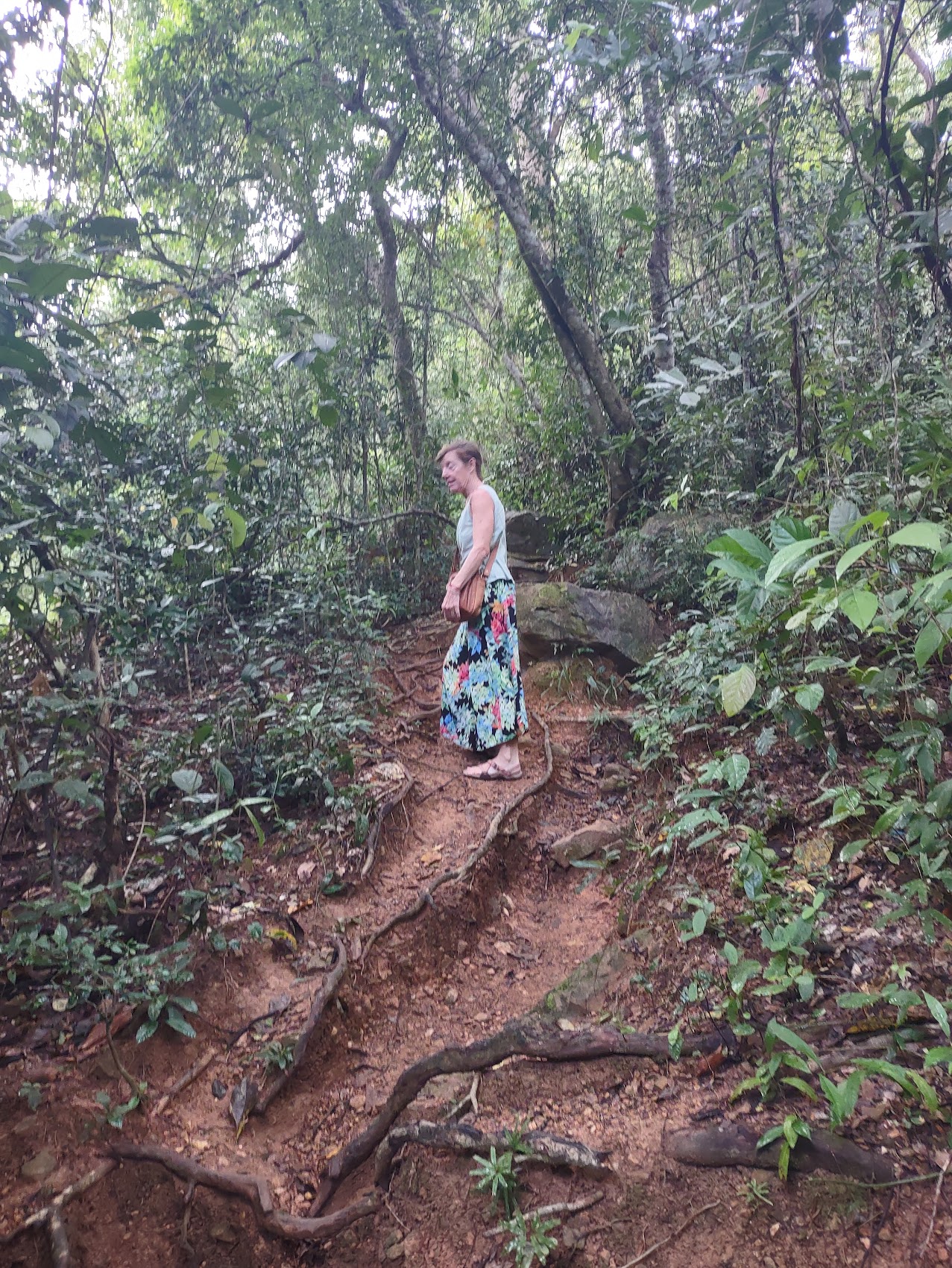
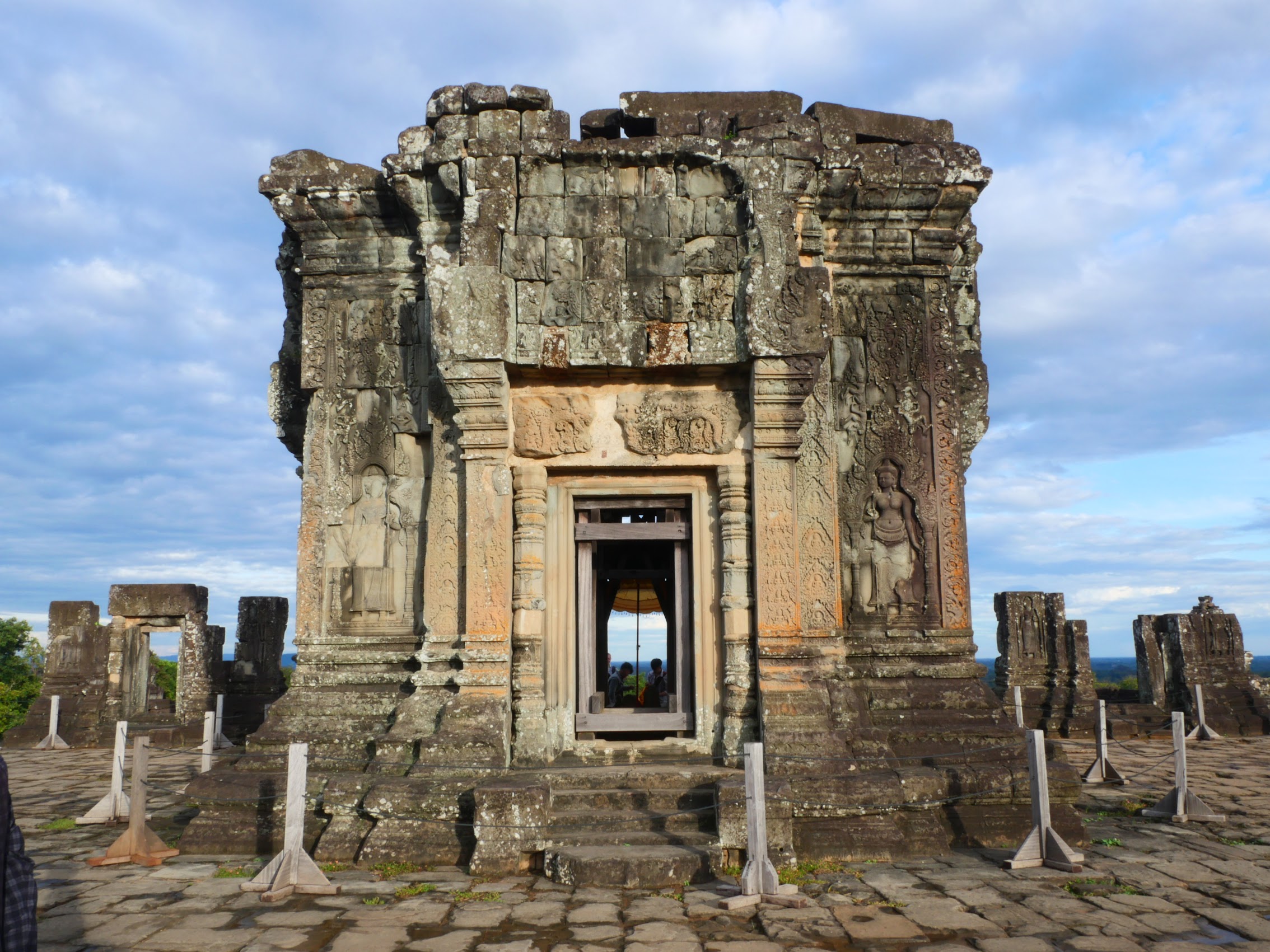
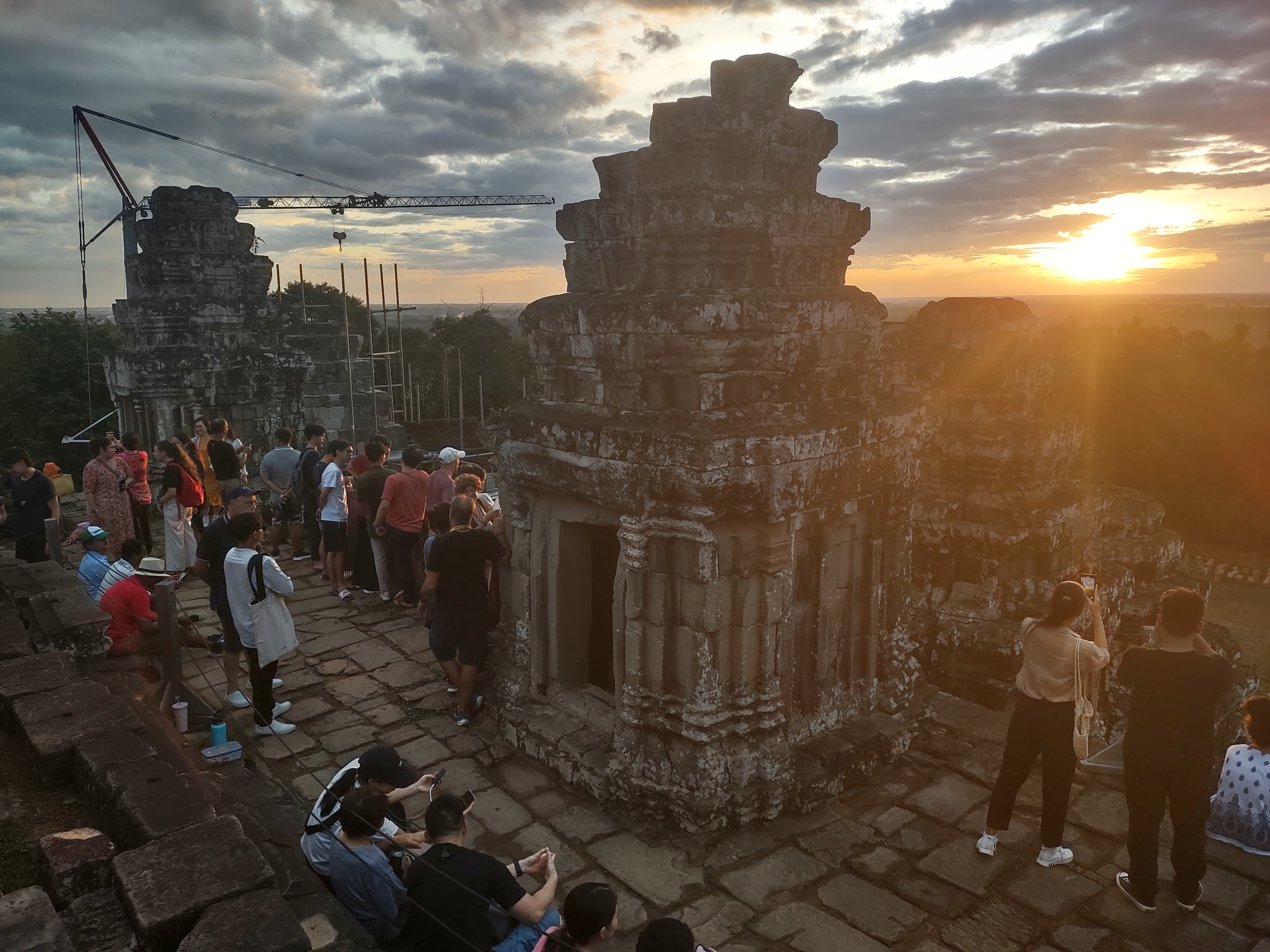
We returned to the Park around 4:00 PM to watch the sunset from the Phnom Bakheng, a 9th century Hindu temple built at the top of a large hill. At the base of the hill, there were two paths up and, when we asked what the difference between them was, we were told “This one easy but long, that one hard but short”. Colleen pressed for the shorter route and, when I noted that we had plenty of time, she more or less called my a baby. It turned out to be a bit of a climb (particularly with some “short cuts” thrown in), but we did make it to the top quickly. From its top, Phnom Bekheng provides views of the surrounding Park, including a glimpse the Angkor Wat temple to the south which we would be visiting the next morning.

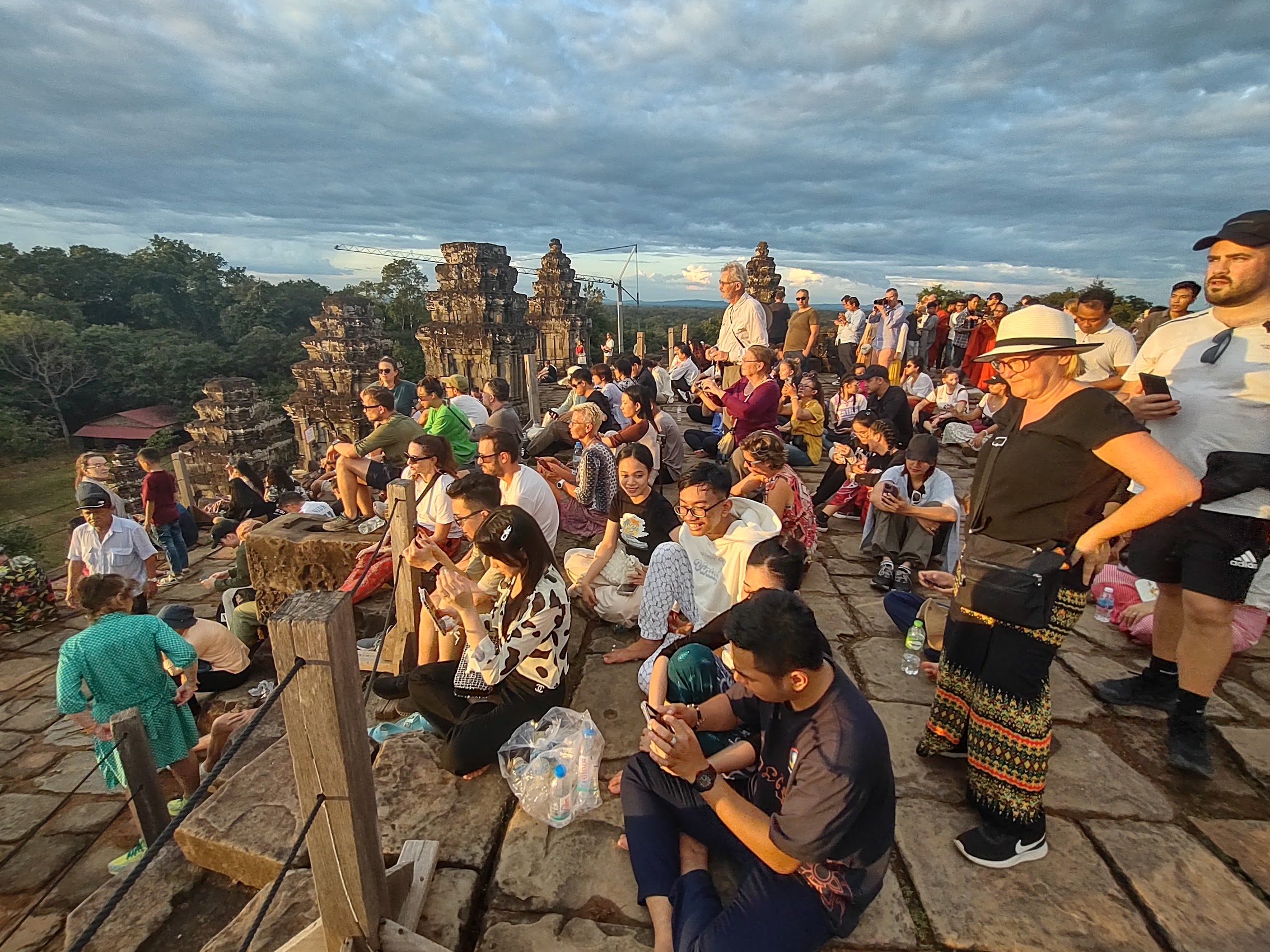
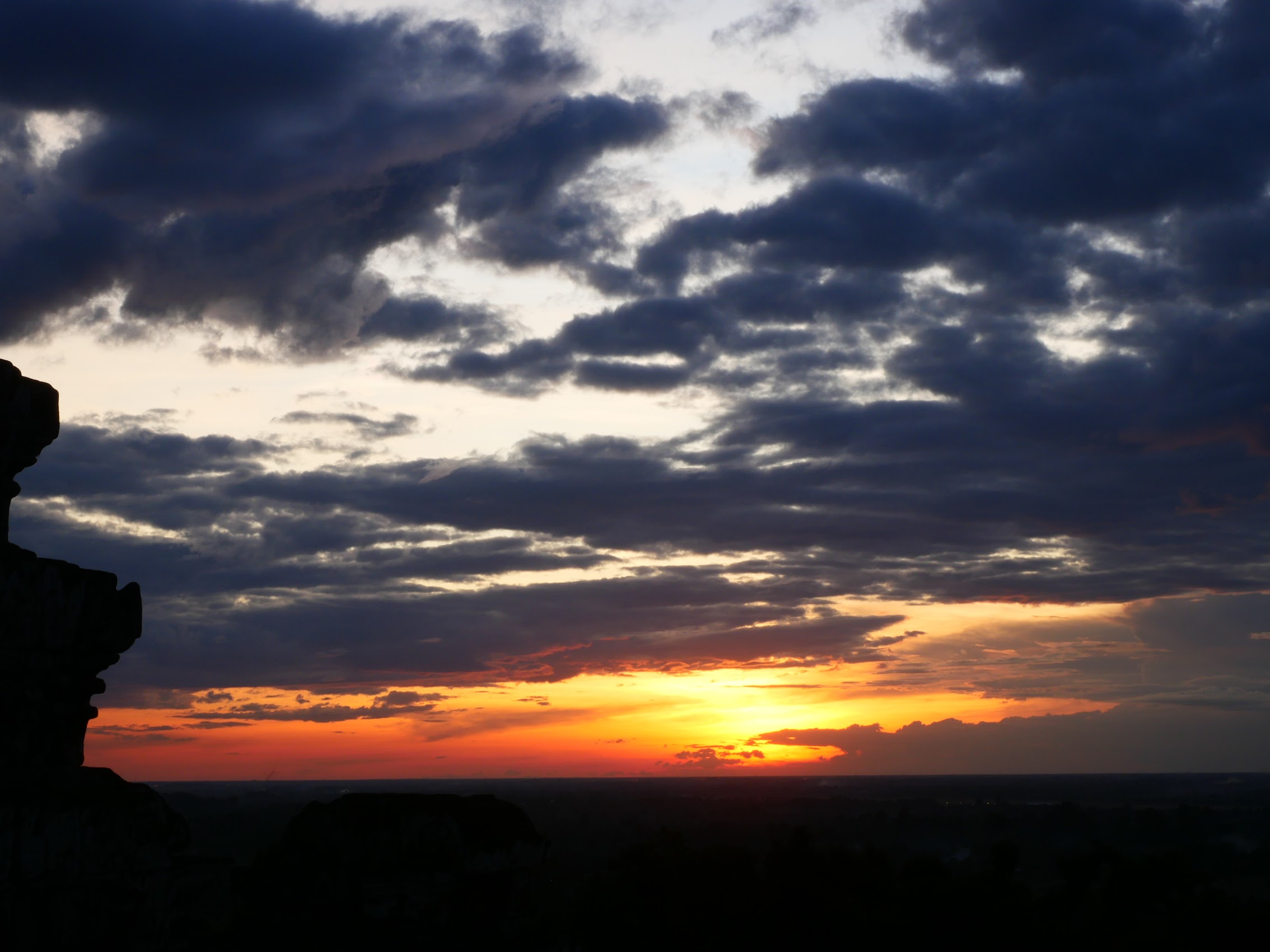
As sunset grew nearer, it got a bit crowded at the top of the temple (standing room only for those who showed up later) and we were glad that Mr. Black had brought us early which allowed us to get a front row seat. The sunset was nice, though not spectacular, but still a pretty nice way to finish our first day in Angkor.


Another Day in the Park
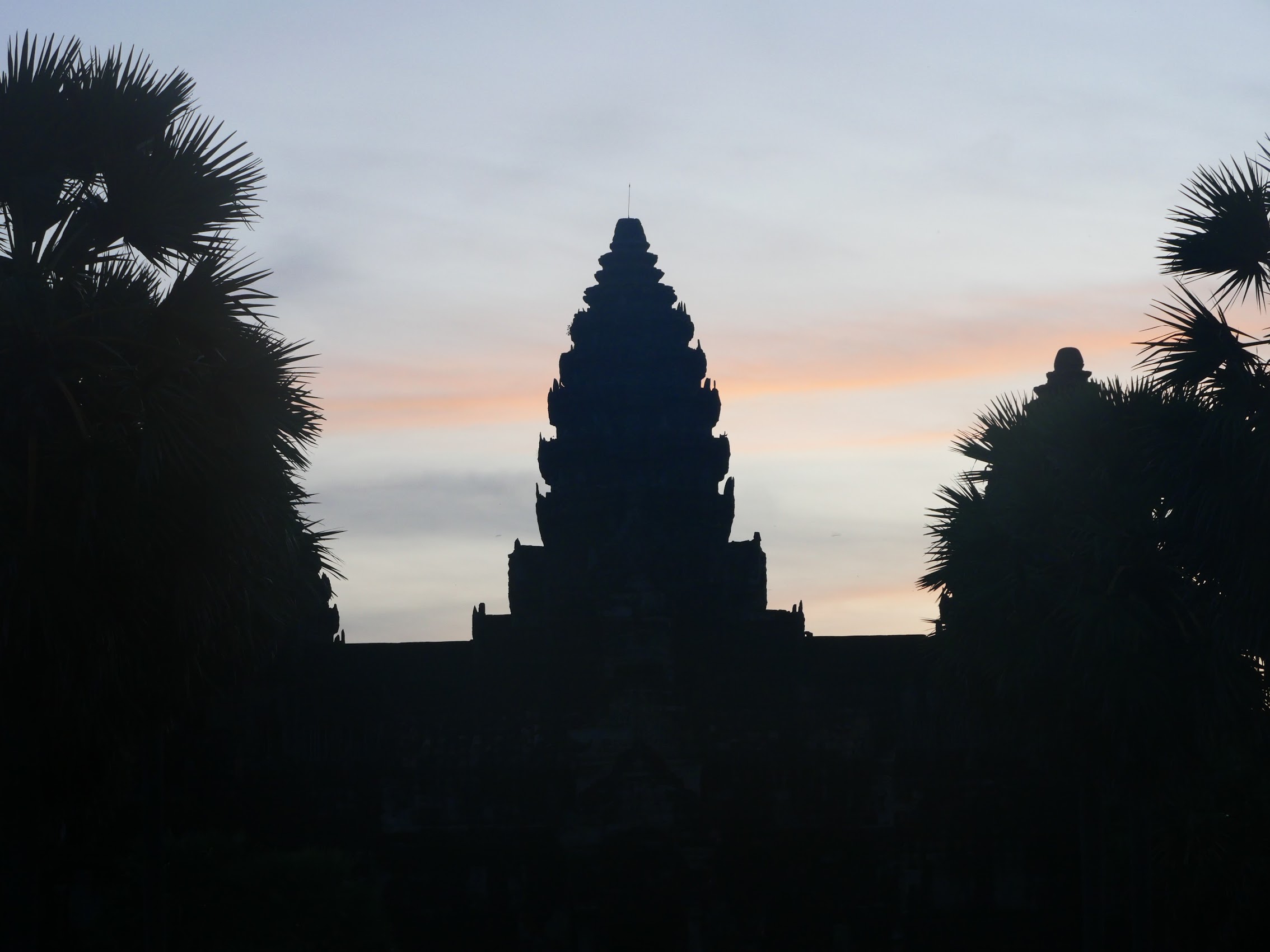
Our second day in Angkor began quite early with a 4:40 AM pick-up and we made our way back to the Park in the dark actually feeling a bit cold in the back of Mr. Black’s tuk tuk. We were dropped off near what he referred to as the “back entrance” of Angkor Wat and, armed with some less than clear directions from Mr. Black, we wandered off into the dark and eventually crossed a bridge over a large moat and found ourselves in front of the Angor Wat Temple, the familiar silhouette of which was now appearing as the sky began to lighten in the east. Like the sunset the night before, it was not the best sunrise we had ever seen, but it was pretty awesome to see the Angkor Wat temple up close for the first time this way.
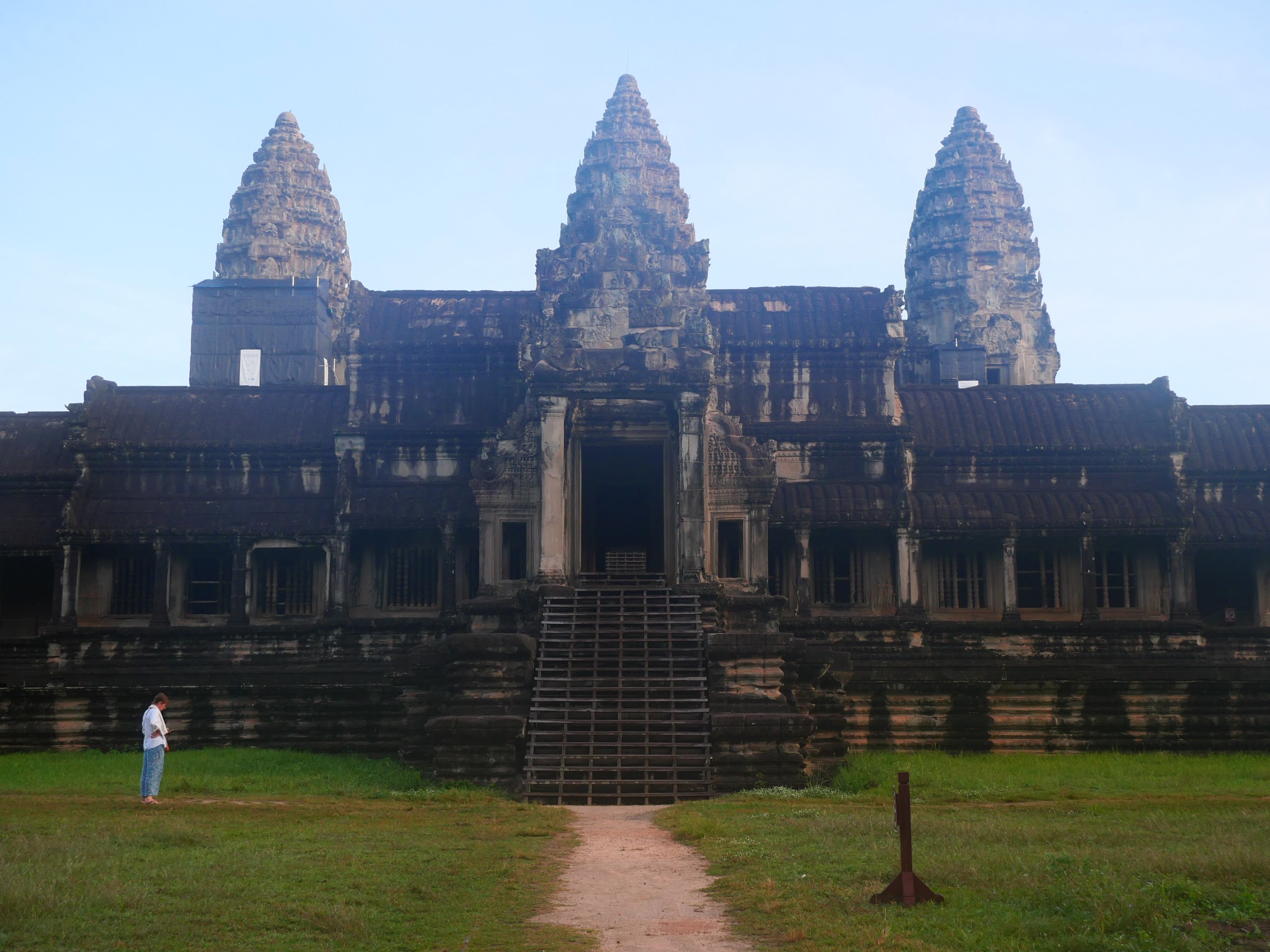
The Angkor Wat temple was built in the early 12th century by King Suryavarman II, initially as a Hindu temple dedicated to the god Vishnu, but towards the end of the 12th century, it transformed into a Buddhist site. Perhaps because of its prominence and historic significance, the temple was in markedly better condition than the ones we had visited the day before, but I think what surprised us most was the size and scale of this place (the area within the outer moat of Angkor Wat is over 400 acres).
The iconic five towers at the center of the temple were beautiful and impressive much like the towers of a gothic cathedral. (The tower over the central shrine rises to a height of 213 feet above the ground, just 13 feet less than the towers of Notre Dame in Paris.) These central towers are enclosed within two rectangular galleries and it was the outermost of these, an enormous colonnaded porch, over a kilometer long on each side, which perhaps most impressed us.
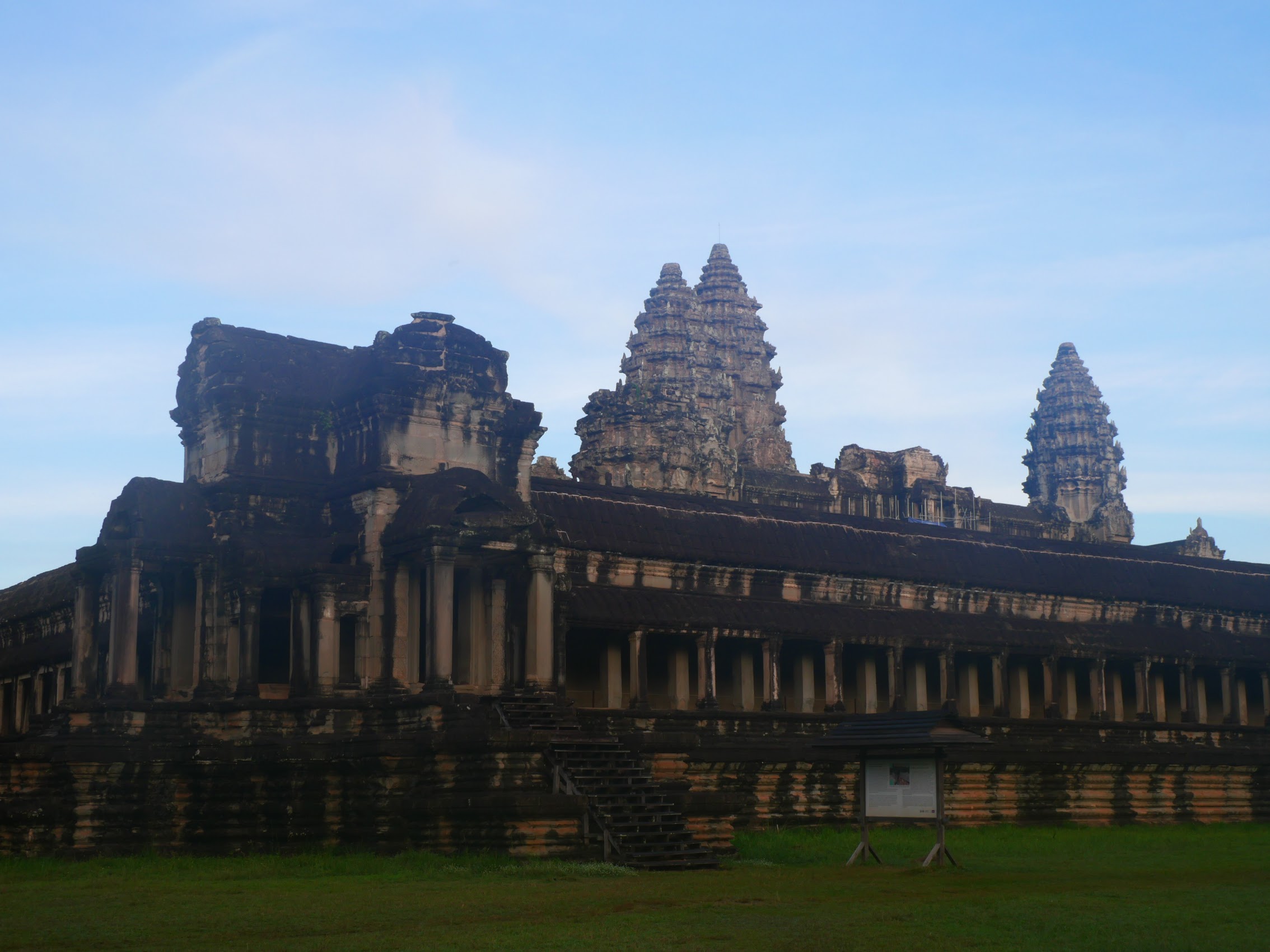
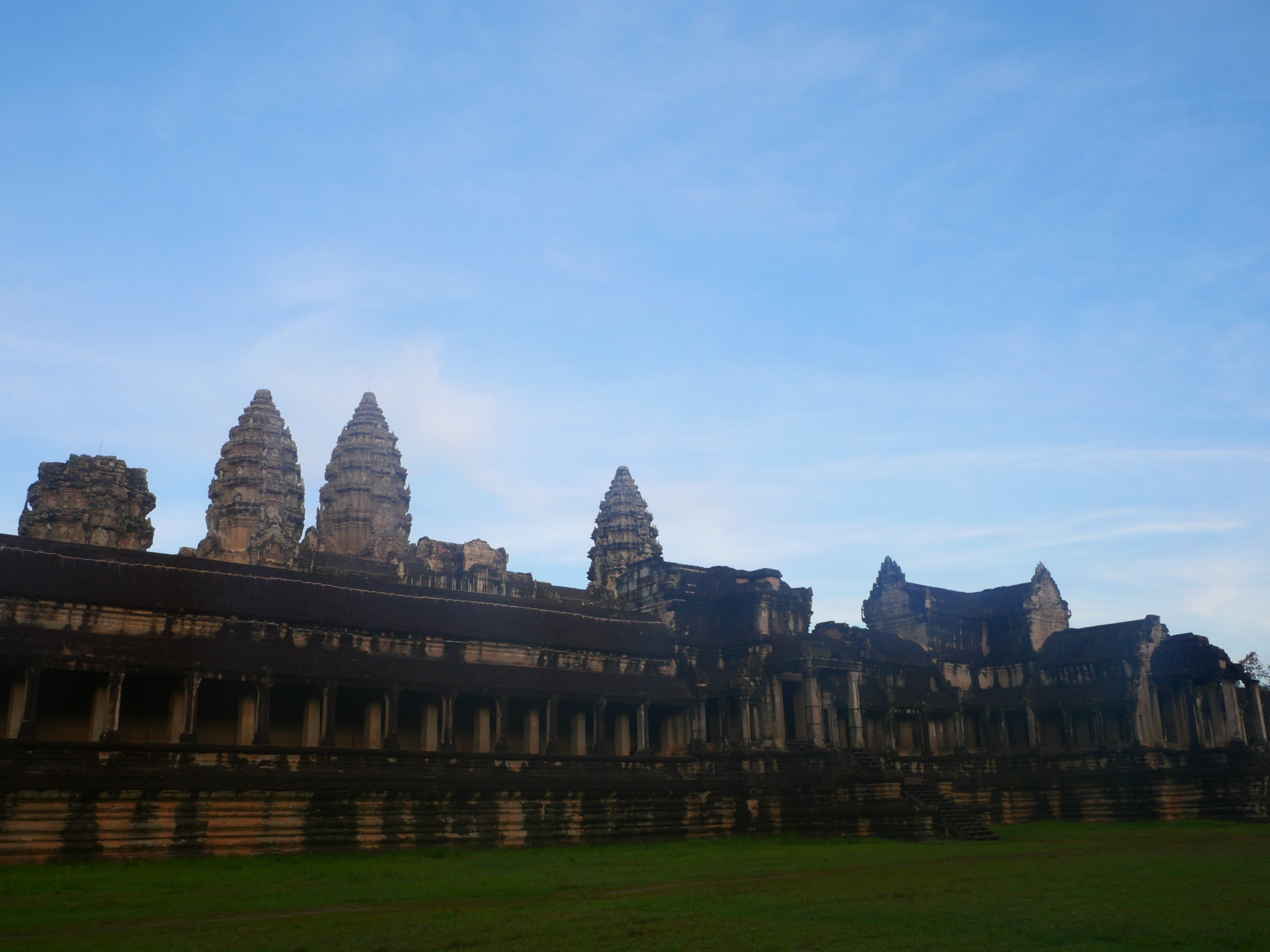

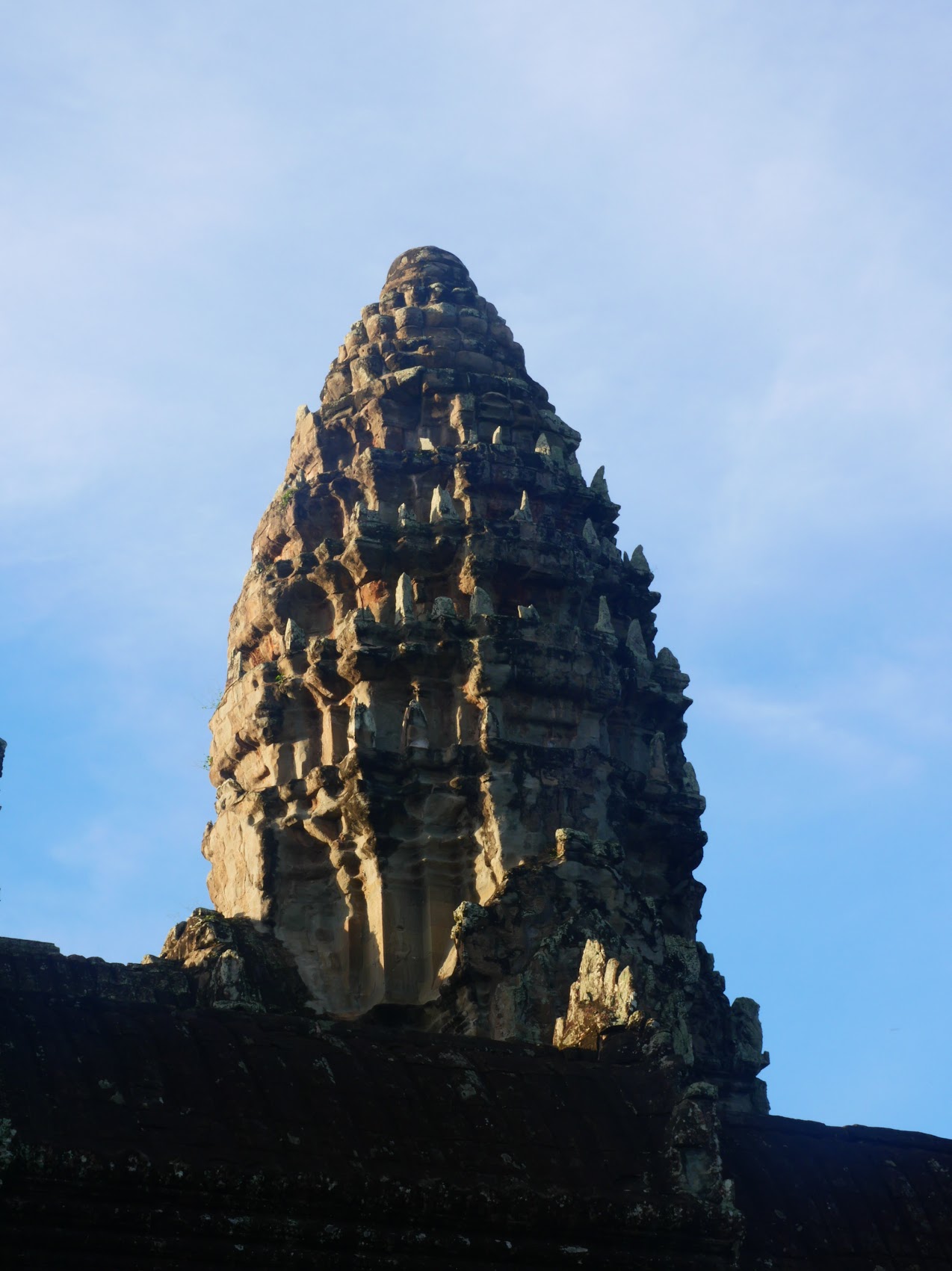
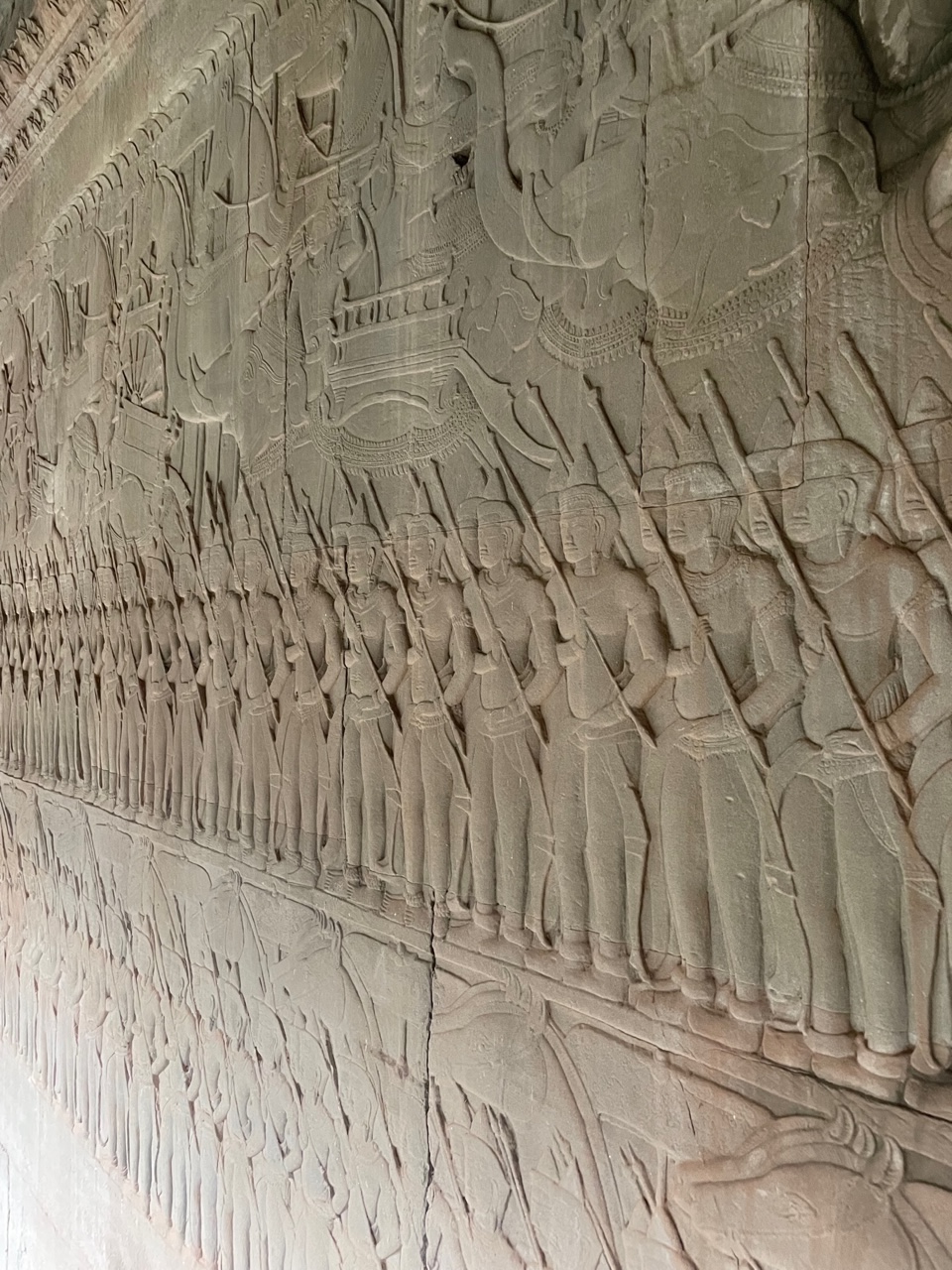
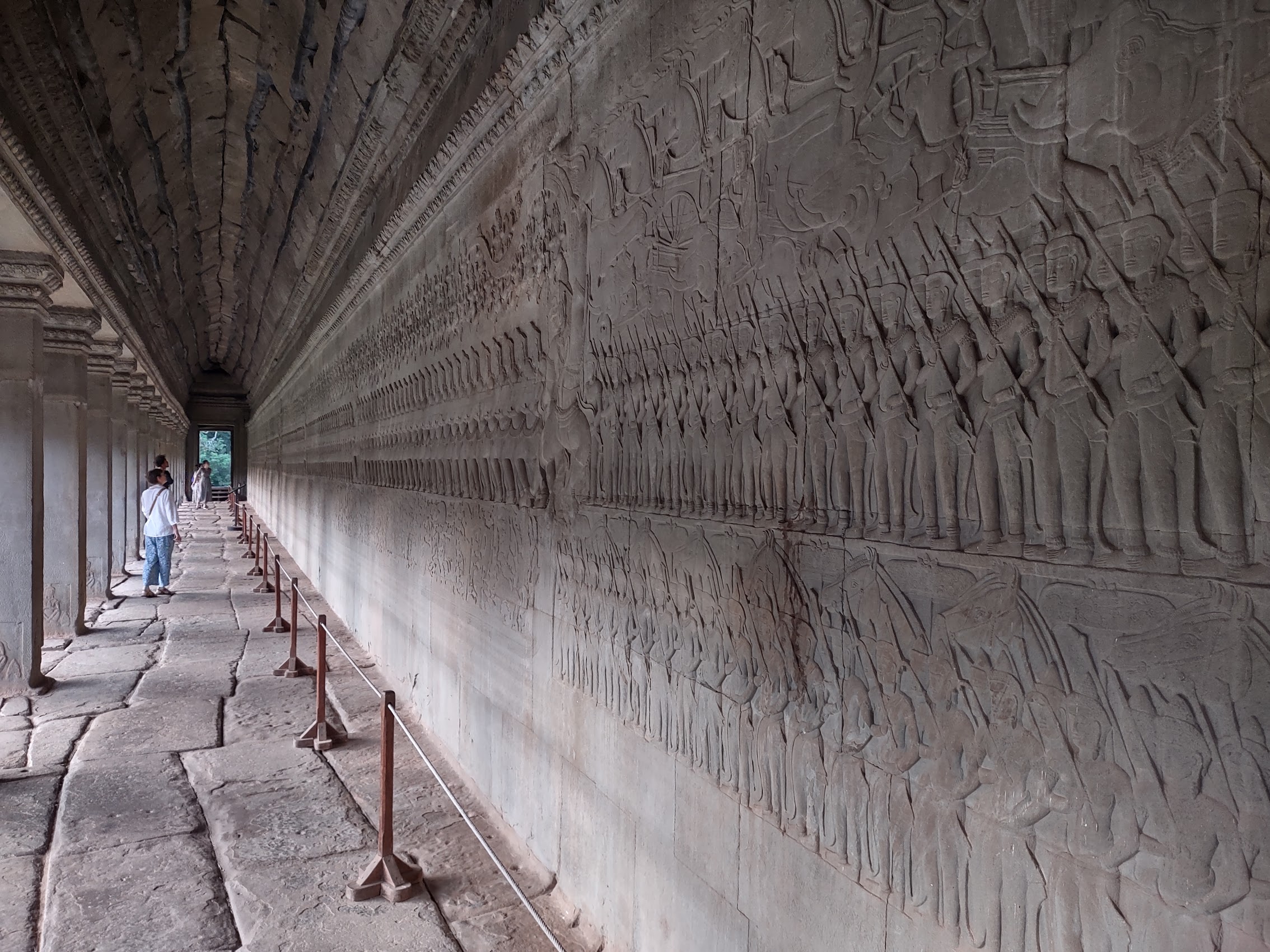
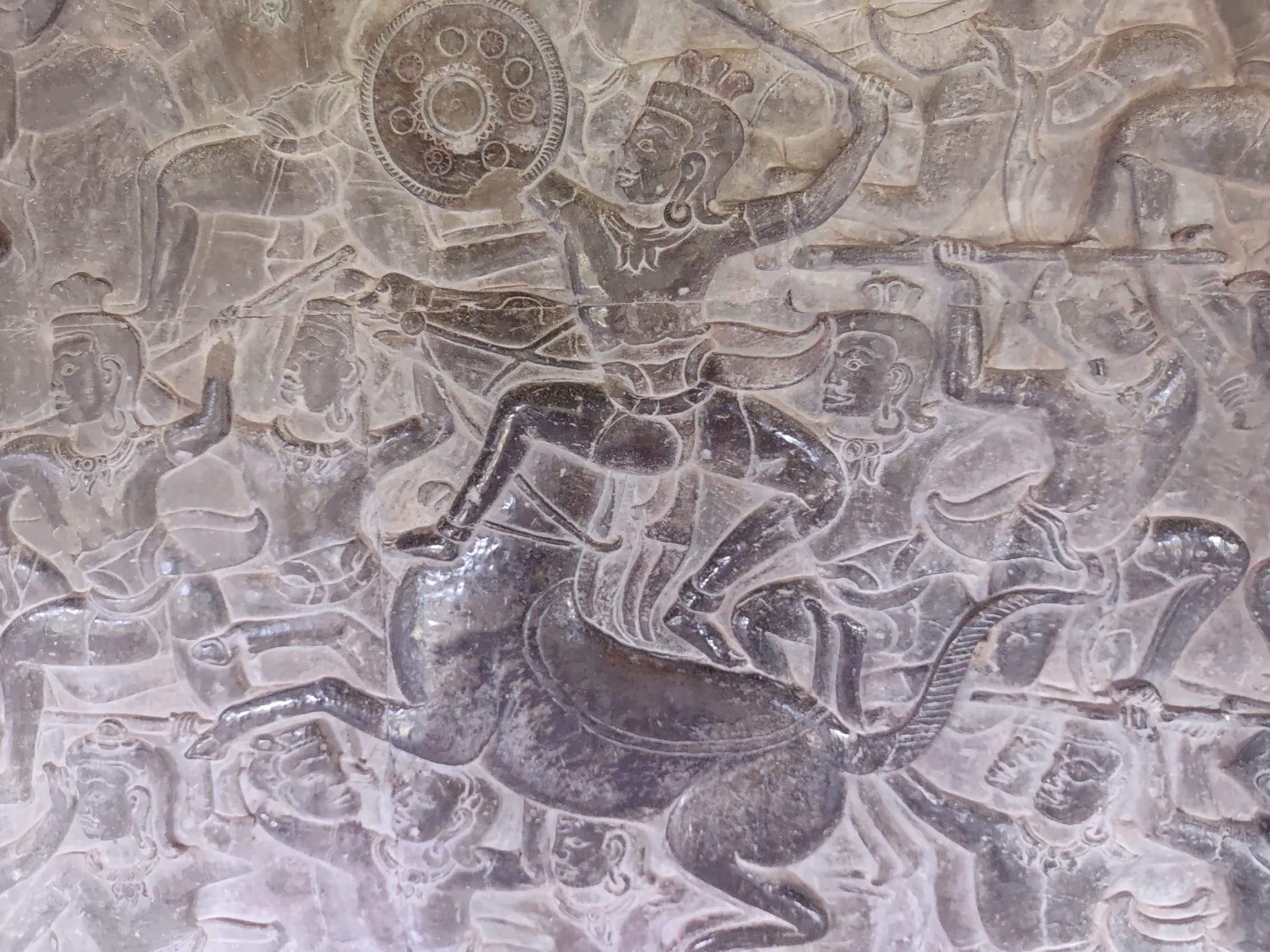
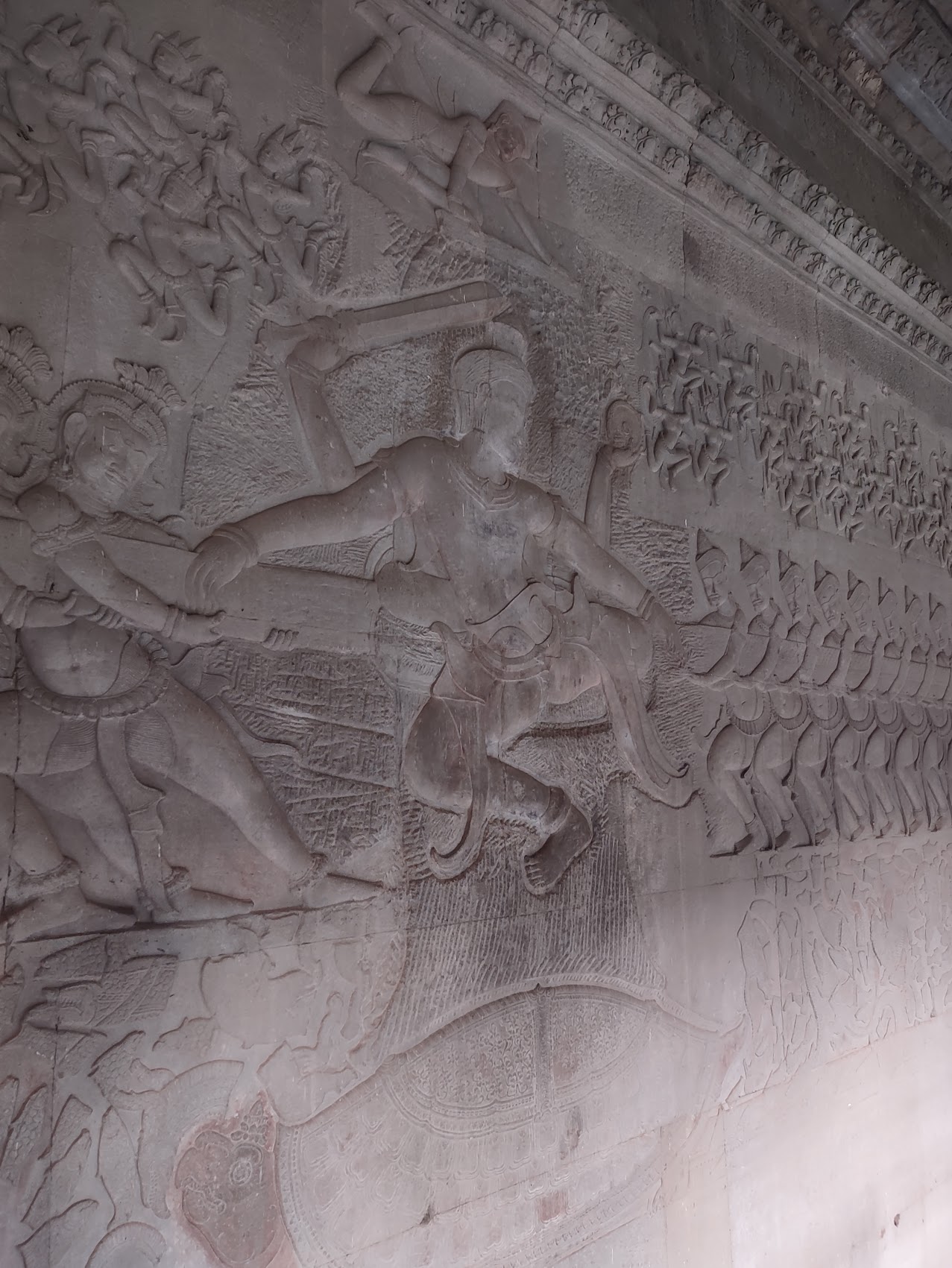
This outer gallery features a series of bas reliefs on its inner walls, each between 150 and 200 feet long, which depict King Suryavarman II and his army as well as seven epic Hindu stories. Thanks to the deep overhang which has protected them from the elements (as well as more recent restoration and preservation efforts), these bas relief panels were in extraordinarily good condition despite being almost a thousand years old.
These panels were a feature of the temple of which we were previously unaware and we were pretty blown away by both the beauty and scale of them. Of these, the most interesting was the southern east facing panel known as the Churning of the Ocean of Milk, which depicts Hindu gods and demons in a dramatically rendered tug of war, representing the eternal struggle of good and evil that churns amrit, the elixir of everlasting life, from the primordial ocean.
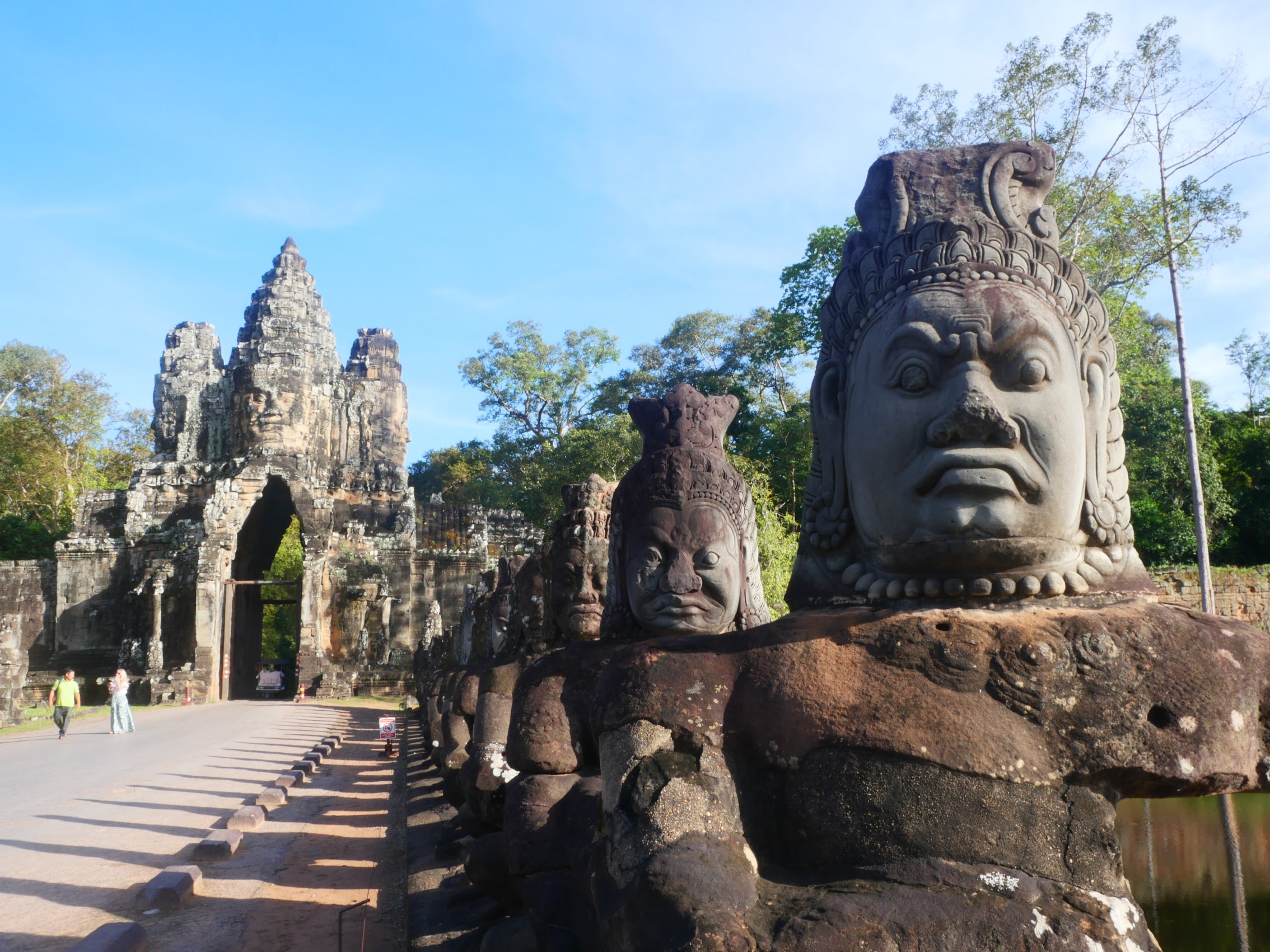
After about two hours of wandering, we eventually found ourselves back at the front entrance and made our way back to Mr. Black and our tuk tuk. From Angkor Wat, we proceeded north to Angkor Thom (or more properly, Nokor Thom). Nokor Thom is a 2,200 acre complex surrounded by a moat and 24 feet high laterite walls which was the last and most enduring capital city of the Khmer Empire established in the late twelfth century by King Jayavarman VII. We entered Nokor Thom through the South Gate across a beautiful causeway lined with Buddhas which spans the moat.

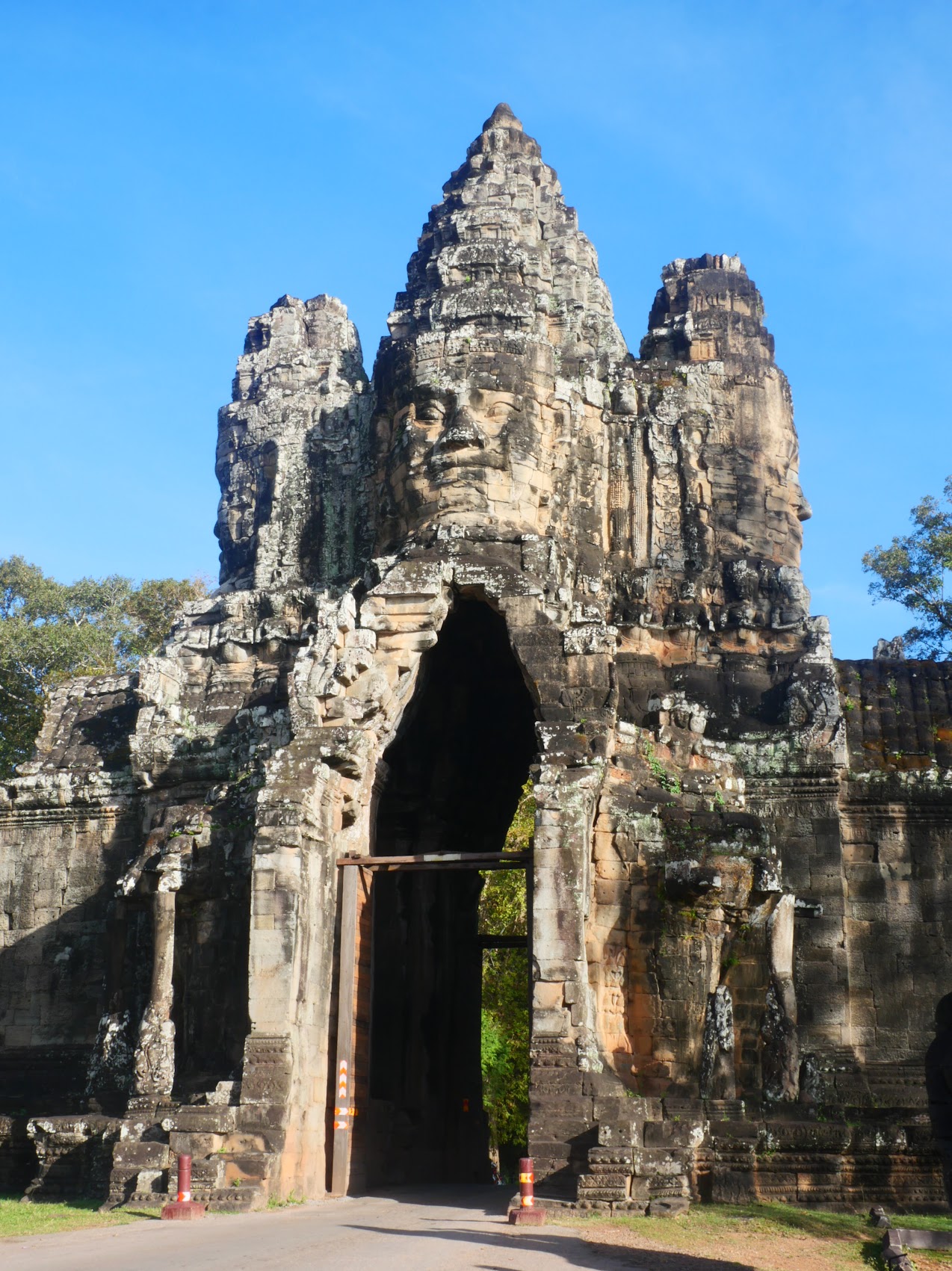

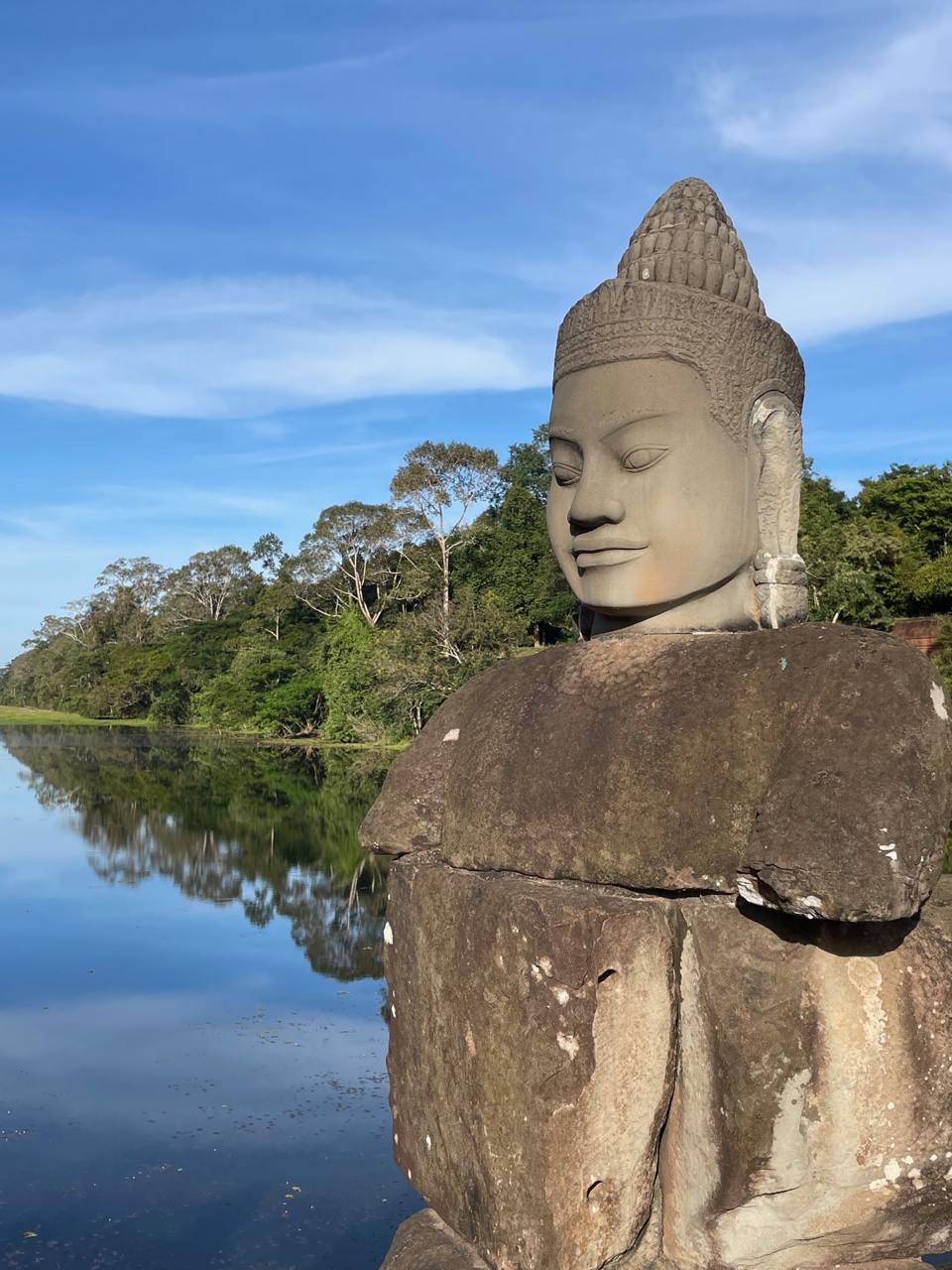
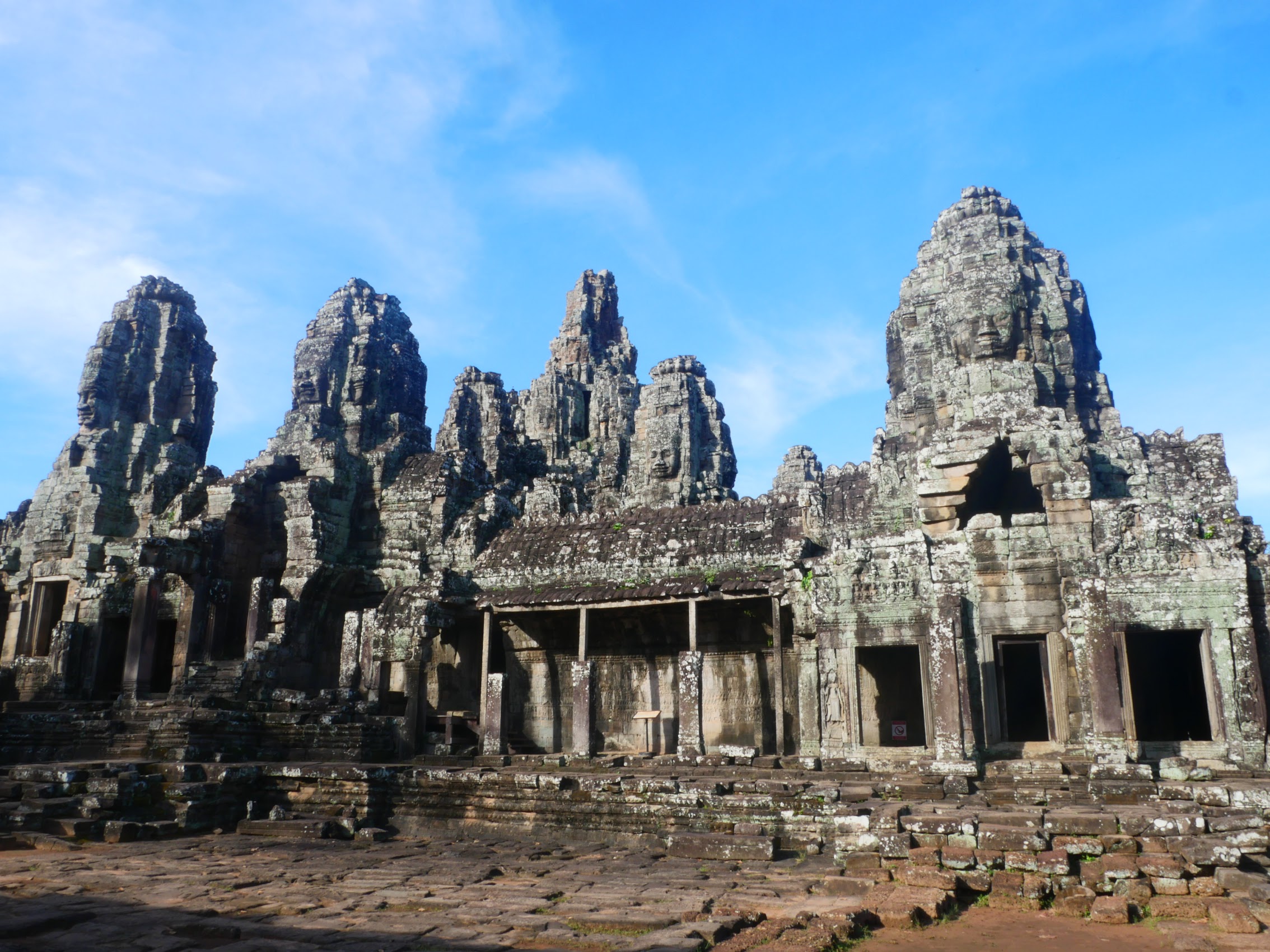
Our first stop in Nokor Thom was the Bayon Temple, a late 12th/early 13th century temple which features late (baroque) Khmer architecture and is known for its many towers with smiling Buddha faces. It’s a pretty labyrinthian place and we quickly got lost in its narrow winding corridors.
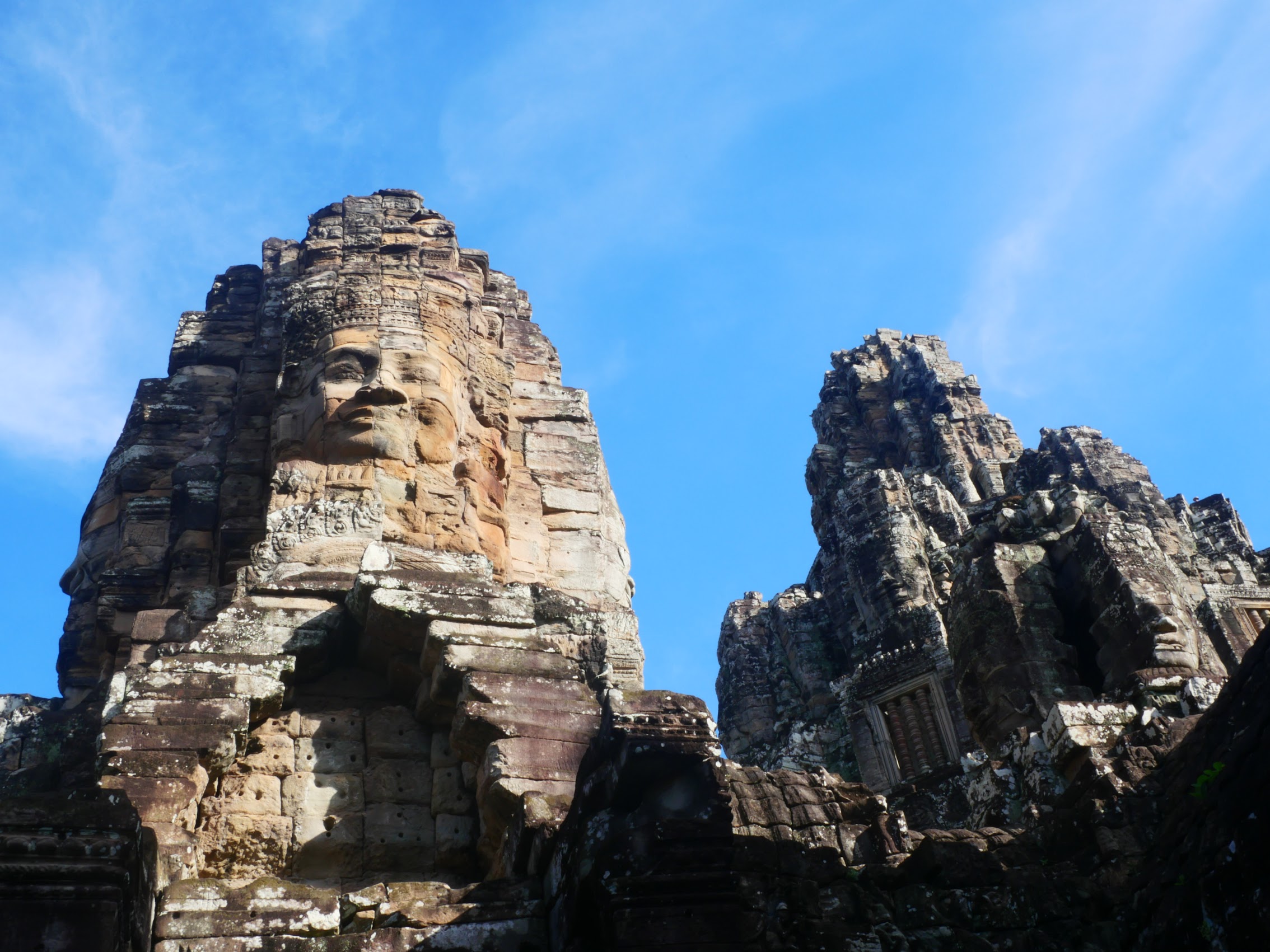

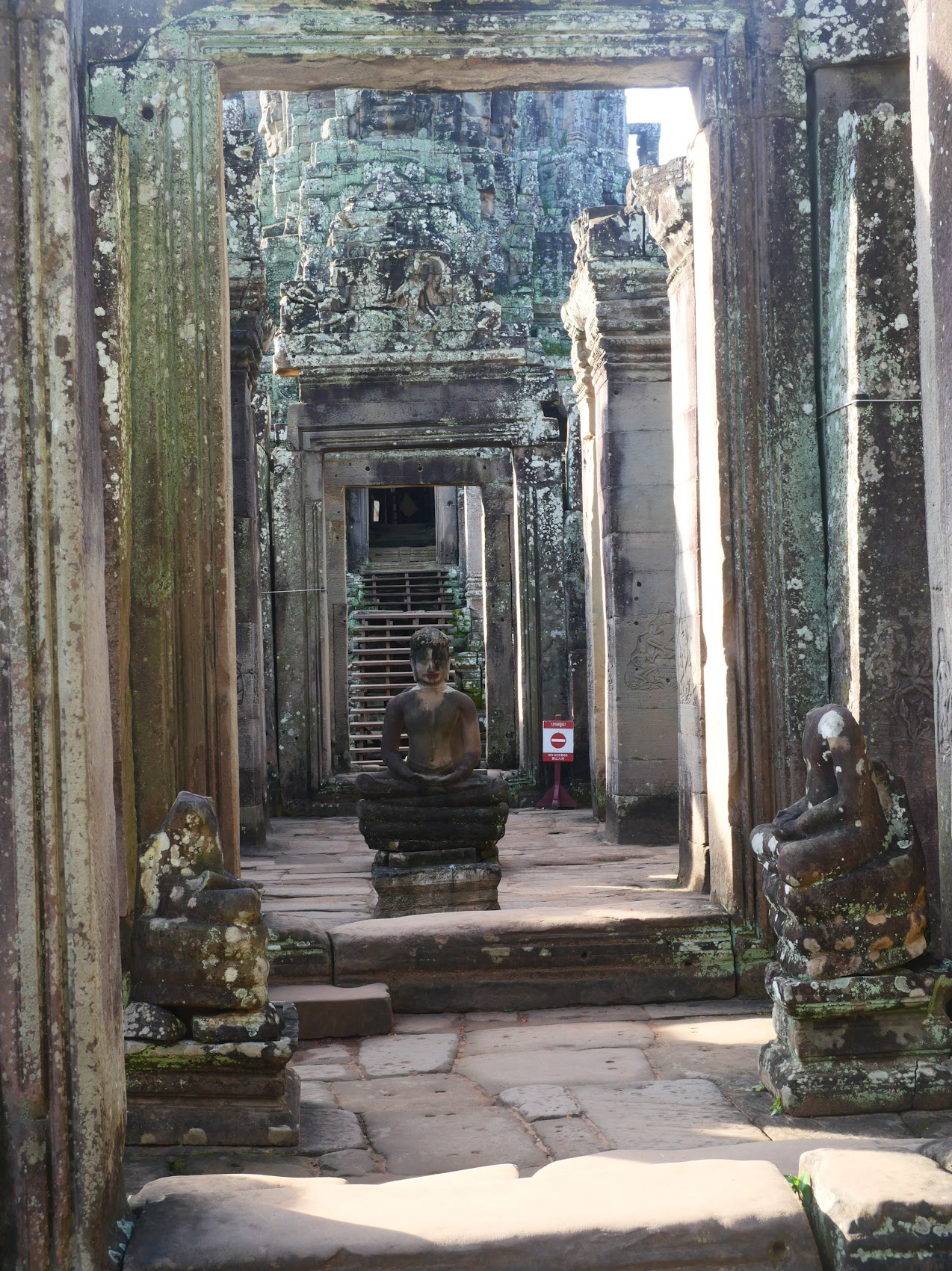
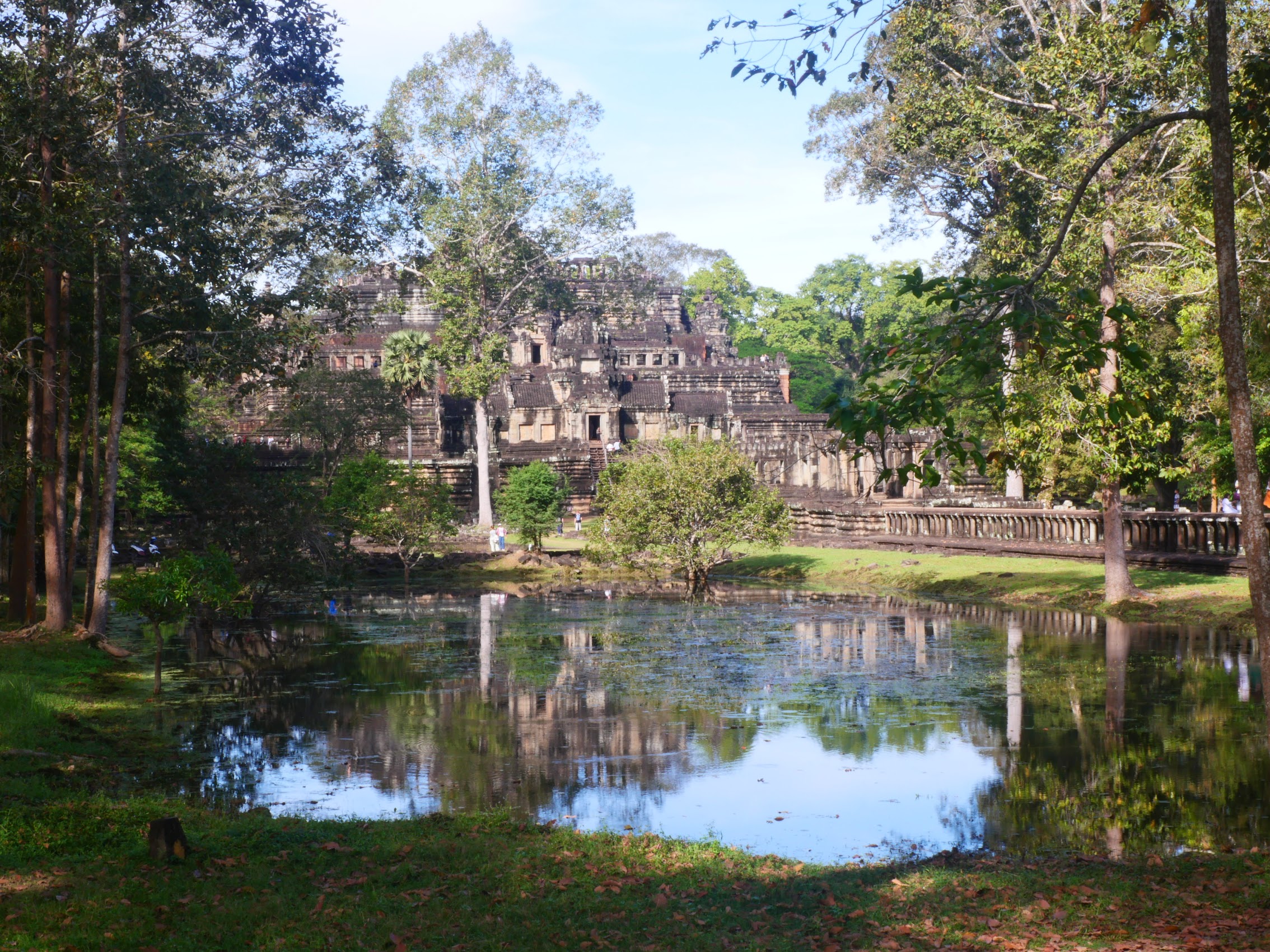
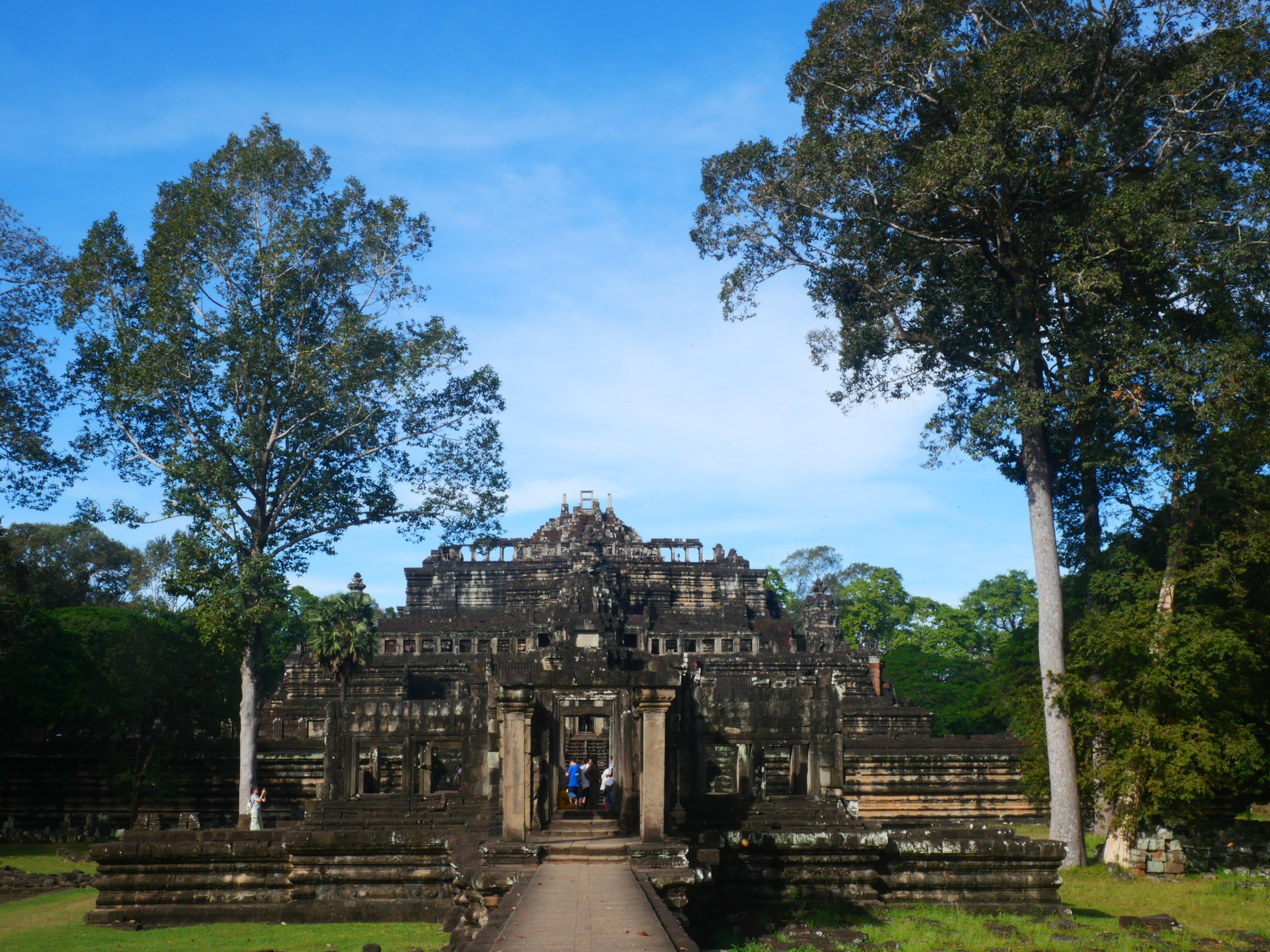
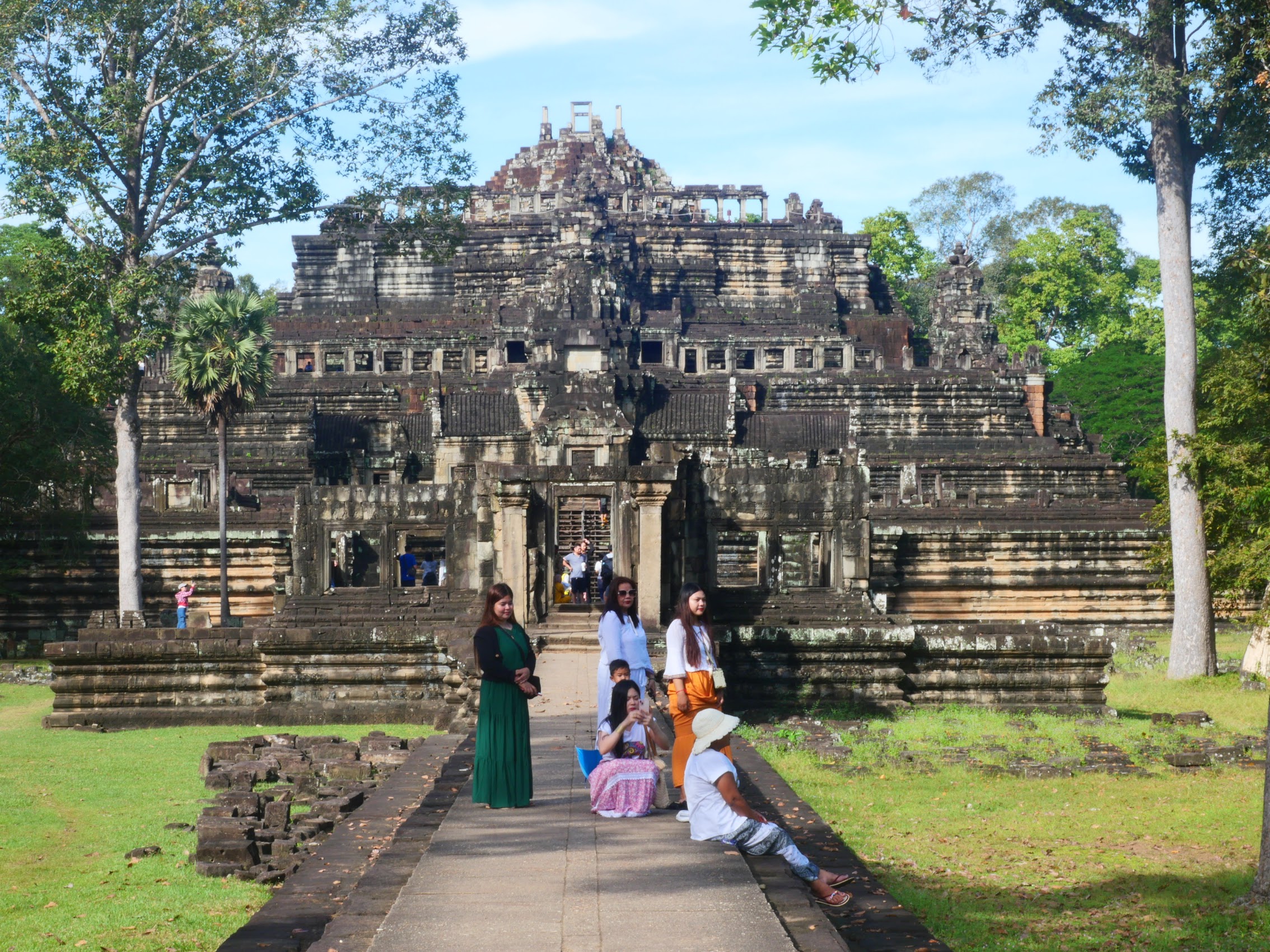
From the Bayon Temple we made our way on foot through what was once the royal square of Nokor Thom with a number of nearby temples and other structures in varying states of decay. These included the Baphuon, an 11th-century pyramid-style temple which I found particularly beautiful in its ruined state surrounded by small ponds and trees.
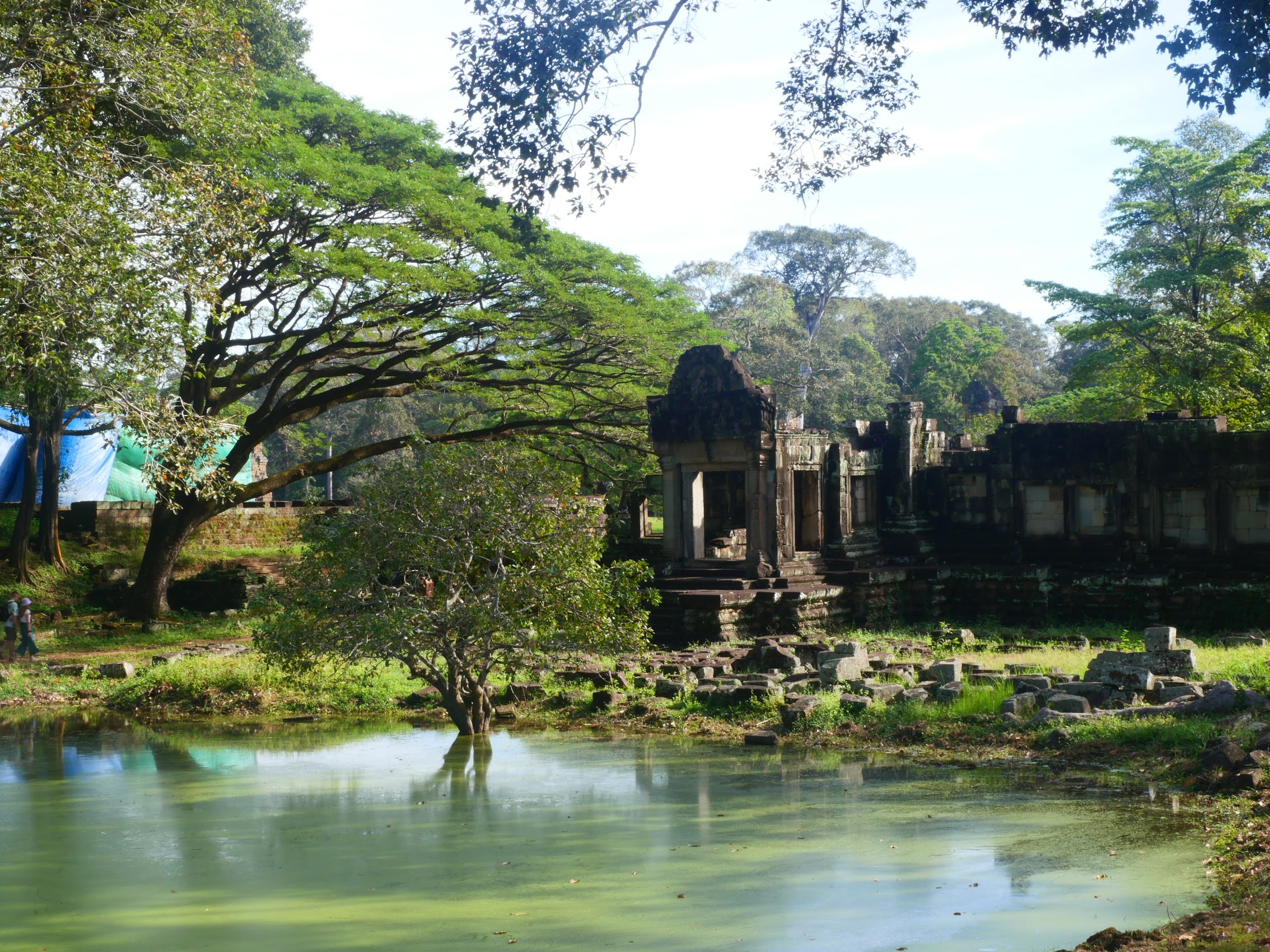
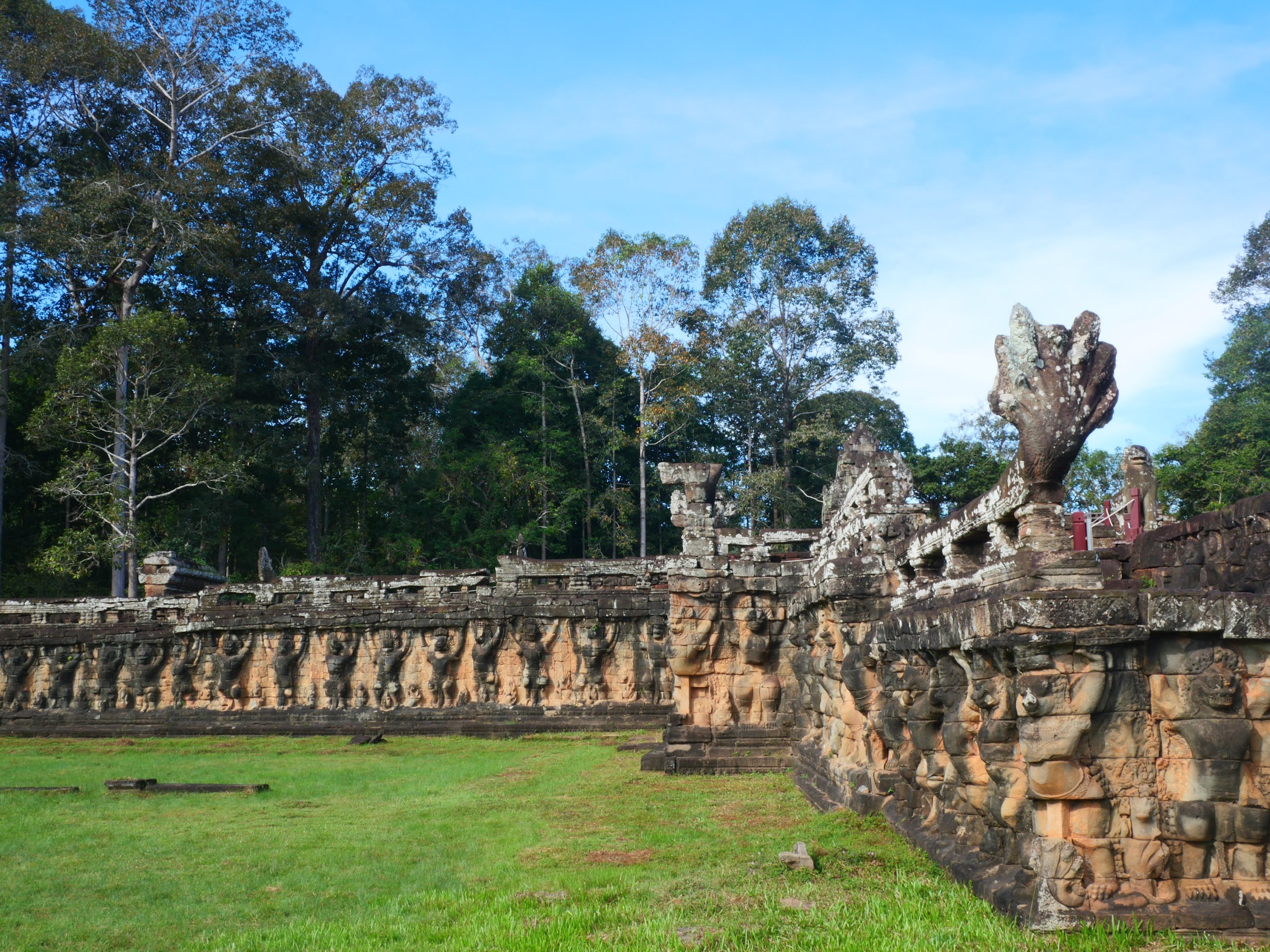
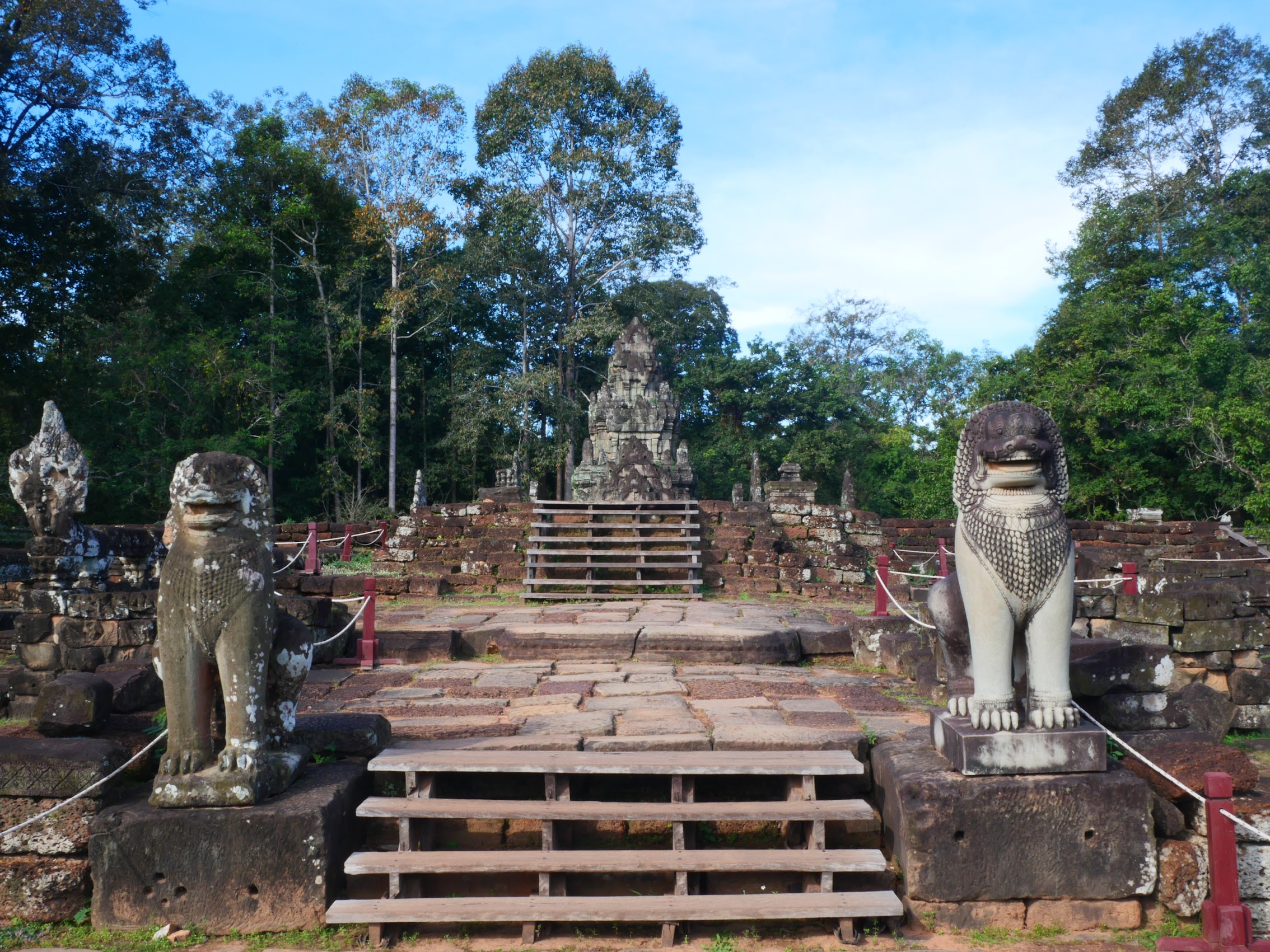
We also visited the Terrace of the Elephants, lined with elephant carvings & statues, this monument was once used by kings for viewing events in the Royal Square. We also visited the Terrace of the Leper King (supposedly called this because the statue it houses has discoloration and moss growing on it was reminiscent of a person with leprosy), as well as some smaller temples and the Prasat Suor Prat, a series of 12 towers which lined the east side of the royal square and were in a pretty extreme state of deterioration.

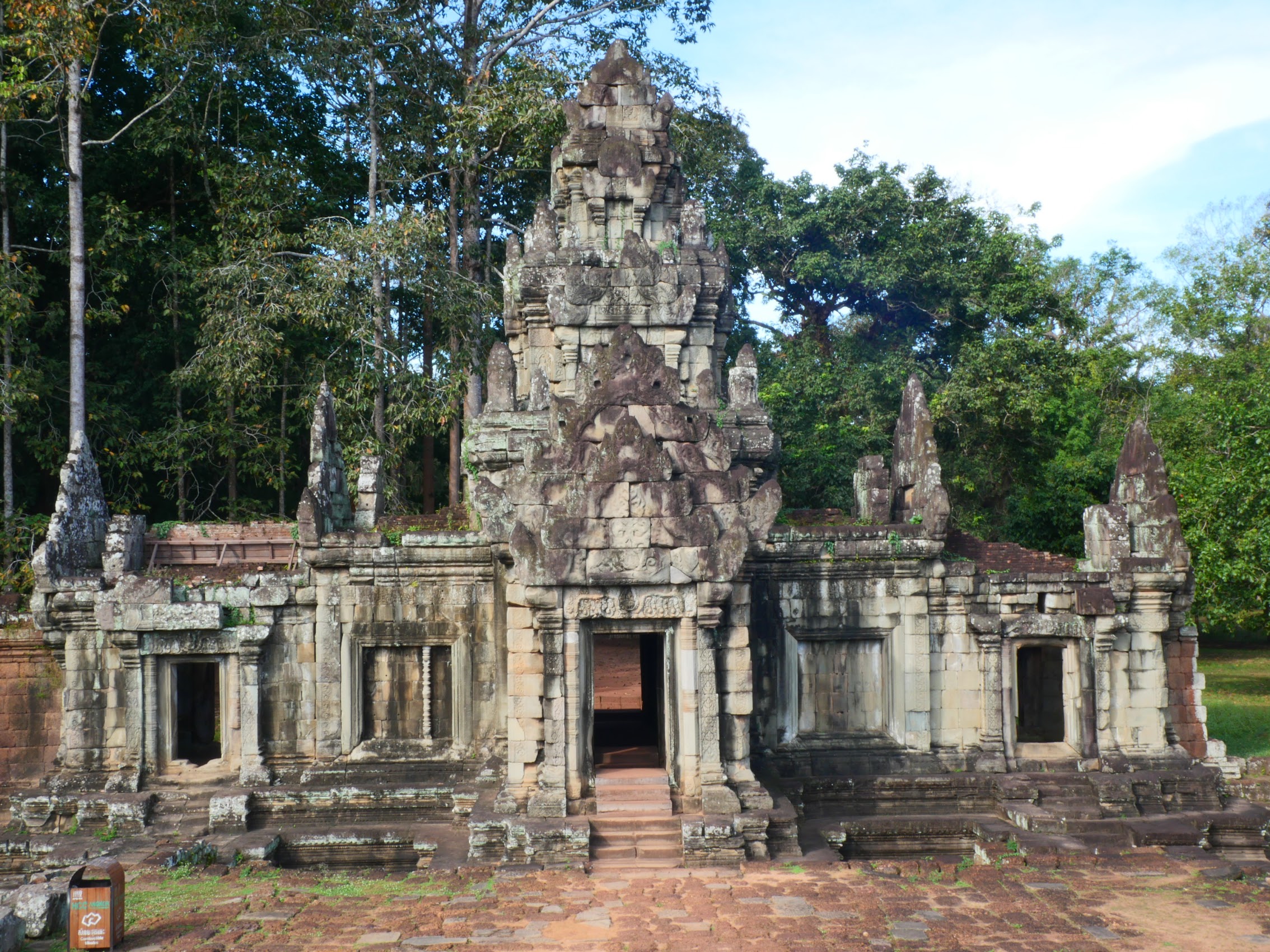

At this point, we were pretty “templed” out from all that we had seen over the past two days (as I suspect our readers are by now as well) and decided to head back to our place where we sadly had to say goodbye to Mr. Black..
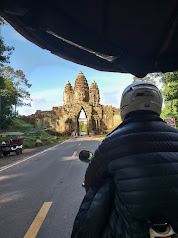
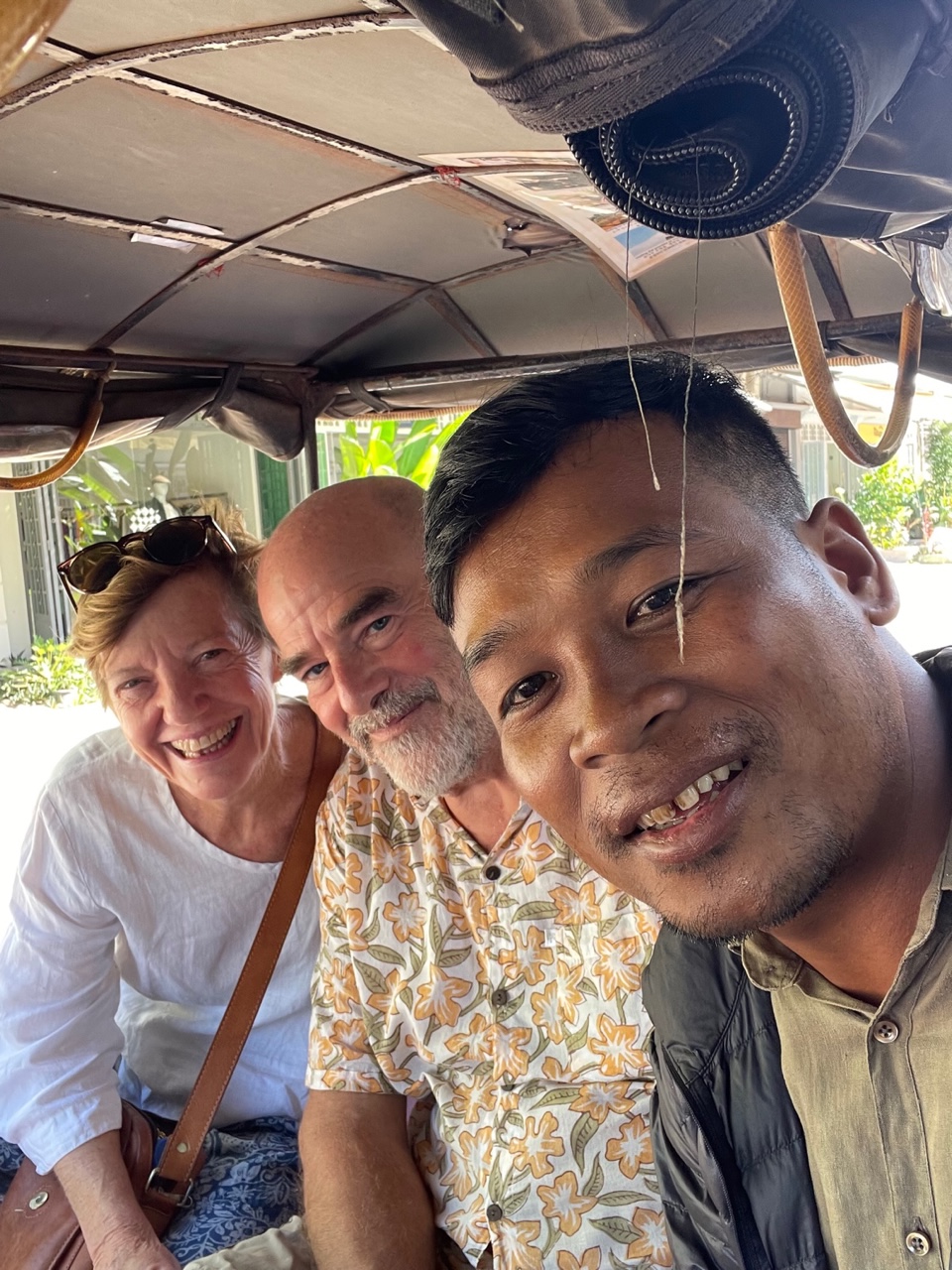
Our time in the Angkor Archeological Park confirmed our earlier suspicions that one could spend weeks in this place visiting the various temples and other structures. While we only saw a few of these, we saw enough to demonstrate what an amazing place this is and I must say that, despite some of our earlier reservations, it was absolutely worth the time and effort that it took to get here. It was truly a magical place and the age and condition of the temples (mostly ruins) made it even more so. And, as regards the Angkor Wat temple, I would have to say (natural wonders aside) that the only place we have seen on this trip which really compares to it in terms of scale and beauty was the Taj Majal.
Evictions in Angkor?
I am compelled to add one footnote to our visit to the Angkor Archeological Park. During our various travels through the Park we passed a good number of smallish makeshift concession areas selling drinks, food, and a variety of tourist tchotchkes and, upon closer inspection, we realized that the many of the locals running these places appeared to actually live there in the Park. While researching our visit, I had stumbled across various articles regarding past and ongoing efforts to evict families who are living in the Park (some of whom have apparently been doing so for generations), ostensibly to protect the site’s UNESCO World Heritage status [see https://www.theguardian.com/global-development/2022/nov/29/evictions-cambodia-angkor-wat-unesco-world-heritage-site] and (apparently) these were them.
I found this rather interesting as the situation in Angkor – local families living (and making a living) in the Park – seemed similar (if not identical) to what we had observed at the ancient city of Petra in Jordan, as well as at the Fort of Jaisalmer, India (both also UNESCO World Heritage sites).
When we were in Jaisalmer, our guide told us that there was a movement afoot there to evict the occupants of the Fort which seemed completely at odds with the touting of Jaisalmer Fort as the world’s largest “living” fort and the only one in all of India. In reviewing the UNESCO citation for the Jaisalmer Fort (it is actually one of six such hill forts in India included in the UNESCO citation), it is interesting to note that it specifically cites the extensive township contained within the Jaisalmer Fort from the outset and still inhabited today. And while my research turned up countless articles lauding it as the largest and oldest “living” fort in the world, I couldn’t find a single one that suggested any move to evict its current inhabitants.
As regards Petra, we had neither heard nor seen anything to suggest that there were any issues regarding the Bedouins living and working in the Park (although we were surprised to see it). Upon doing a bit more research, I discovered that “officially”, the Bedouins living there were “removed” from the site in 1985 when the park became a UNESCO World Heritage site. But unofficially (illegally even?), they are still there, although in smaller numbers than prior to 1985. (From our own experiences there, I believe that it is just too damn hot in Petra for anyone to care who does or doesn’t live there.)
So why the fuss in Angkor?
Some deeper digging on Angkor uncovered a series of UNESCO resolutions and decisions related to concerns over uncontrolled development of the site (presumably the structures built by the occupants) which, if not addressed to UNESCO’s satisfaction, could result in the site losing its World Heritage status. Unfortunately, reviewing these documents tends to lead one to the conclusion that UNESCO World Heritage status is a bit of a forced preservation mechanism and, while it’s not clear how much of a factor UNESCO World Heritage status has in attracting tourists, it is clear that Angkor is Cambodia’s largest tourist attraction with 2 million visitors annually a number which, based on all the new hotels and resorts we saw around the Park, they hope to significantly increase in the future.
Perhaps it is a matter of how long the inhabitants have been there? The current inhabitants of the Jaisalmer Fort have been there for hundreds of years over many generations and are generally considered to be descendants of some of the Fort’s original inhabitants. In Petra, the Bedouins living within the Park claim to be descended from the Nabataeans who occupied this land at the end of the Roman Empire and have lived among the tombs and caves for over 170 years. The current inhabitants of Angkor also claim to be descendants of the original inhabitants and while it is less clear how long the current inhabitants have lived there (they say “generations”), it is clear that they were there before the UNESCO World Heritage designation.
Certainly, part of it is a matter of scale. There are an estimated 50 or 60 families living in Petra and maybe twice that many in Jaisalmer. In Angkor, a much larger and more expansive place, the number of families who have or will be impacted by these forced evictions and questionable relocation practices is estimated at 10,000 or more. Because of this, the situation has actually become a human rights issue with Amnesty International and other international organizations coming out in support of the people living in Angkor.
Along with some newfound skepticism for UNESCO, all of this raises some difficult questions for me regarding how we as a civilization approach historic sites like Angkor. While I am typically opposed to efforts to “restore” such sites and generally supportive of efforts to stabilize and maintain them, is it our intent to freeze them in time? If people occupied a site before it was designated by UNESCO wouldn’t their continued existence there be part of the natural and ongoing development of the site? While we would certainly not want any harm to come to the ancient temples and other structures in Angkor, isn’t there a way to achieve this while still allowing the current inhabitants to live there as well?
Absent further contemplation, I’m really not sure what the best approach would be here, but I’m pretty certain that the forced relocation of 10,000 families is not it.
Everything Else
Over our three days in Siem Reap, we grew to really like our quiet little street which was located only a couple of blocks from Siem Reap’s infamous Pub Street, which is known for late night partying and drinking, and it proved to be a nice quiet retreat from all that. The area around our neighborhood was full of interesting arts and crafts shops as well as some more conventional shopping malls and we spent most of the time we weren’t visiting the Angkor Wat Temple complex wandering and shopping.
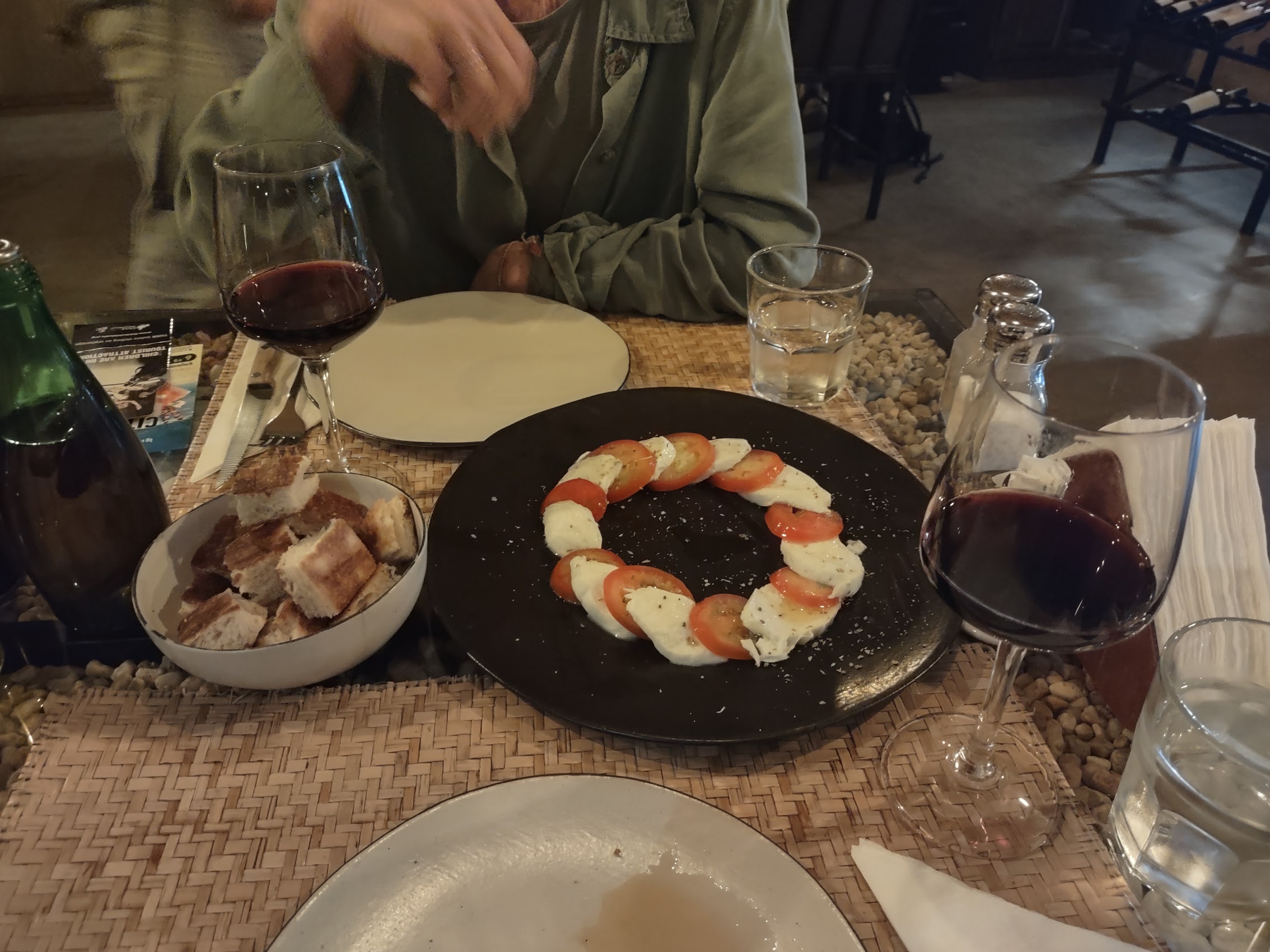
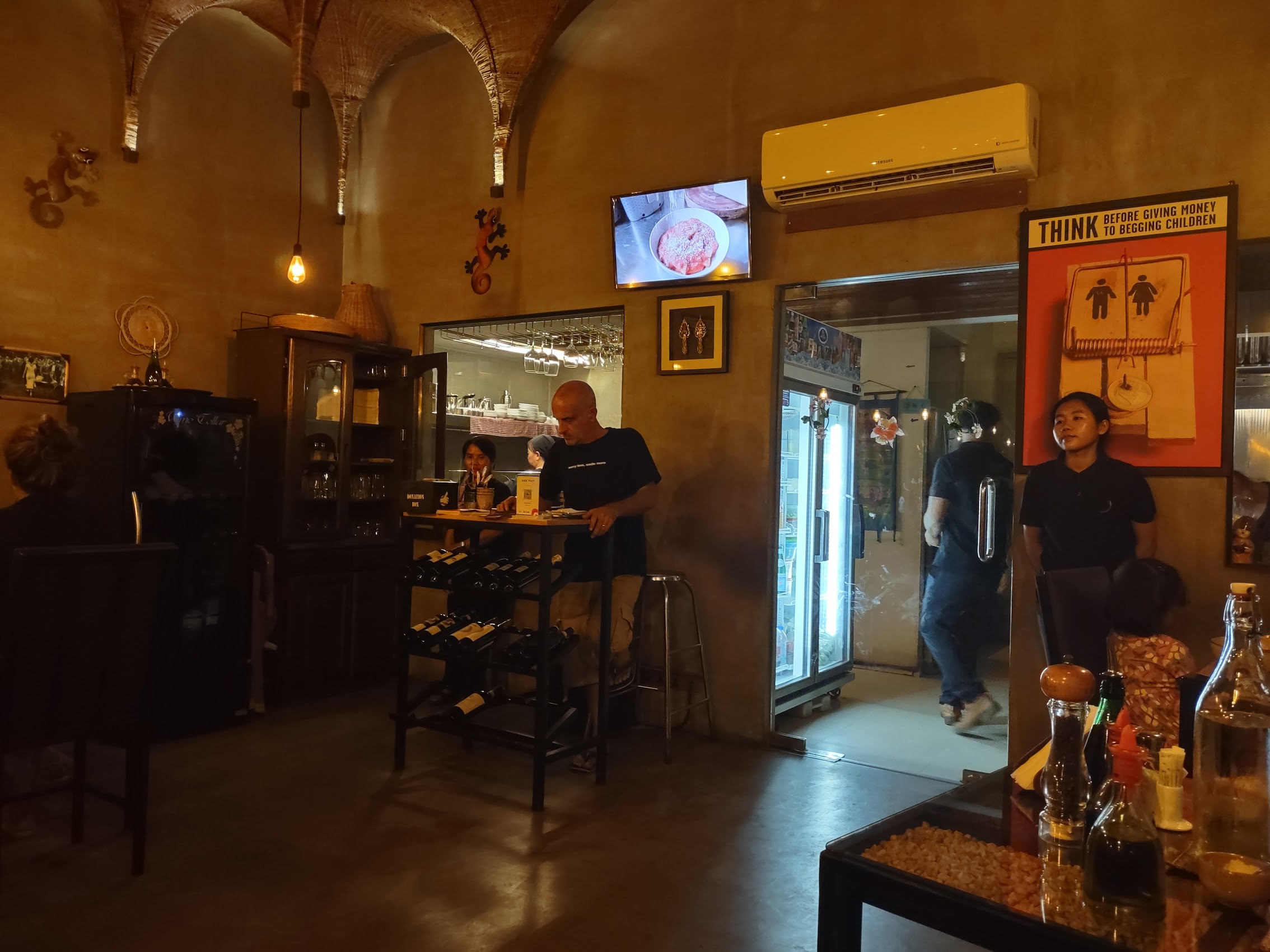
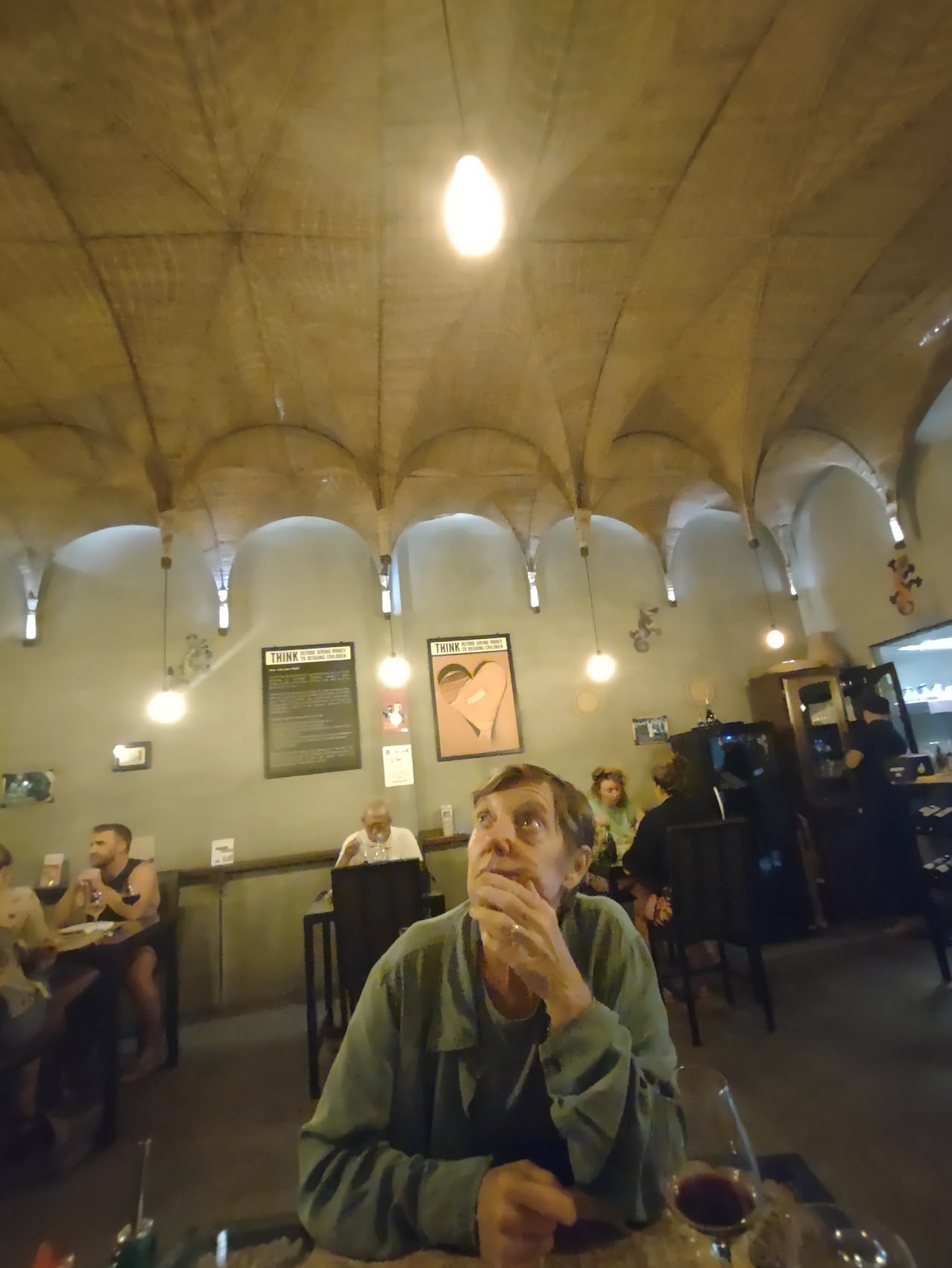
We reconnoitered the neighborhood a bit on our first night to do some grocery shopping then had a great Italian dinner at a place at the end of our block called Mama Shop Italian which we had passed earlier and which looked and smelt so good that we had to return.
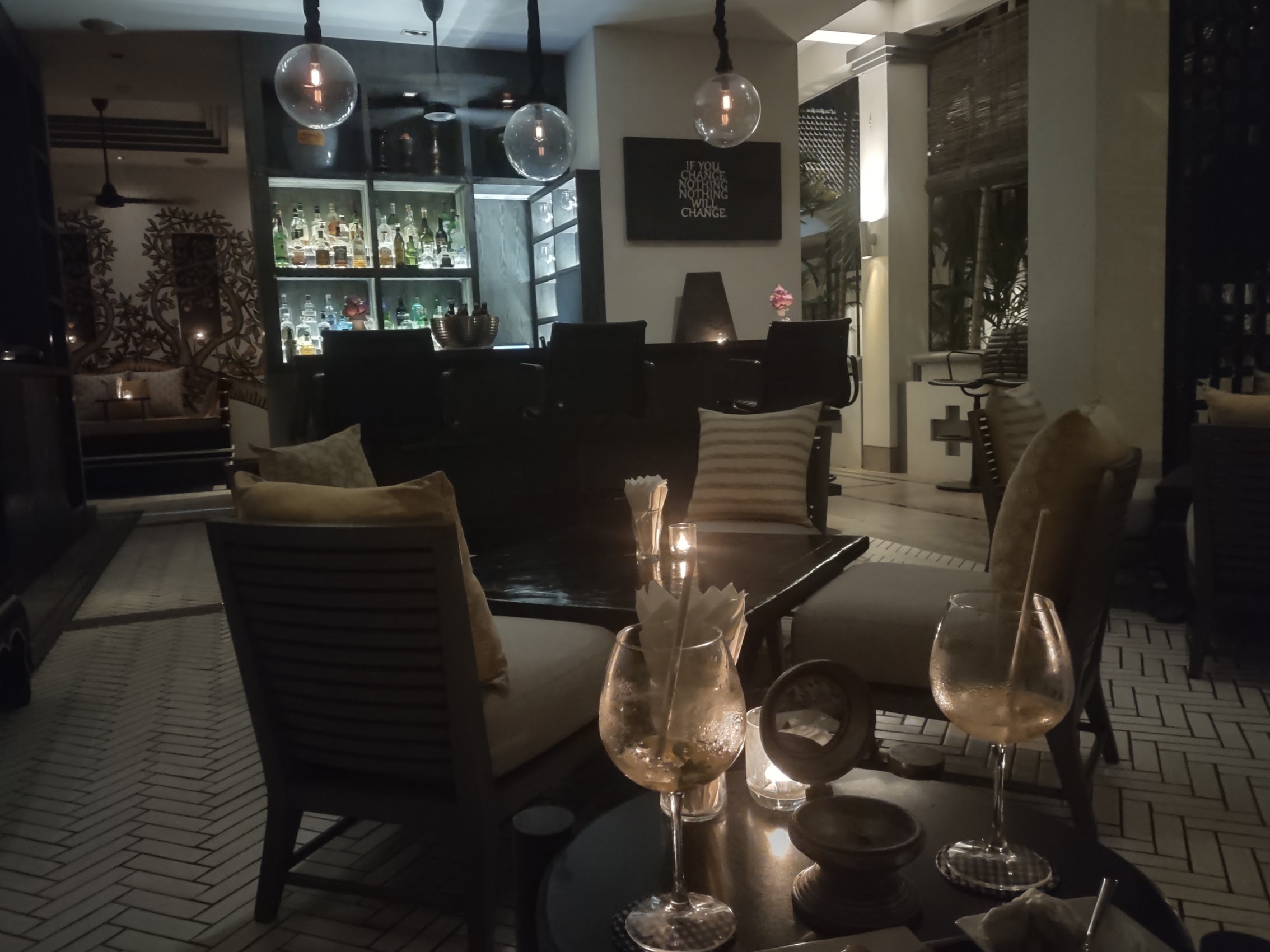
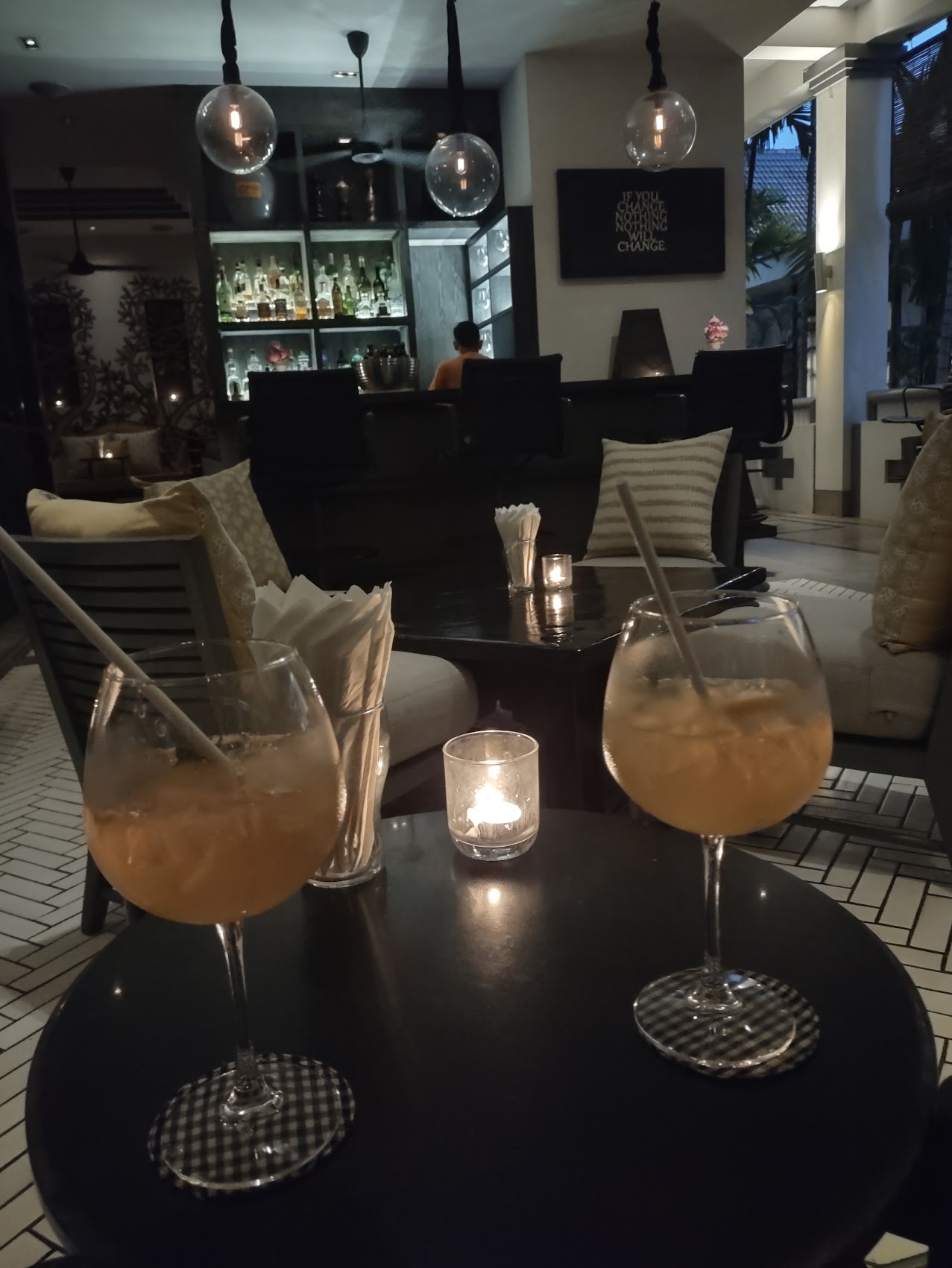
On another afternoon, we got caught outdoors by a sudden thunderstorm while shopping and ended up taking shelter in a nearby boutique hotel called Kroya where we had some great cocktails, snacks, and hospitality.
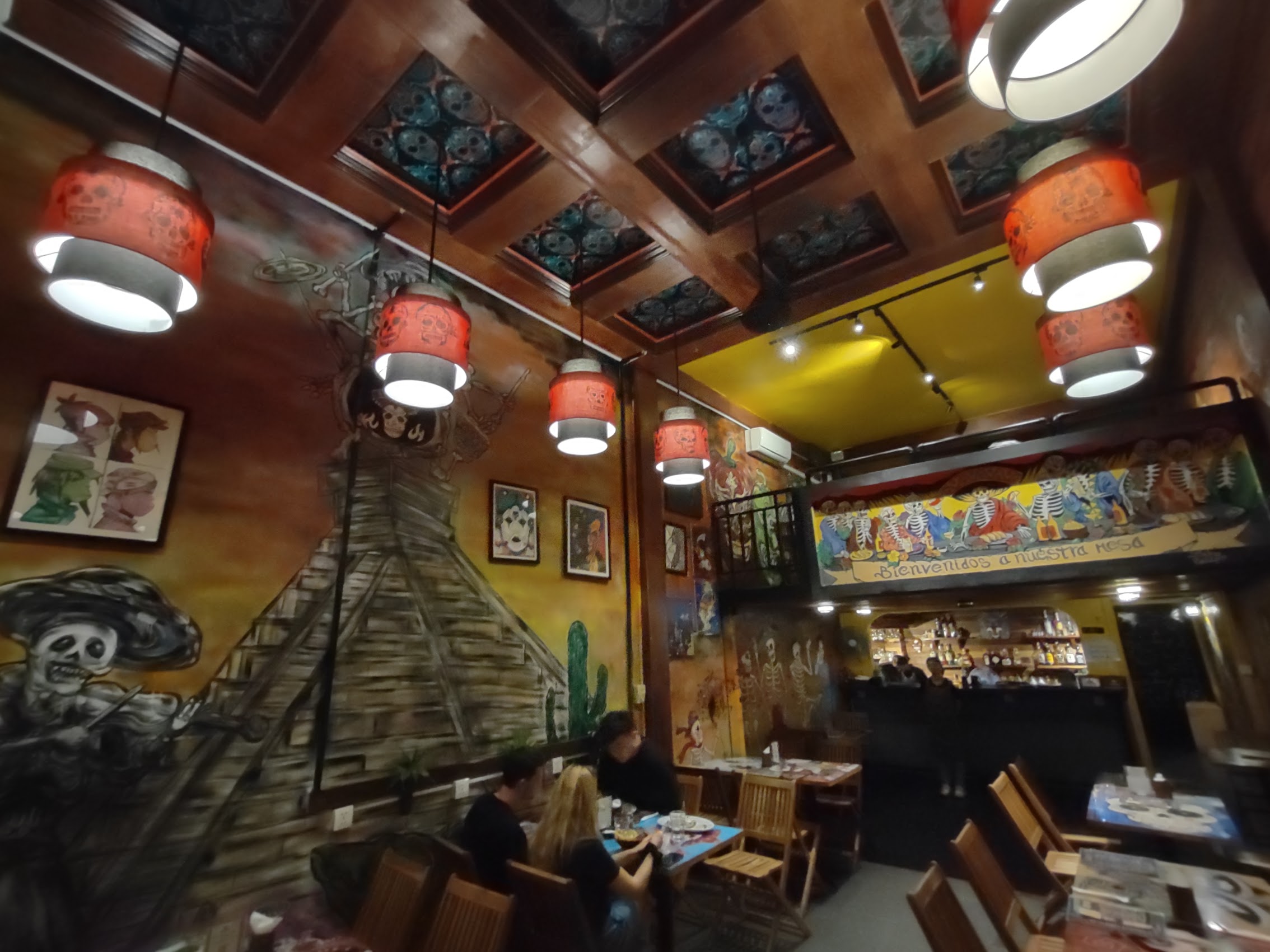
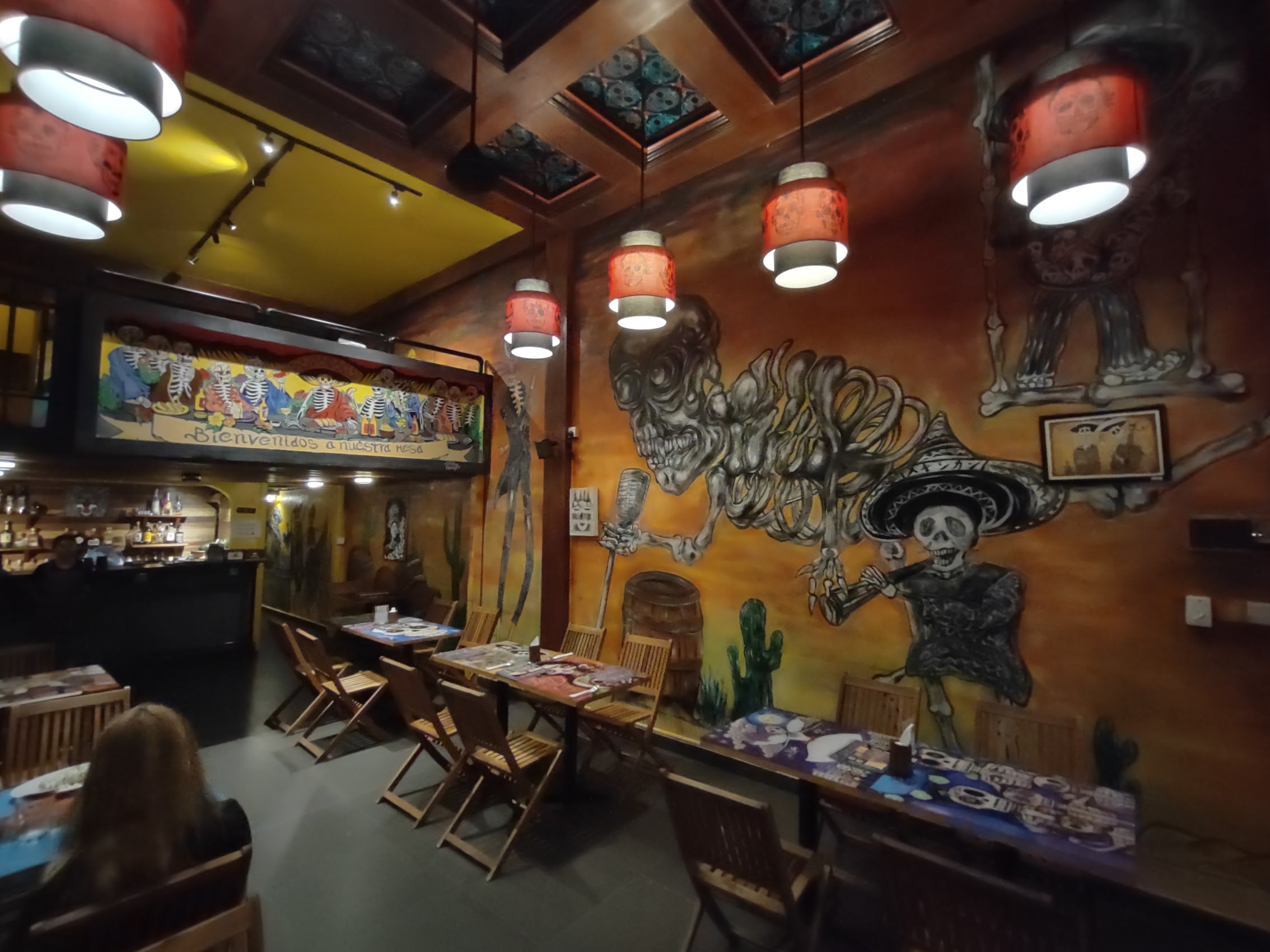
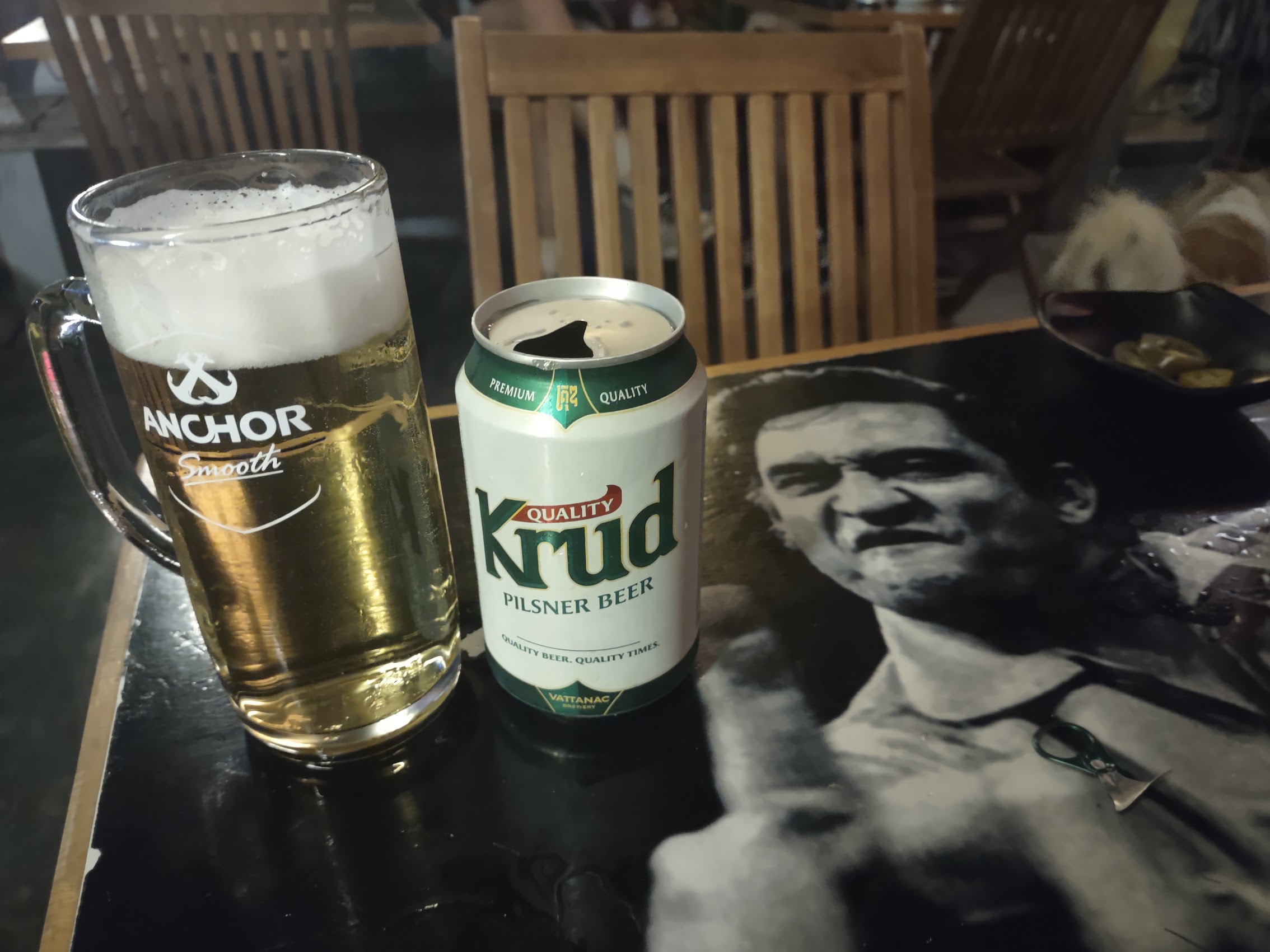
Once the storm had passed we went back to our street where we had some great Mexican food and country music at a fun place called “Maybe Later” at the other end of our block where I discovered the local beer with the questionable name of “Krud”. (It probably seems kind of strange to be eating Italian and Mexican food in Cambodia, but there are times when a taste of home goes a long way.)

On another night in Siem Reap, Colleen fixed us a great dinner of chicken stew which we enjoyed with a nice bottle of wine. (There are also times when a home-cooked meal goes a long way!) We always try to book places with kitchens, even on short stays, but it does take a bit of extra effort to cook on the road and I am truly blessed to have a partner who enjoys cooking enough to make that effort (even if it is partly driven by saving money) and who does it so well.


On our last day we spent the morning doing trip planning and then took a last walk around town. We visited the Wat Preah Prom Rath which turned out to be a tourist attraction rather than an actual temple but was quite beautiful in any case.
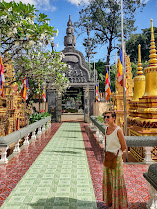
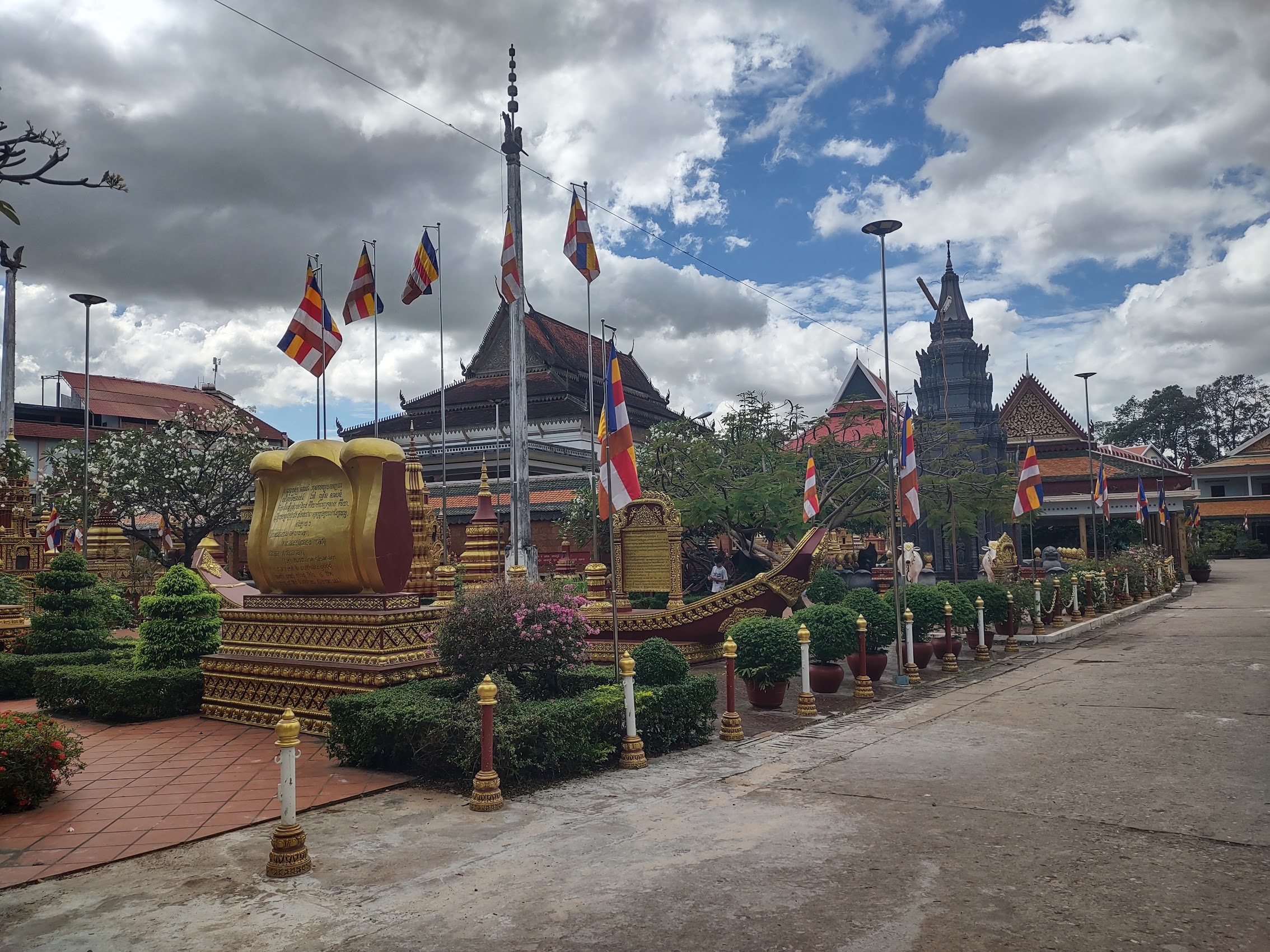

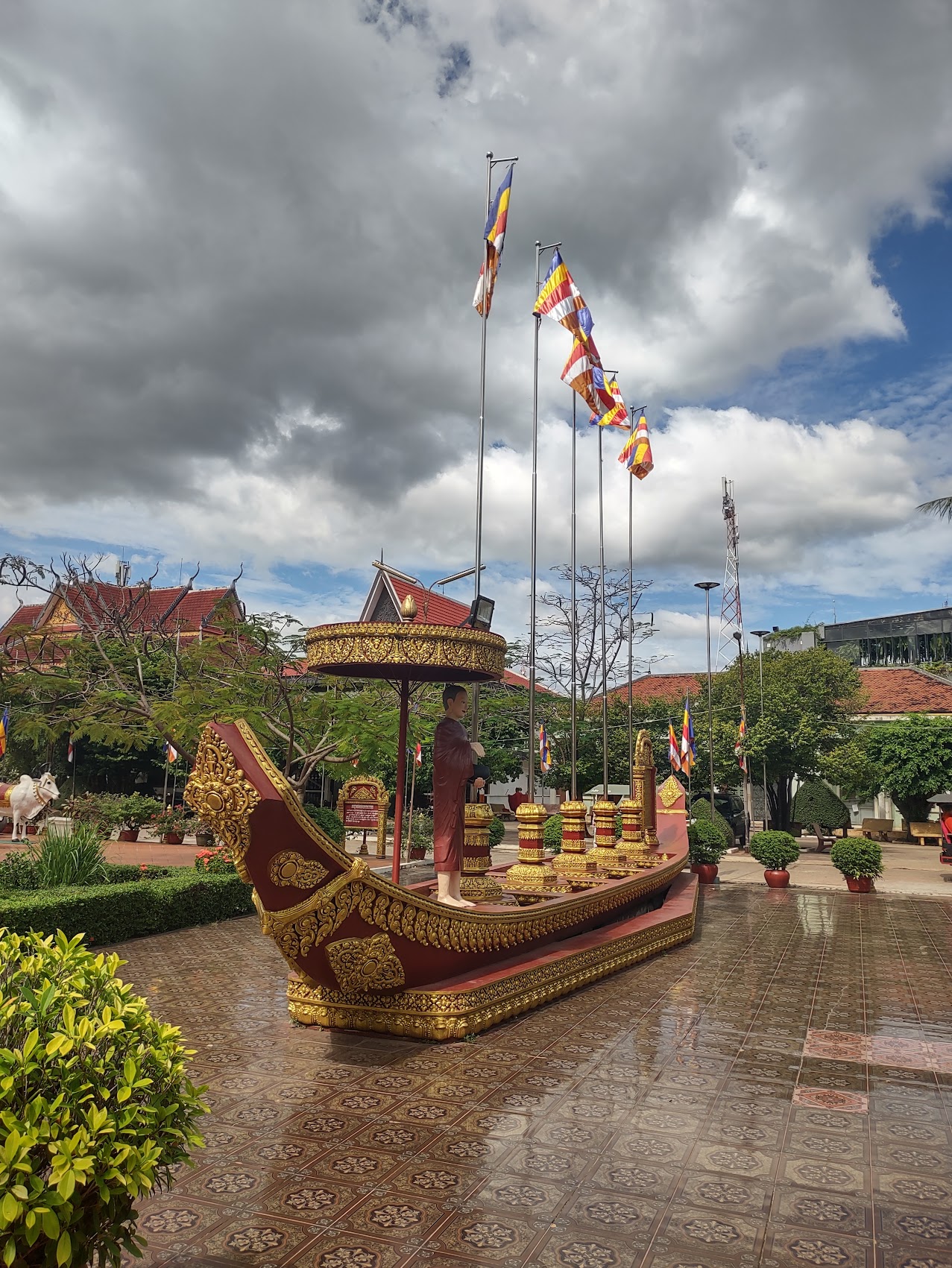
We did a bit of last minute shopping (Colleen found the bath salts she was looking for but I was unable to find the “Krud” hat that I so desired) and then made our way to Pub Street, which we had yet to visit.
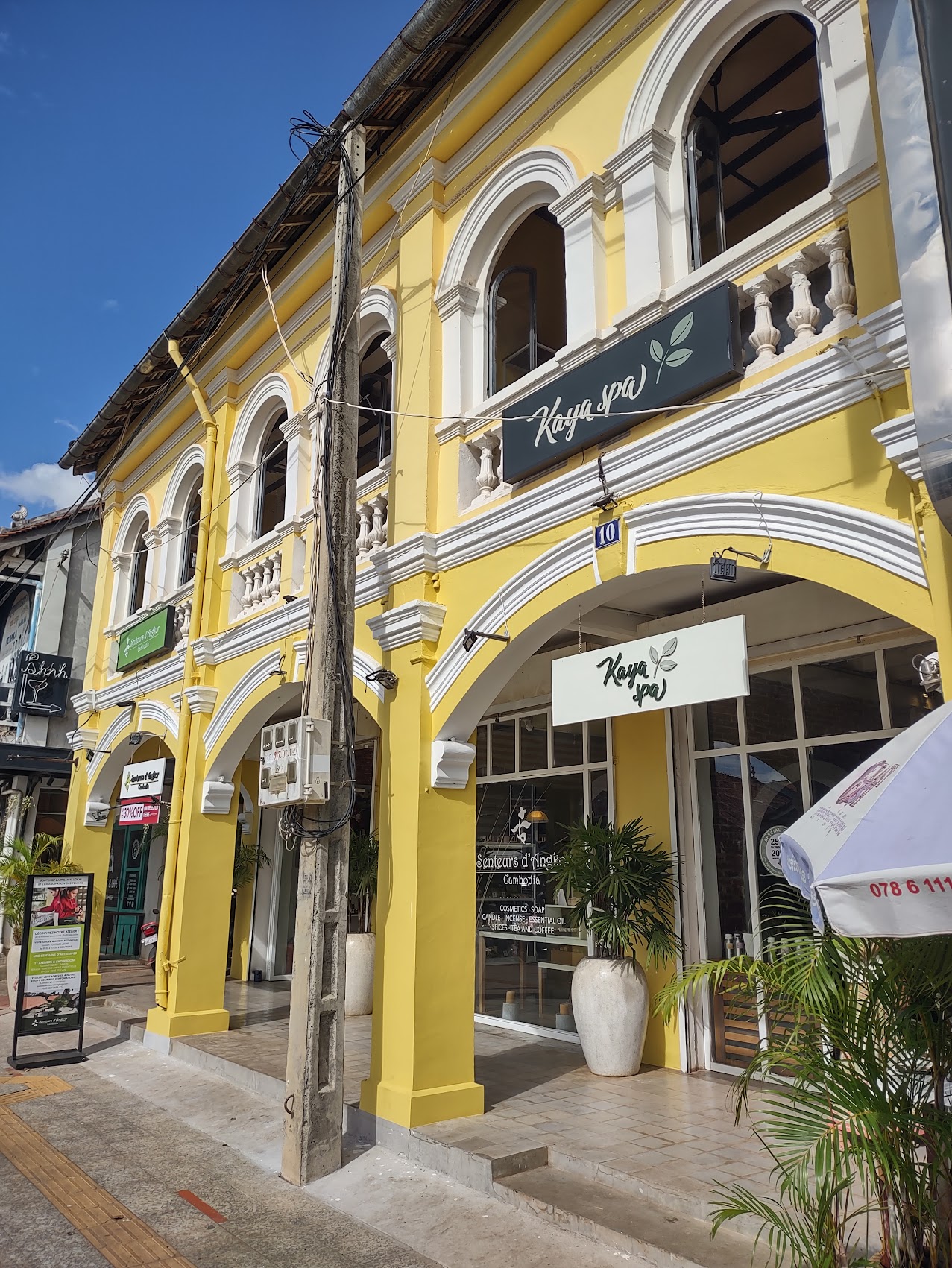

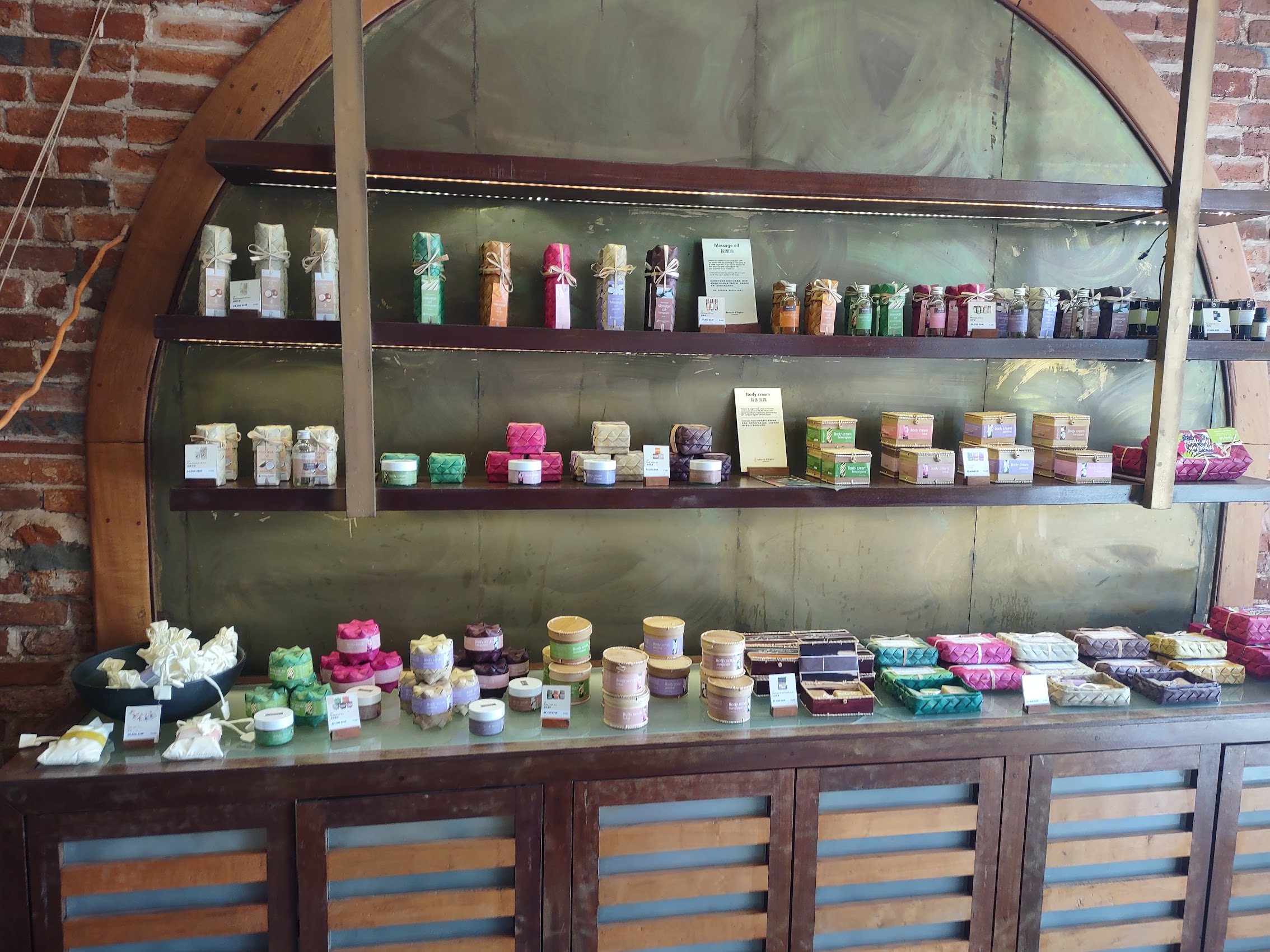
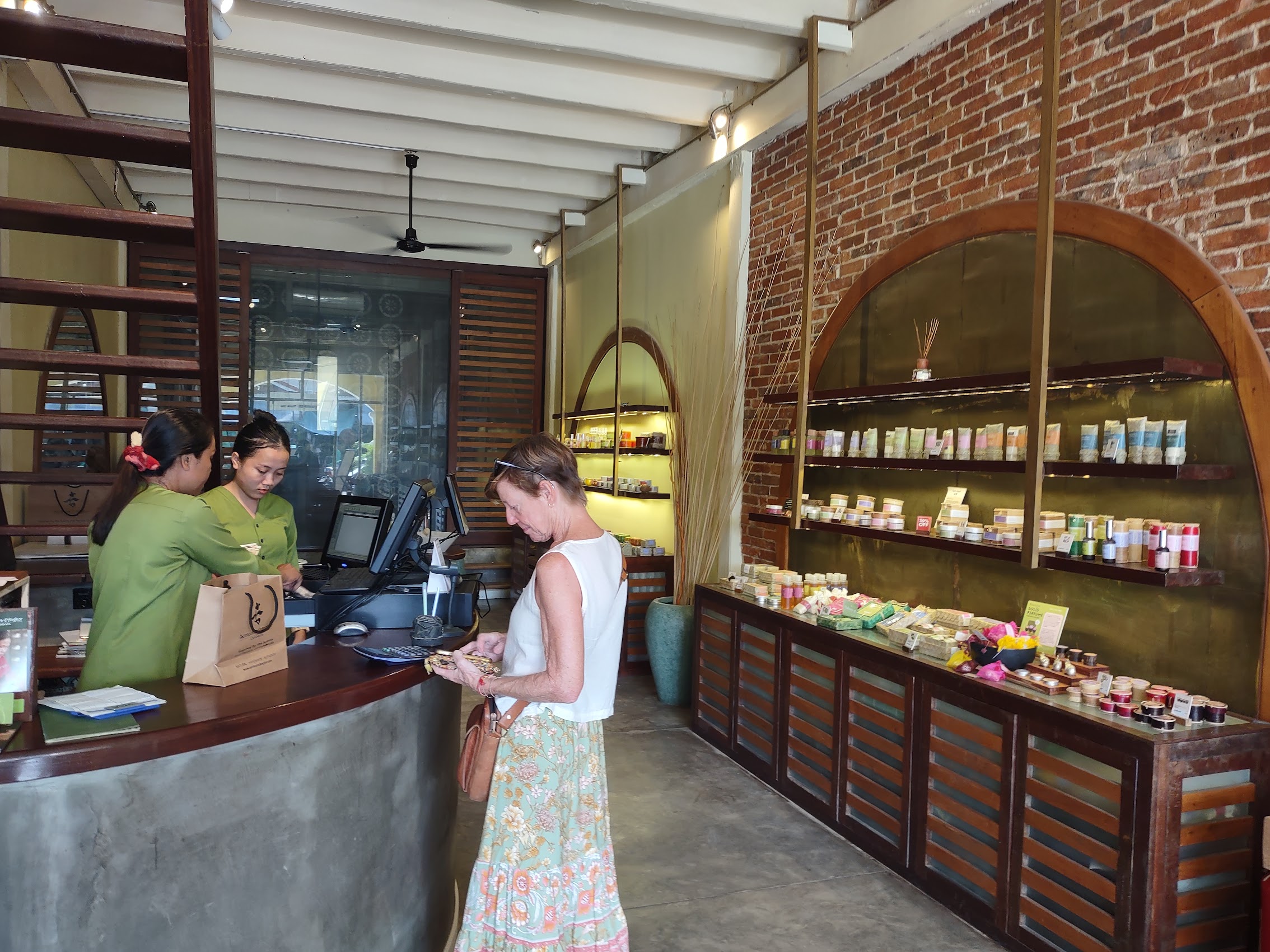

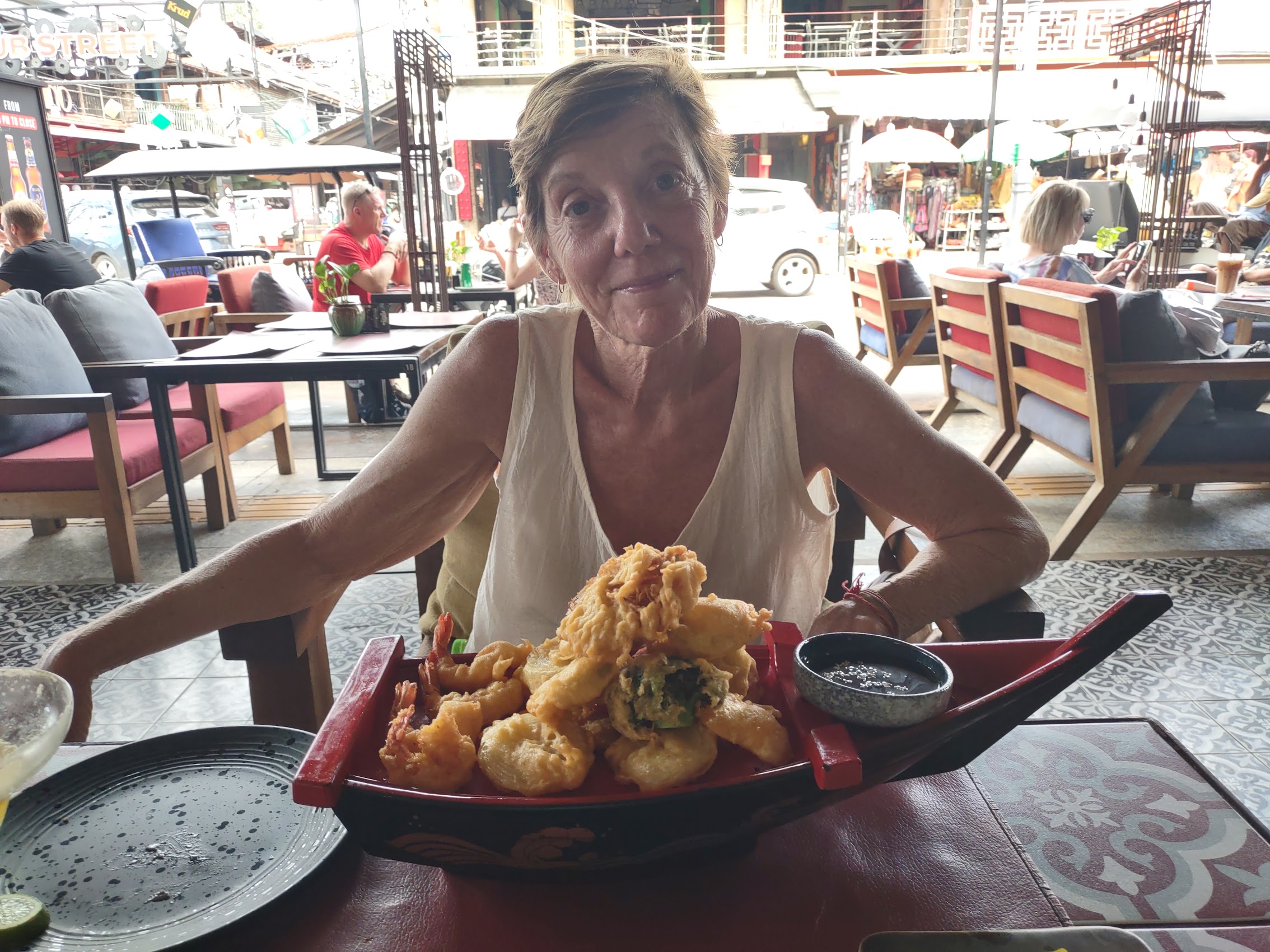
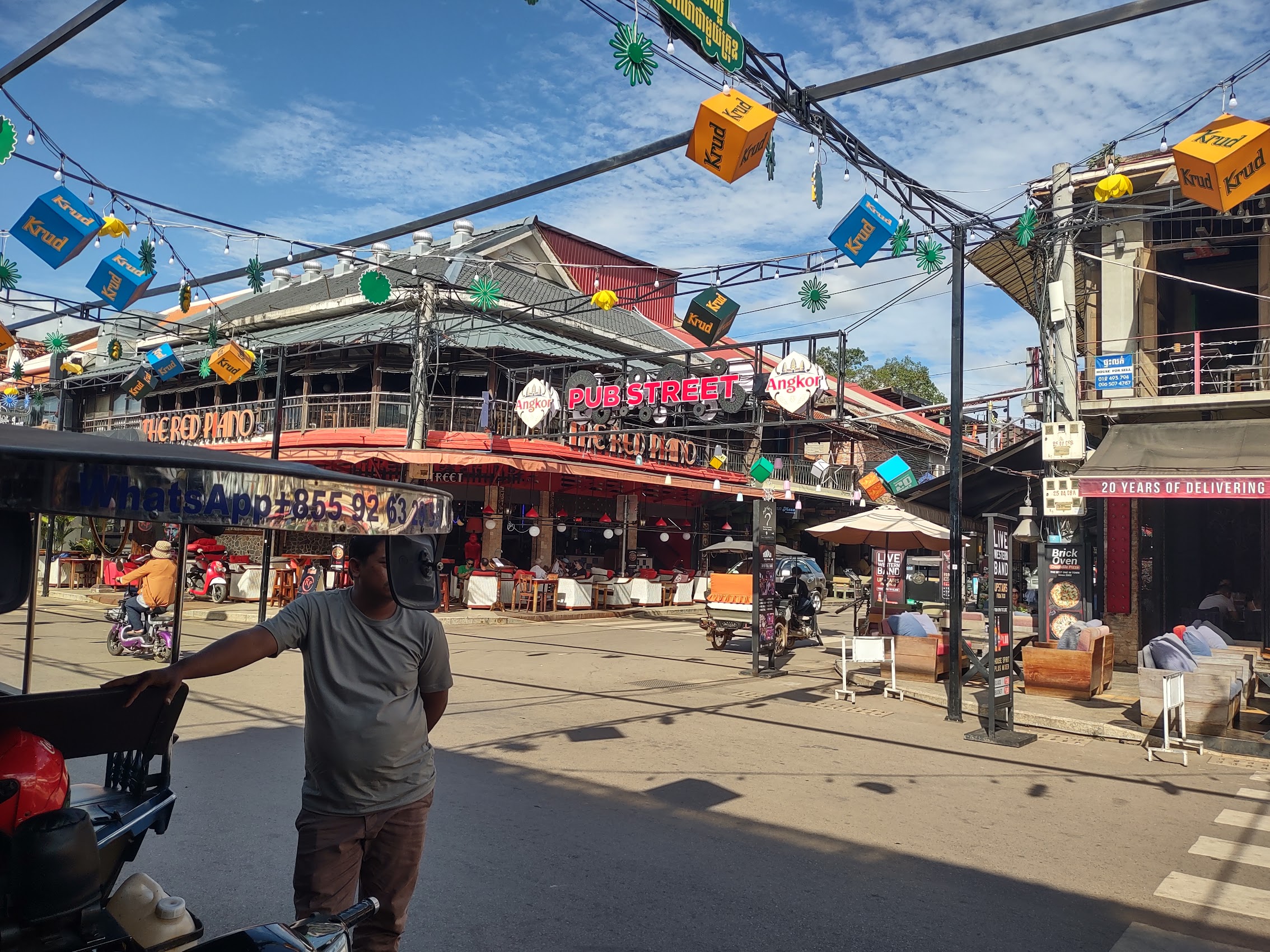
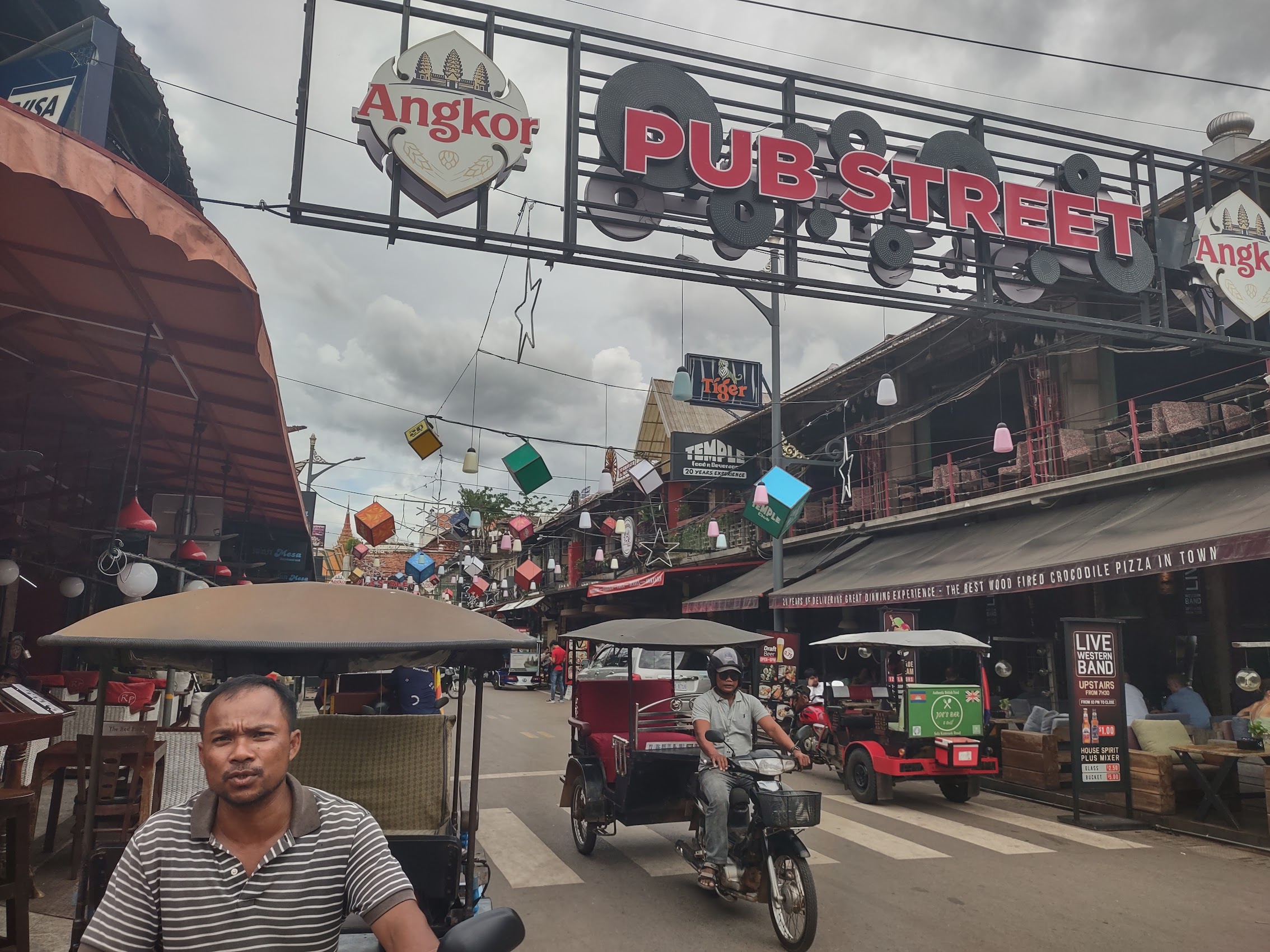
We stopped at a place called (interestingly enough) the Temple for drinks and a bite (pizza for me, a large “boat” of tempura for Colleen) before heading home to get packed and organized for an early departure the next morning for our second and last stop in Cambodia, the city of Phnom Penh.
 Burning the Inheritance
Leave a comment